
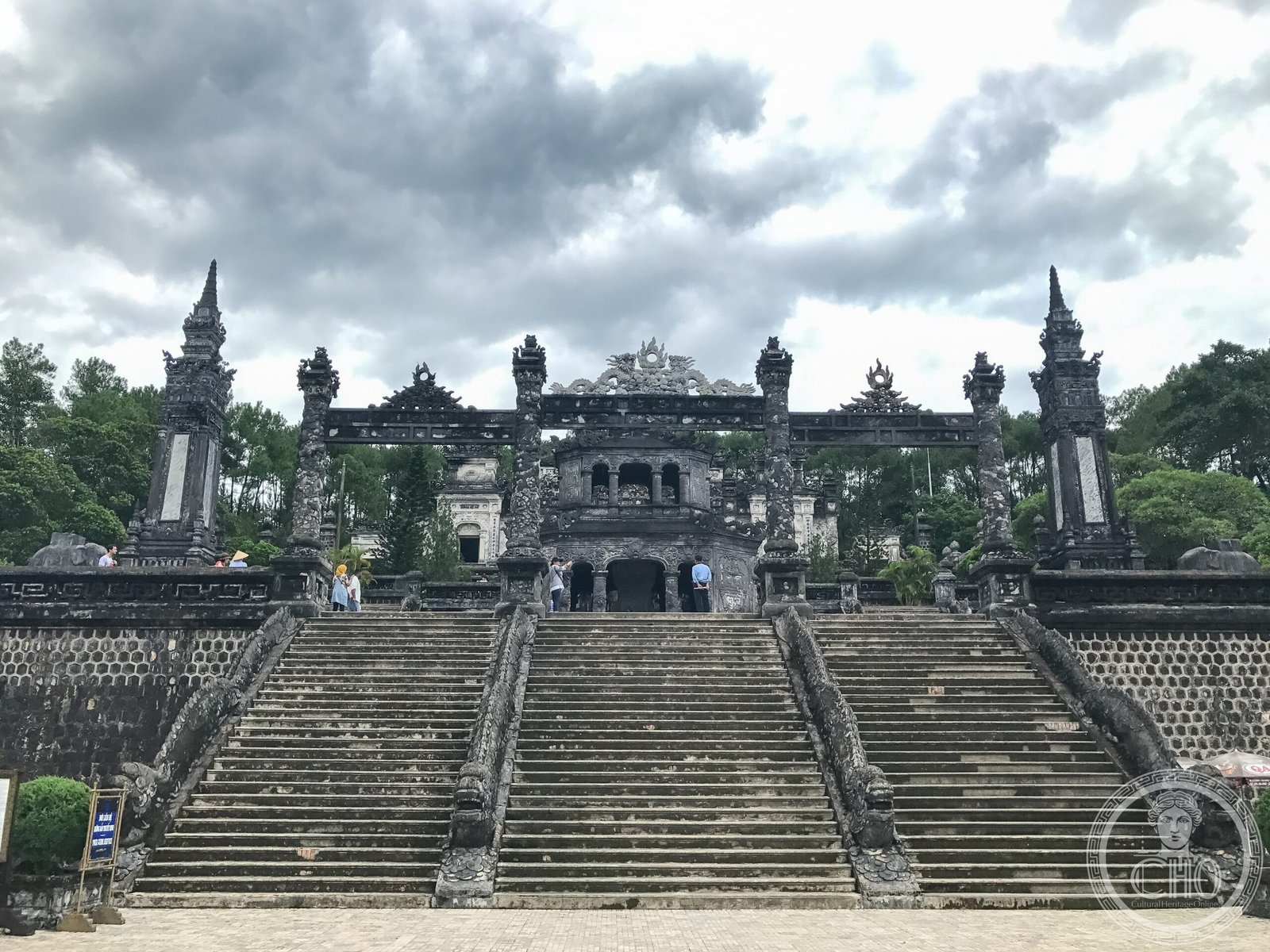
A fusion of Vietnamese and Western architectural traditions, this imperial mausoleum honors the twelfth emperor of the Nguyễn dynasty and stands as a symbol of Vietnam’s modernizing court.
At a glance
The Tomb of Khải Định (officially Ứng Mausoleum) rises on Châu Chữ mountain near Huế, Vietnam’s historic imperial capital. Completed in 1931 after eleven years of construction, it represents a deliberate architectural dialogue between Eastern and Western design traditions—a reflection of the emperor’s embrace of modernity in early twentieth-century Vietnam.
History
Built for Khải Định, the twelfth emperor of the Nguyễn dynasty, the tomb was constructed between 1920 and 1931. Its extended construction period and hybrid style underscore a moment of cultural transition in Vietnamese history, when imperial courts were integrating foreign architectural influences into their monumental traditions.
What you see
The tomb blends Vietnamese architectural heritage with Western stylistic elements, creating a distinctive visual vocabulary. This fusion appears in both decorative details and structural composition, marking it as architecturally singular within Vietnam’s imperial necropolis tradition and inviting comparison with later twentieth-century cross-cultural building practices across Asia.
Cultural significance
The Tomb of Khải Định embodies the Nguyễn dynasty’s final decades and Vietnam’s complex relationship with modernization. Its architectural synthesis—rather than adherence to traditional Vietnamese forms—documents how imperial courts negotiated cultural identity amid global change. It remains a key monument to Vietnam’s pre-colonial period.
Key facts
- Country: Vietnam
- Location: Châu Chữ mountain, Huế
- Completed: 1931 (11 years of construction)
- Coordinates: 16.39893, 107.59029
- UNESCO: World Heritage Site (1993, as part of the Complex of Hué Monuments)
Practical information & getting there
The tomb is accessible from Huế. For opening hours, admission fees, and visitor facilities, consult official tourism resources or contact the Hué Monuments Conservation Center.
Sources & resources
Find it on the map
See this place and what’s around it →📷 Become a Cultural Heritage Online photographer
Share your photos of places: they stay published under your name as the author. The more they're seen, the more you get noticed — and soon a contest will reward the most appreciated photos.
Log in or sign up free to add a photo