
_-_2024-09-14_-_4.jpg)
A six-storey hotel built in 1911 on the corner of the rue Caulaincourt and the rue Joseph-de-Maistre, above the Montmartre Cemetery, by the owner of the Élysée Montmartre dance hall. It took its name from the terrace on its roof, which the Paris press was already describing in 1912. The building is not a listed monument and the City of Paris does not protect it; its date and its first years are documented in the newspapers of the time.
At a glance
The Terrass’’ Hotel was opened in 1911 by Edmond Hurand, who already owned the Élysée Montmartre. By November of that year it was advertising in Le Matin as the “Terrass’ Hôtel, corner of rue Caulaincourt and rue de Maistre”, and in December 1912 Le Petit Parisien described it as a hotel of six storeys crowned by a vast terrace overlooking Paris, “and named, for that reason, the Terrass’ Hôtel”. It has stayed a hotel for more than a century and, according to the hotel, in the hands of the founder’s family. The name of its architect is not known to us.
Key facts
- Where: 12-14 rue Joseph-de-Maistre, corner of rue Caulaincourt, 75018 Paris (Quartier des Grandes-Carrières)
- Built: land bought in 1909, hotel opened in 1911, according to the hotel and to a 2015 trade article; open and advertising by 13 November 1911 (Le Matin)
- Construction period: 1851–1914, in the building database of the Paris urban planning agency (APUR)
- Founder: Edmond Hurand, owner of the Élysée Montmartre
- Architect: not known to us
- Protection: none. Not a listed historic monument; not a protected building of the Paris PLU (on this street the PLU protects numbers 7 and 17)
- Current use: hotel, the Terrass’’ Hotel, with a restaurant and bar on the top floor
- Coordinates: 48.886482, 2.333123 · open in Google Maps
History
The rue Joseph-de-Maistre was built in stages. Its first stretch, from the rue Lepic, was an old lane of the commune of Montmartre, the rue des Dames, already drawn as a path on the maps of 1672 and 1730; it took the name of the Savoyard philosopher Joseph de Maistre in 1874, and was extended towards the rue Marcadet after a decree of 1893. On its odd-numbered side it runs along the wall of the Montmartre Cemetery.
According to the hotel and to a 2015 article in the trade press, Edmond Hurand bought the land at the corner of the rue Caulaincourt in 1909 and had a hotel built there, inaugurated in 1911. The newspapers of the time confirm the date. On 13 November 1911 Le Matin carried an advertisement for the “Terrass’ Hôtel (place Clichy), corner of rue Caulaincourt and rue de Maistre”. In June 1912 Le Journal advertised the “Terrass’Hotel, 12, rue de Maistre” with rooms by the month or by the day, electric light, bathrooms and a lift. A volume of the architectural weekly La Construction moderne for 1911–1912 already cited the terrace of the “Terrass-Hotel, rue de Maistre” among the examples of roof terraces in Paris.
On the afternoon of 17 December 1912 a boiler burst in the cellar of the hotel. The next day Le Petit Parisien, which placed the hotel “opposite the Montmartre Cemetery, at number 12”, counted eight people injured, and Excelsior seven. It was in that report that Le Petit Parisien described the building as a hotel of six storeys under a vast terrace overlooking Paris.
The later story of the hotel rests on the hotel and on secondary accounts. The French Wikipedia article on the street, citing a 2015 article in Vanity Fair, says that the hotel was first meant for working people, that André Breton, Colette, Michel Simon and Pierre Brasseur came to its bar, and that Jean Genet lived there modestly between the wars; the hotel names Colette, Michel Simon, Pierre Brasseur and the pianist Samson François among its guests. In 2015 the hotel reopened after seven months of works. According to the trade article, the plans of 1911 were found and used to return the fronts to their original appearance, with the entrance under a glass canopy at the corner as the restaurant entrance had been, and early twentieth-century painted advertisements were uncovered and restored; the seventh floor was entirely rebuilt.
What you see
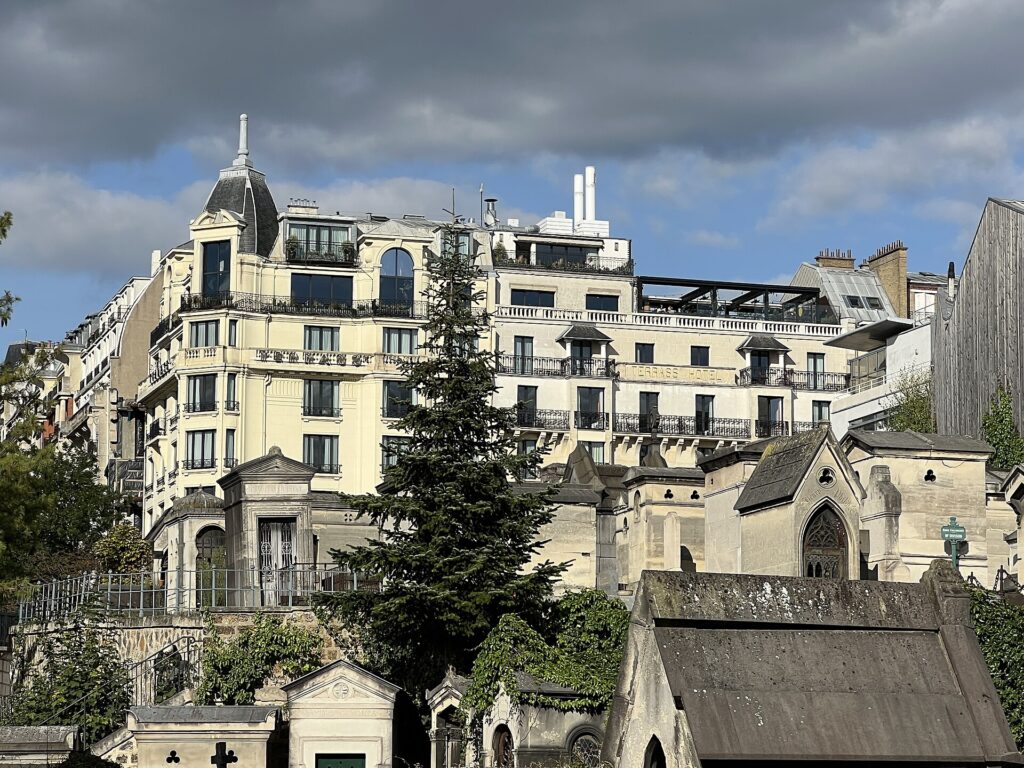
The photograph looks up at the hotel from the Montmartre Cemetery, over the roofs of its stone chapels. The building is faced in a pale cream colour and seen in two parts. On the left, the corner pavilion rises to a slate dome with a tall pointed finial; its rounded corner is lined with small iron balconies, and near the top a continuous wrought-iron balcony runs across the whole front, below a large arched window.
On the right, the long wing on the rue Joseph-de-Maistre carries the name “Terrass’’ Hotel” in gold letters on a band between two floors, framed by two small balconies each sheltered by a little slate roof on posts. Lower down, iron balconies rest on rows of stone brackets. A stone balustrade runs along the top of the wing, and behind it the roof terrace that gave the hotel its name is covered today by a dark metal pergola and glass screens.
Practical information
- The building is a hotel, the Terrass’’ Hotel, with a restaurant and a bar on the top floor; the interiors are for guests and customers.
- The fronts can be seen from the rue Joseph-de-Maistre and the rue Caulaincourt. The best overall view is from the Montmartre Cemetery, below the hotel, during the cemetery’s opening hours.
- The building has no heritage protection; what is described here is its history, not a listed interior.
Getting there
The hotel stands where the rue Caulaincourt meets the rue Joseph-de-Maistre, on the western slope of the Butte Montmartre. The nearest Métro station is Blanche (line 2), a few minutes’ walk to the south by the rue Lepic; Abbesses (line 12) and Place de Clichy (lines 2 and 13) are a little further.
Nearby
- The Montmartre Cemetery, directly below the hotel, whose wall the rue Joseph-de-Maistre follows on its odd-numbered side.
- Café des 2 Moulins, on the rue Lepic, about 200 metres to the south.
- Saint-Jean de Montmartre and the Abbesses Métro entrance by Hector Guimard, each about 450 metres to the south-east.
- Élysée Montmartre, the dance hall that Edmond Hurand already owned when he built the hotel, under a kilometre to the east.
Do you know more?
On this page we have published what the newspapers of 1911 and 1912 record about the Terrass” Hotel, and what can be seen of the building today. We could not find the name of the architect who designed it for Edmond Hurand, nor the building permit, and the stories of its famous guests rest on the hotel and on later articles. If you know something — the architect, a document from the building works, an old photograph or postcard of the hotel and its terrace, a memory of the people who stayed here — write to Sofia, who looks after these pages.
Write to Sofia or send a message on WhatsApp
Please start your message with the title of this page, so it reaches the right file. Every contribution is checked against independent sources before it goes on the page, and we always say where a piece of information came from.
Sources
- Le Matin, 13 November 1911 (Gallica), advertisements page: “Terrass’ Hôtel (place Clichy), coin rue Caulaincourt et rue de Maistre”.
- Le Journal, 5 June 1912 (Gallica), classified advertisement for the Terrass’Hotel, 12 rue de Maistre: rooms by the month and day, electricity, bathrooms, lift.
- Le Petit Parisien, 18 December 1912 (Gallica), front page: a boiler bursts in the cellar of the hotel at number 12, “en face du cimetière Montmartre”, eight injured; the hotel of six storeys under a vast terrace, “dénommée, pour cette raison, le Terrass’ Hôtel”. And Excelsior, 18 December 1912 (Gallica): the explosion at the “Terrass Hôtel, situé 12, rue de Maistre”, seven victims.
- La Construction moderne, volume for 1911–1912 (Gallica): the terrace of the “Terrass-Hotel, rue de Maistre” among the examples of roof terraces in Paris.
- Tendance Hôtellerie, press release on the reopening (29 July 2015): land bought in 1909, inauguration in 1911, the plans of 1911 used to restore the fronts, the restored painted advertisements, the rebuilt seventh floor.
- Terrass’’ Hotel, “The hotel”, official site: the owner’s account of 1911, Edmond Hurand, the family ownership, the guests, the renovation by the architect Muriel Gaz.
- Wikipedia (fr), Rue Joseph-de-Maistre: the history of the street, the cemetery wall, and the entry for numbers 12-14 (Edmond Hurand, 1911; the guests and Jean Genet, citing Vanity Fair, November 2015).
- Félix de Rochegude, Promenades dans toutes les rues de Paris. XVIIIe arrondissement, Paris, Hachette, 1910 (Internet Archive): the former chemin and rue des Dames, and the name given in 1874.
- Ville de Paris, PLU – Protections patrimoniales (Paris Data, dataset plub_pvp): protections 18-1560 (no. 7) and 18-0460 (no. 17); none for numbers 12-14.
- APUR, Emprise bâtie Paris (open data): construction period 1851–1914 for the building on the corner of the rue Caulaincourt.
- OpenStreetMap / Nominatim: position, returned as 12, Rue Joseph de Maistre, Quartier des Grandes-Carrières, Paris 18e.
Find it on the map
See this place and what’s around it →📷 Become a Cultural Heritage Online photographer
Share your photos of places: they stay published under your name as the author. The more they're seen, the more you get noticed — and soon a contest will reward the most appreciated photos.
Log in or sign up free to add a photoIs this page about you?
This page is read by travellers and heritage enthusiasts who find it on Google. Tell us how you are connected to this place and we will take it from there.