

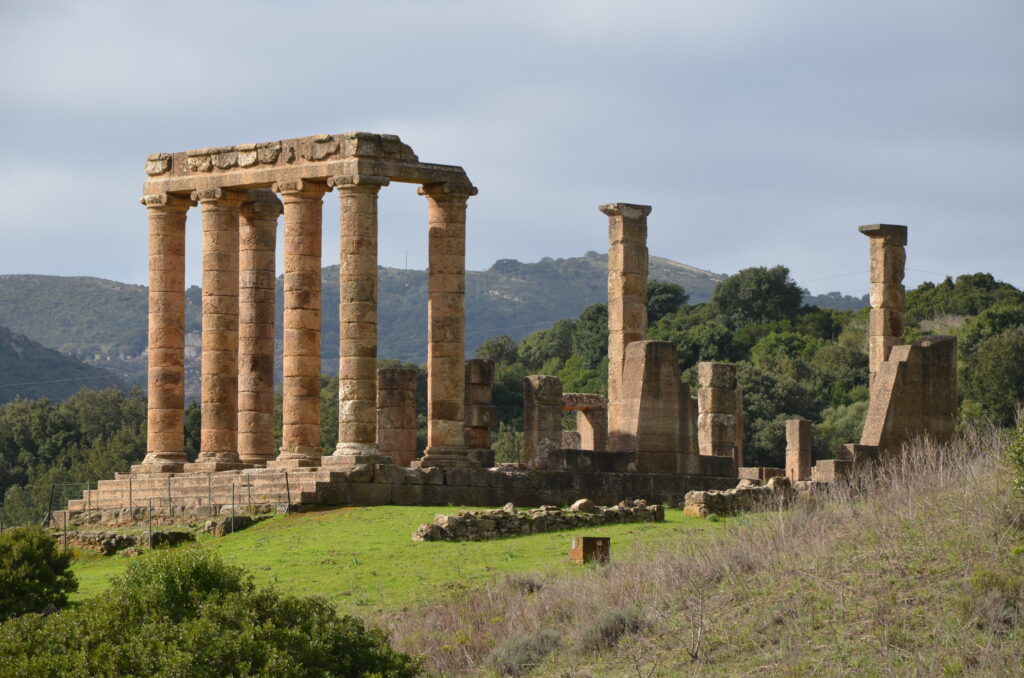
The Temple of Antas is an ancient sanctuary in the Fluminimaggiore territory of Sardinia, originally established as a Nuragic sacred site and later rebuilt in Punic and Roman phases.
At a glance
The monument stands in a valley dominated by the limestone relief of Monte Conca s'Omu. It was constructed from local limestone and reached its greatest architectural elaboration during the Roman era, with an entrance staircase, a podium, and a columned pronaos. The surrounding sacred area, added later, is noted for springtime meadow vegetation.
Key facts
- Located in the territory of Fluminimaggiore, south-west Sardinia.
- Originated as a Nuragic sanctuary, with shaft tombs dating from the 9th century BC.
- Underwent Punic construction phases around 500 BC and around 300 BC.
- Roman phases date to the Augustan period and to the 3rd century AD, when the Caracalla inscription was added.
- The Roman building had a pronaos with four front columns, an approximately 11-metre-deep naos, and a white mosaic floor.
- Paid admission is required to visit.
History
The site began as a Nuragic sanctuary, probably intercantonal, and was also active in pre-colonial, Punic and Roman times. From the early Iron Age, in the 9th century BC, it had a funerary significance, as shown by single-person shaft tombs discovered near the podium. One tomb yielded a Nuragic bronze figurine of a nude male deity holding a spear, associated with the Punic god Sid and the local deity Babai, later known in the Roman era as Sardus Pater Babai. During the Punic era the sanctuary saw two construction phases, around 500 BC and around 300 BC. The currently visible structure belongs to the Roman era, with an initial Augustan phase and a second renovation in the 3rd century AD, when an inscription honouring Emperor Caracalla was placed on the pediment.
What you see
The visible remains include a partially reconstructed staircase with three surviving levels, a podium, a pronaos with four smooth-shafted columns on the facade and one on each side, and an approximately 11-metre-deep naos whose floor retains its white mosaic covering. An adyton with two almost-square rooms equipped with cisterns lies beyond the naos.
Practical information
- Paid admission.
- Access from Fluminimaggiore via Strada Statale 126, turning onto the road for Antas.
Getting there
The temple is located in the territory of Fluminimaggiore, south-west Sardinia, a little more than half an hour by car from Iglesias. From Fluminimaggiore, proceed along via Vittorio Emanuele, continue onto viale Antonio Congia, then via Vittorio Emanuele, join Strada Statale 126, and take the road for Antas.
Nearby
- Su Mannau cave
- Licheri Watermill
- Fluminimaggiore
- Malacalzetta mines
- Malfidano mine
- Marganai forest
Sources
- https://www.sardegnaturismo.it/en/explore/temple-antas
- https://www.sardegnacultura.it/en/articles/fluminimaggiore-tempio-di-antas
- https://en.wikipedia.org/wiki/Fluminimaggiore
Find it on the map
See this place and what’s around it →📷 Become a Cultural Heritage Online photographer
Share your photos of places: they stay published under your name as the author. The more they're seen, the more you get noticed — and soon a contest will reward the most appreciated photos.
Log in or sign up free to add a photoIs this page about you?
This page is read by travellers and heritage enthusiasts who find it on Google. Tell us how you are connected to this place and we will take it from there.