

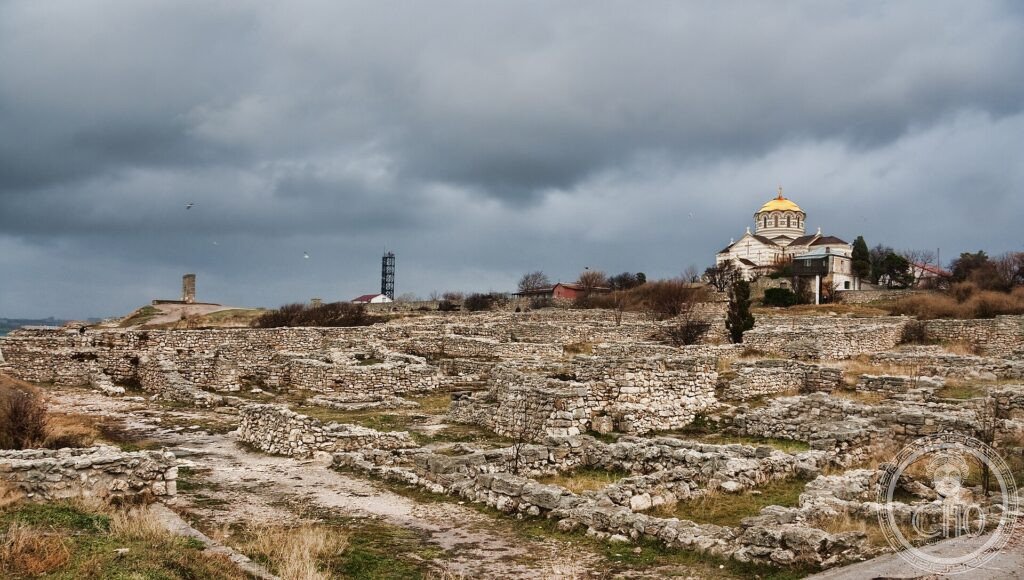
Founded by Greek settlers on the shores of Crimea, Chersonesos lived for more than a millennium: a Greek city, then Roman, then Byzantine, where — according to tradition — Prince Vladimir was baptised, bringing Christianity to Rus’. What remains are the streets, the walls and the divided fields of its countryside, the chora.
At a glance
Tauric Chersonese was a Greek colony founded in the 5th century BC on the south-western coast of the Crimean peninsula, on the Black Sea. For nearly two thousand years it remained a city — Greek, then Roman, then Byzantine — trading grain and wine. By tradition it was here that Prince Vladimir of Kyiv was baptised, bringing Christianity to the Rus. Its ruins, together with the remarkably preserved field-systems of its agricultural hinterland (the chora), were inscribed by UNESCO in 2013.
Key facts
- UNESCO: World Heritage since 2013 (Ancient City of Tauric Chersonese and its Chora)
- Founded: 5th century BC by Greek colonists from Heraclea Pontica
- The chora: a rare surviving ancient Greek agricultural land-division
- Long life: Greek, Roman and Byzantine city over some 1,800 years
- Baptism of the Rus: by tradition Prince Vladimir was baptised here
- Setting: on the Black Sea coast near Sevastopol, Crimea
History
Colonists from Heraclea Pontica founded Chersonesos around the 5th century BC, building a democratic city-state that grew wealthy on grain and wine. Around it they divided the land into a vast grid of farm plots, the chora, whose boundaries can still be traced — one of the best-preserved examples of ancient Greek rural planning.
The city passed under Roman and then Byzantine control, becoming a frontier outpost of the empire on the Black Sea. According to the Rus chronicles it was here, around 988, that Vladimir of Kyiv was baptised, a turning point for Slavic Christianity. The city declined in the late Middle Ages and was abandoned, leaving its grid of streets and ruins by the sea.
What you see
The excavated city spreads along the shore: streets, house foundations, an antique theatre, columns and the lines of its defensive walls, with the waves breaking just beyond. A 19th-century cathedral marks the traditional site of Vladimir’s baptism.
Beyond the city, the countryside still bears the grid of the ancient chora, the plots and field-walls of the Greek farmers laid out more than two thousand years ago.
Practical information
- Site: an archaeological reserve on the coast, with a museum
- Time needed: half a day
- Note: located near Sevastopol, Crimea
- Setting: ruins directly on the Black Sea shore
Getting there
Tauric Chersonese lies on the Black Sea coast on the outskirts of Sevastopol, on the Crimean peninsula. GPS: 44.6117° N, 33.4933° E.
Nearby
- The chora — the ancient field-systems inland, part of the site
- Black Sea coast — the bays and cliffs of south-western Crimea
- Bakhchysarai — the former Crimean Tatar khan’s palace nearby
Sources
- UNESCO World Heritage Centre — “Ancient City of Tauric Chersonese and its Chora” (ref. 1411)
- National Preserve of Tauric Chersonese — official body
- Encyclopaedia Britannica — Chersonesus
Find it on the map
See this place and what’s around it →📷 Become a Cultural Heritage Online photographer
Share your photos of places: they stay published under your name as the author. The more they're seen, the more you get noticed — and soon a contest will reward the most appreciated photos.
Log in or sign up free to add a photo