
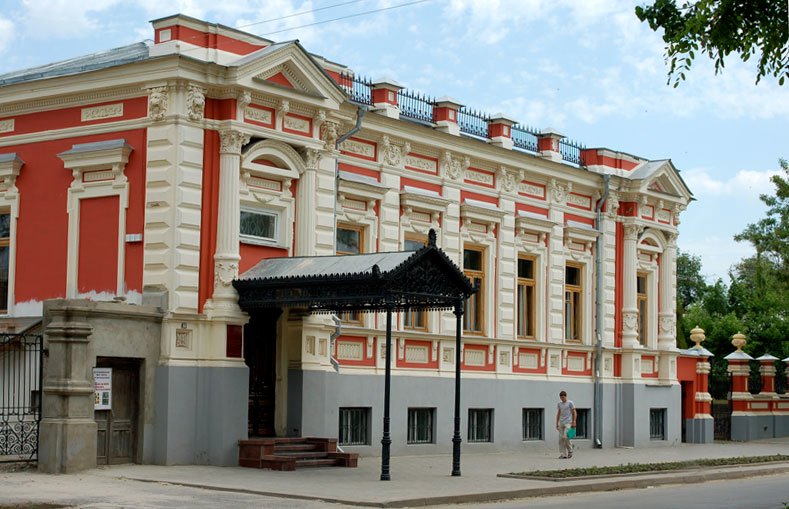
A provincial gallery rebuilt from ruin, holding icons, Realist landscapes and Soviet-era canvases inside a nineteenth-century merchant’s mansion on Alexandrovskaya Street.
At a glance
The Taganrog Museum of Art traces its roots to the art department of the city’s museum, established before the end of the 19th century. It was formally inaugurated as an independent institution in 1968. Since 1975 it has occupied the former mansion of merchant Anton Handrin, at Alexandrovskaya street 56.
History
The museum’s earliest holdings date to the late 1800s, gathered as part of Taganrog’s civic museum. Much of the collection took shape during the Soviet period, organised around two poles: Russian art before the 1917 Revolution and Soviet art proper. That continuity was violently broken during the Occupation of Taganrog, between 1941 and 1943. The entire collection was looted. What visitors see today was rebuilt in the decades after the war, piece by piece, until the museum found its present home in 1975.
What you see
The building itself is a former merchant’s residence, not a purpose-built gallery. Its rooms hold icons from the 17th and 18th centuries alongside 18th- and 19th-century paintings. Late-19th-century Realism dominates one wing: genre scenes and portraits by Konstantin Savitsky, Konstantin Makovsky, Henryk Siemiradzki, Nikolay Bogdanov-Belsky and Vasily Maksimov. Landscapes by Alexei Savrasov, Isaac Levitan and Arkhip Kuindzhi hang nearby, alongside sketches by Viktor Vasnetsov, Vasily Surikov and Vasili Vereshchagin. The Soviet department follows, with paintings by Igor Grabar, Aleksandr Gerasimov, Nikolai Krymov and Vladimir Stozharov, sculpture by Yevgeny Vuchetich and Matvey Manizer, and graphic work by Vladimir Favorsky, Yuri Neprintsev and Andrei Goncharov. Step outside into the inner yard and the scene shifts entirely. Since 1976, sepulchral monuments rescued from the abandoned Taganrog Old Cemetery stand there, transferred to save them from destruction.
Cultural significance
Few regional museums carry a loss quite like this one. The wartime looting stripped the collection bare. Its postwar reconstruction represents an act of cultural persistence as much as curation. The museum now functions as a compact survey of Russian art across a pivotal century, spanning empire, revolution and Soviet consolidation. The cemetery monuments in the yard add an unusual, melancholy coda, preserving funerary sculpture that would otherwise have vanished with the graveyard itself.
Key facts
- Location: Alexandrovskaya street 56, Taganrog, Russia
- Institution inaugurated: 1968
- Present building occupied since: 1975, former mansion of merchant Anton Handrin
- Collection origins: art department of Taganrog’s city museum, late 19th century
- Collection lost entirely during the 1941–1943 Occupation of Taganrog
- Two core departments: pre-1917 Russian art and Soviet art
- Inner yard holds rescued monuments from Taganrog Old Cemetery, since 1976
Practical information & getting there
The museum sits in central Taganrog, on Alexandrovskaya street, within walking distance of the city’s older quarters. Taganrog is reachable by train and bus from Rostov-on-Don. Check the official website before visiting, as opening hours and admission details are best confirmed directly with the museum.
Sources & resources
Find it on the map
See this place and what’s around it →📷 Become a Cultural Heritage Online photographer
Share your photos of places: they stay published under your name as the author. The more they're seen, the more you get noticed — and soon a contest will reward the most appreciated photos.
Log in or sign up free to add a photoIs this page about you?
This page is read by travellers and heritage enthusiasts who find it on Google. Tell us how you are connected to this place and we will take it from there.