

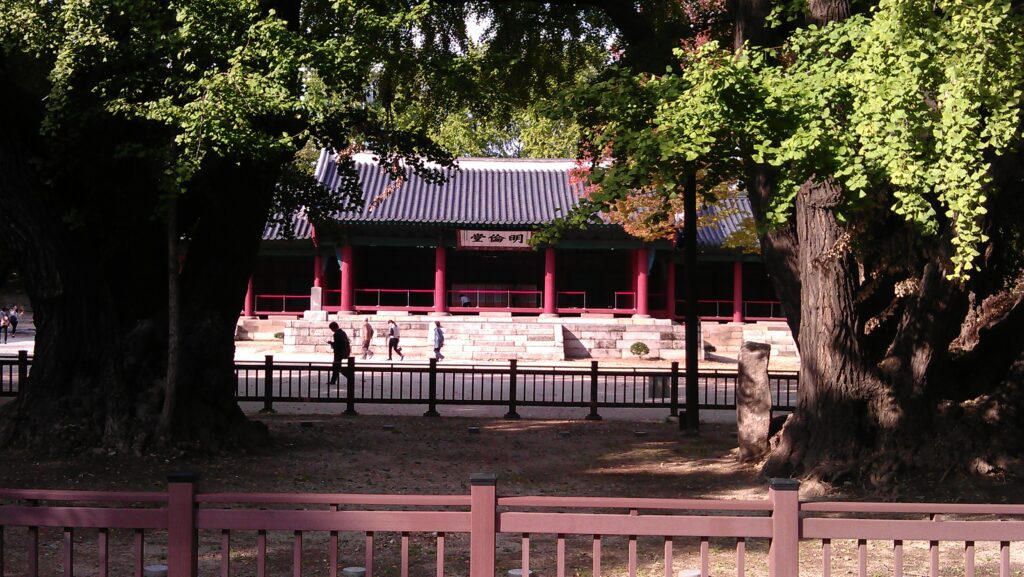
The oldest seat of higher learning in Korea stands in Jongno-gu, where a Confucian academy of 1398 became a modern university in 1946.
At a glance
Sungkyunkwan University keeps its humanities campus around the old Seonggyungwan academy, on the ground where it was built in 1398, in the Myeongnyun district of central Seoul. The academy was the only national seat of higher learning in the Joseon state, and it held that position for five centuries. The university that inherited it was licensed in 1946. The shrine and the lecture hall of the old academy stand inside the campus, in daily use beside the modern buildings.
Key facts
- Academy founded in 1398, the seventh year of King Taejo
- The only national seat of higher learning under the Joseon dynasty
- Shrine rebuilt in 1601 and lecture hall in 1606, after the invasion of 1592
- University licensed on 25 September 1946
- Comprehensive university from 1953, with three colleges and twelve departments
- Daedong Institute for Korean Studies founded in 1958
- Address: 25-2 Myeongnyun 3-ga, Jongno-gu, Seoul
History
The academy opened in 1398. It stands where it was built. The first Joseon king had moved the capital to Hanyang and wanted the state's highest seat of learning in the north-east quarter, at Sungyo-bang. The university dates its foundation to that year, taking both the name of the academy and the site it occupied.
The dynasty had no other national seat of higher learning. The state ran the academy through the whole of the Joseon period. When the Japanese invaded in 1592 the academy burnt to the ground. The shrine was rebuilt in the thirty-fourth year of King Seonjo, 1601, and the lecture hall five years after that.
In 1895 a royal decree turned the academy into a modern institution with a three-year course in the classics, adding history, geography and mathematics, with entrance and graduation examinations, terms and timetables. Under Japanese rule the school was reduced to lesser colleges, then to a training institute in 1944. The line was picked up again after 1945. The university was licensed on 25 September 1946, with faculties of letters and of law and economics, and it lost its building to fire in 1950, with some 70,000 classical books.
It became a comprehensive university in 1953, with colleges of letters and science, law and economics, and pharmacy, and twelve departments. The stone main hall was finished in 1954. The Daedong Institute for Korean Studies followed in 1958, founded to study Korean and East Asian culture and to state the national culture in scholarship. The academy buildings still stand inside the campus that grew beside them.
What you see
The precinct sits inside the campus, entered past the modern lecture blocks. The historic halls are low and wide, with heavy tiled roofs carried on red columns over raised stone platforms. A board above the entrance carries the hall's name in Chinese characters. A stone terrace and a screen of old trees give the courtyard its scale, and a low fence keeps visitors off the wooden floors.
The place is not a museum. Students cross the courtyard between classes, and the university still uses the two halls for ceremonies. Shrine and lecture hall are the stops that matter. Both are visited on foot, in the course of a campus day.
Practical information
- Address: 25-2 Myeongnyun 3-ga, Jongno-gu, Seoul
- A working university campus: the historic precinct sits inside the humanities campus
- The academy buildings are entered from the campus, not from a separate gate
- The shrine keeps its memorial rites; the compound is visited on foot
Getting there
The campus stands in Myeongnyun 3-ga, in the historic north-east quarter of central Seoul, inside the line of the old city wall.
Nearby
- Changgyeonggung Palace
- Jongmyo Shrine
- Daehangno
Sources
Find it on the map
See this place and what’s around it →📷 Become a Cultural Heritage Online photographer
Share your photos of places: they stay published under your name as the author. The more they're seen, the more you get noticed — and soon a contest will reward the most appreciated photos.
Log in or sign up free to add a photoIs this page about you?
This page is read by travellers and heritage enthusiasts who find it on Google. Tell us how you are connected to this place and we will take it from there.
This entry stays online and free either way — and a free account lets you add to it yourself.