
Sukhothai was the first capital of the Thai kingdom, and its ruined temples still stand across a moated plain where the Thai alphabet, the walking Buddha image and a distinct Buddhist art style were all first created. The park preserves that founding moment of Thai civilisation in brick, stone and water.
At a glance
Sukhothai Historical Park occupies the site of the first Thai kingdom’s capital, founded around 1238 by the chiefs Si Inthrathit and Pha Mueang. Its name means Dawn of Happiness. The park contains around 193 temples and monuments spread across roughly 70 square kilometres of former city, much of it enclosed by moats that once served the old capital’s defences and water management.
The site is closely associated with King Ramkhamhaeng the Great, who is credited with creating the Thai alphabet in 1283. The Ram Khamhaeng Inscription, the oldest surviving document written in that script, describes the prosperity and justice of his rule and is now held in the National Museum in Bangkok.
Key facts
- Founded: c.1238 CE by Si Inthrathit and Pha Mueang, who drove out the Khmer garrison
- Golden age: under King Ramkhamhaeng the Great, 1279–1298
- Thai alphabet: created in 1283, first recorded on the Ram Khamhaeng Inscription of around 1292
- Scale: around 193 temples and monuments across some 70 square kilometres
- Status: inscribed by UNESCO in 1991 as the Historic Town of Sukhothai and Associated Historic Towns
History
The Kingdom of Sukhothai was established around 1238 when local Thai chiefs overthrew the Khmer garrison controlling the town. Over the following two centuries it grew into the first independent Thai state, ruling much of the central plains of what is now Thailand.
Its most celebrated ruler, Ramkhamhaeng the Great, reigned from 1279 to 1298. He is credited with devising the Thai alphabet in 1283, extending the kingdom to its greatest territorial reach, and, according to tradition, allowing any citizen to ring a bell at the palace gate to seek his judgment directly.
In 1438 Sukhothai was absorbed by the rival Kingdom of Ayutthaya. The city was abandoned and gradually reclaimed by jungle, until its ruins were designated a historical park and, in 1991, inscribed by UNESCO together with the associated towns of Si Satchanalai and Kamphaeng Phet.
What you see
Wat Mahathat forms the ceremonial heart of the park, its central lotus-bud chedi surrounded by roughly two hundred Buddha statues and a ring of subsidiary chedis, the whole complex bordered by a moat that mirrors the temples in the water at dawn. The lotus-bud chedi, with its tapering spire, is the signature form of the Sukhothai architectural style.
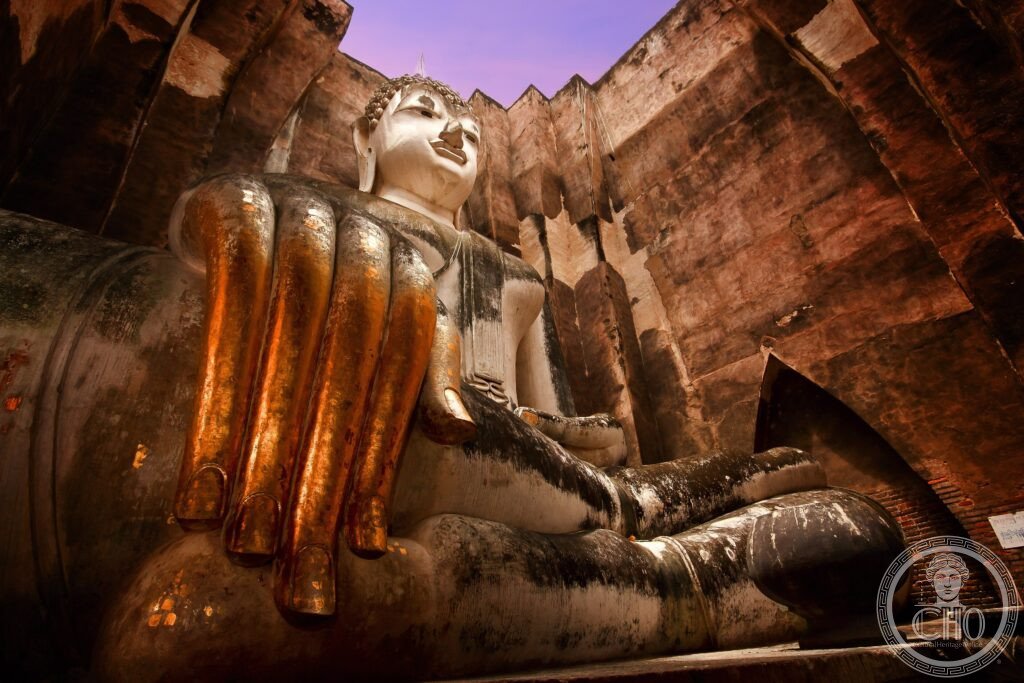
At Wat Si Chum a seated Buddha nine metres high, known as Phra Achana, is enclosed so tightly within its pavilion that the statue almost fills the space. A narrow passage within the walls, decorated with slate carvings of the Jataka tales, leads to a viewpoint above the Buddha’s head; local legend holds that a king once hid there and spoke through the statue to unnerve enemy troops. Wat Saphan Hin holds a standing Buddha some twelve and a half metres tall on a hilltop.
Sukhothai is also the birthplace of the walking Buddha image, a pose showing the Buddha mid-stride that had no precedent in earlier Buddhist art, where figures were shown only seated or standing. The Sukhothai walking Buddha is marked by a fluid, almost weightless posture and elongated fingers tipped with a flame motif representing enlightenment. The park is flat and its temples are spaced closely enough that cycling, with bicycles available for hire near the entrance, is the usual way to move between them.
Practical information
- Layout: the park is divided into five zones, Central, North, East, South and West; the Central zone holds the main temples, including Wat Mahathat and Wat Si Chum, and requires its own entrance ticket
- Getting around: bicycles can be hired at the park entrance; a bicycle or tuk-tuk can cover all zones over one or two days
- Best light: Wat Mahathat is at its most striking early in the day, when the temples are reflected in the surrounding moat
- Loy Krathong: during the festival, held on the full moon of the twelfth lunar month, the park hosts a light-and-sound show, fireworks and thousands of floating lantern boats on its lake; accommodation should be arranged well ahead
Getting there
Sukhothai can be reached by direct bus from Bangkok, or by flying to Phitsanulok Airport and continuing overland to the town. Travellers arriving by train usually change at Phitsanulok for the onward bus. Check current schedules and fares with the relevant transport operators before travelling.
Nearby
- Si Satchanalai Historical Park — around 50 km north, reachable by bus or along a cycling path; part of the same UNESCO listing as Sukhothai, it was a co-capital ruled by the crown prince and includes Wat Chang Lom, ringed by elephant niches, and Wat Chedi Jet Thaew with its rows of lotus-bud chedis
- Kamphaeng Phet Historical Park — around 77 km south; also part of the same UNESCO listing, with the ruins of Wat Phra Kaeo, once home to the Emerald Buddha before it moved to Bangkok, the elephant-buttressed Wat Chang Rob, and surviving sections of the old city walls
- Chiang Mai — around 350 km north; Thailand’s second city, with its own moated old town and access to Doi Inthanon National Park
- Chiang Rai — further north; known for the White Temple, the Blue Temple, the Golden Triangle and the tea plantations of Doi Mae Salong
Sources
- Wikipedia, Sukhothai Historical Park
- Wikipedia, Ramkhamhaeng the Great
- Wikipedia, Wat Mahathat, Sukhothai
- UNESCO, Historic Town of Sukhothai and Associated Historic Towns
Find it on the map
See this place and what’s around it →
📷 Become a Cultural Heritage Online photographer
Share your photos of places: they stay published under your name as the author. The more they're seen, the more you get noticed — and soon a contest will reward the most appreciated photos.
Log in or sign up free to add a photo