
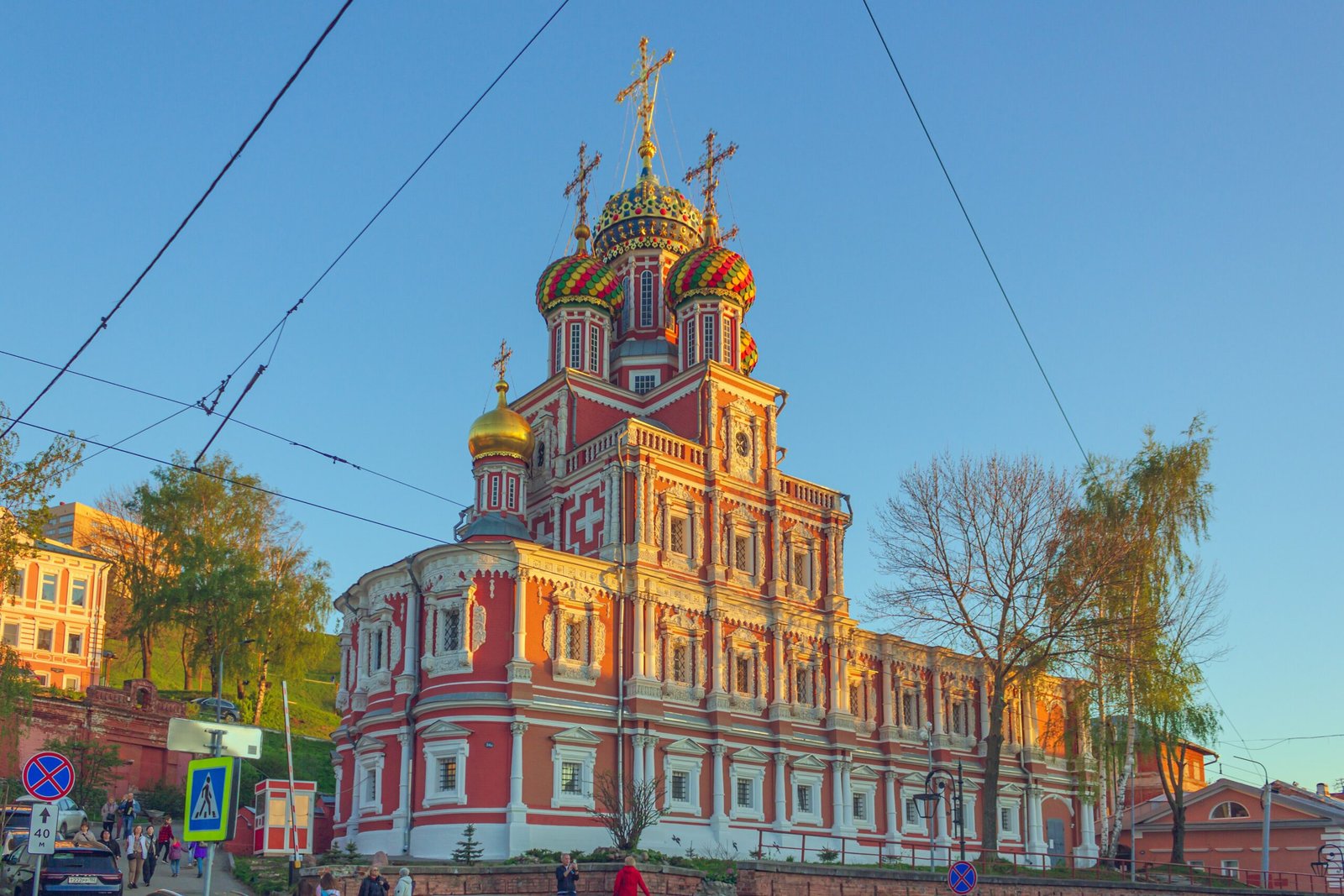
On Rozhdestvenskaya Street stands a church built to advertise a merchant fortune in white stone and gilding. It survived fire, imperial suspicion and Soviet demolition orders.
At a glance
Consecrated in 1719, the church was financed by the wealthy merchant Grigory Stroganov and completed under his widow, Maria Yakovlevna, after a fire nearly destroyed the unfinished building. It is the signature monument of the Stroganov Baroque style, a distinctive Russian idiom mixing Muscovite tradition with imported ornament. The church remains heritage-listed today.
History
Work started in 1696. By 1701 the building was almost finished when fire broke out inside the temple. Maria Yakovlevna Stroganova paid to restore it. Archbishop Pitirim consecrated the completed church in 1719. Peter the Tsar closed it in 1722, and it stayed shut until his death in 1725. Further fires struck in 1768, 1782 and 1788. Alexander Stroganov funded major repairs between 1807 and 1812. Later, in the 1870s and 1880s, architects Lev Dahl and Robert Kilevein oversaw a thorough restoration. The belltower had begun leaning in the 1860s; two decades later it had shifted 1.2 metres, forcing workers to dismantle and rebuild its upper tiers in 1887. Under Soviet rule officials planned to destroy the church. Its rector, Sergius Veisov, gathered documents and photographs and lectured on the Stroganov Baroque’s cultural value, arguments that helped save the building. It was reconsecrated on 3 July 1993.
What you see
The church rises on two levels. Above sits a three-apse altar, a prayer hall, a refectory and a porch. White stone carving covers the surfaces, inside and out, dense with foliage and shell motifs typical of the style bearing the Stroganov name. The belltower takes the form of an octagon set on a cube, its dome topped by a cross and a weather vane. Stone slabs near the top carry Slavic letters dividing a circle into seventeen parts, following the old Russian method of marking time. The original clock mechanism has been lost. A new one now keeps the hours.
Cultural significance
The church stands as a defining example of Stroganov Baroque, a regional style tied to one merchant dynasty’s ambition and taste. Its survival through fire, imperial closure and Soviet-era threats gives it added weight as a document of endurance. Sergius Veisov’s advocacy in the 1920s and 1930s turned the building into a case study of how local memory can outlast political hostility. Later restorers, including Lev Dahl, treated it as a monument worth technical care, not just piety.
Key facts
- Location: Rozhdestvenskaya Street, Nizhny Novgorod, Russia
- Built: 1696–1719, funded by merchant Grigory Stroganov
- Consecrated: 1719, by Archbishop Pitirim of Nizhny Novgorod and Alatyr
- Restoration architects (1870s–1880s): Lev Dahl and Robert Kilevein
- Style: Baroque architecture, specifically Stroganov Baroque
- Heritage status: listed
- Reconsecrated: 3 July 1993
Practical information & getting there
The church sits on Rozhdestvenskaya Street, a central historic thoroughfare in Nizhny Novgorod, easily reached on foot from the city’s riverside quarter. Check the official diocesan page linked below for current service times before visiting. As an active parish church, dress modestly and expect services to take precedence over sightseeing.
Sources & resources
Find it on the map
See this place and what’s around it →📷 Become a Cultural Heritage Online photographer
Share your photos of places: they stay published under your name as the author. The more they're seen, the more you get noticed — and soon a contest will reward the most appreciated photos.
Log in or sign up free to add a photoIs this page about you?
This page is read by travellers and heritage enthusiasts who find it on Google. Tell us how you are connected to this place and we will take it from there.