
A library built from one collector’s obsession, now one of Russia’s principal repositories of historical literature.
At a glance
The State Public Historical Library traces its lineage to 1863, when the private collection of Moscow antiquarian Alexander Dmitrievich Chertkov first opened to the public. It formally became a state institution in 1938. Today it holds over four million items in more than 65 languages.
History
Chertkov’s library was unusual for its time. He gathered antique and Russian coins, Egyptian and ancient Russian antiquities, painted Etruscan vases and mirrors, alongside natural science specimens including minerals, insects and herbaria. His decision to grant public access in 1863 made it Russia’s first public-use library. The collection later passed to the State Historical Museum, becoming its library and steadily expanding. On March 20, 1938, the Politburo of the Central Committee ordered its merger with the Joint Library of the Institute of Red Professors and several smaller libraries. Out of this merger came the State Public Historical Library of the Russian Soviet Federative Socialist Republic. Its mandate was explicit: serve as the central historical library of the Russian Federation, hold domestic and foreign historical literature in print and manuscript, and function as a research institute in historical bibliography and library science. By 1970 the collection had grown to roughly three million items, including over 30,000 rare historical books. After the Soviet Union’s collapse, the institution was renamed the State Public Historical Library of Russia. Its core purpose did not change.
What you see
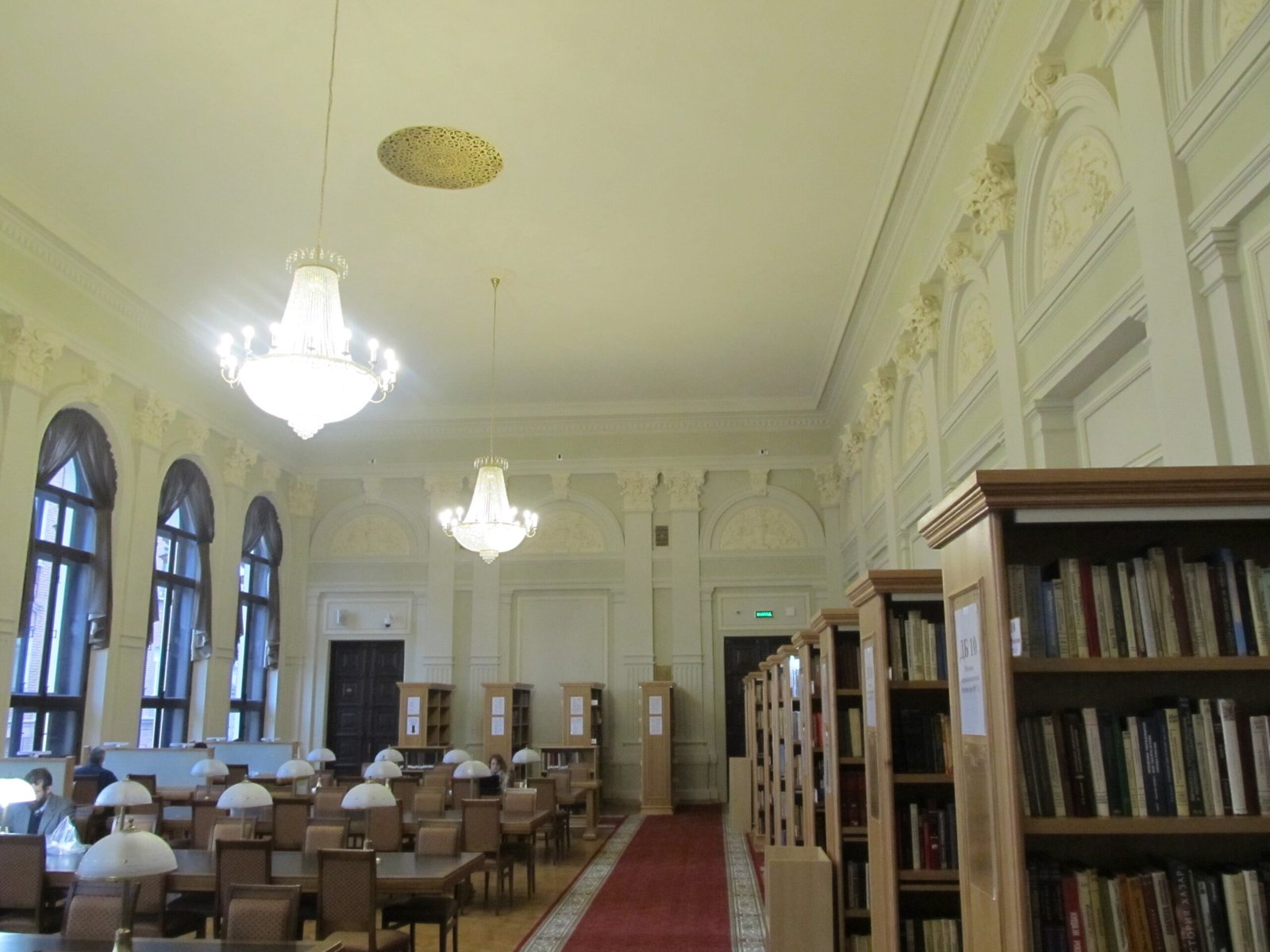
The article does not describe the library’s building or architectural features in detail. What defines the institution instead is its internal organization. By 1970 it maintained a general reading room alongside three specialized research rooms, devoted respectively to the history of the Soviet Government and Communist Party, general history, and eastern history. This structure reflects a library built for scholars rather than casual browsing. Shelves span centuries of material, from Chertkov’s rare volumes to modern acquisitions.
Cultural significance
Few libraries owe their existence so directly to a single private passion. Chertkov’s decision to open his collection reshaped what public access to knowledge meant in imperial Russia. The library’s later absorption into Soviet state infrastructure preserved that founding impulse while multiplying its scale. It remains a working research institute, not a museum piece. Historians of Russian, Soviet and international history rely on it as a primary bibliographic resource.
Key facts
- Origins in 1863, as Chertkov’s public library
- Formally established as a state library on March 20, 1938
- Formed by merging the museum library with the Institute of Red Professors’ library
- Held roughly 3 million items by 1970, including 30,000+ rare books
- Now holds over 4 million books in more than 65 languages
Practical information & getting there
The library is located in central Moscow. Check the official website before visiting, since access, reading room rules and opening hours are set by the institution directly. Bring identification, as is standard for Russian research libraries.
Sources & resources
Find it on the map
See this place and what’s around it →📷 Become a Cultural Heritage Online photographer
Share your photos of places: they stay published under your name as the author. The more they're seen, the more you get noticed — and soon a contest will reward the most appreciated photos.
Log in or sign up free to add a photoIs this page about you?
This page is read by travellers and heritage enthusiasts who find it on Google. Tell us how you are connected to this place and we will take it from there.