

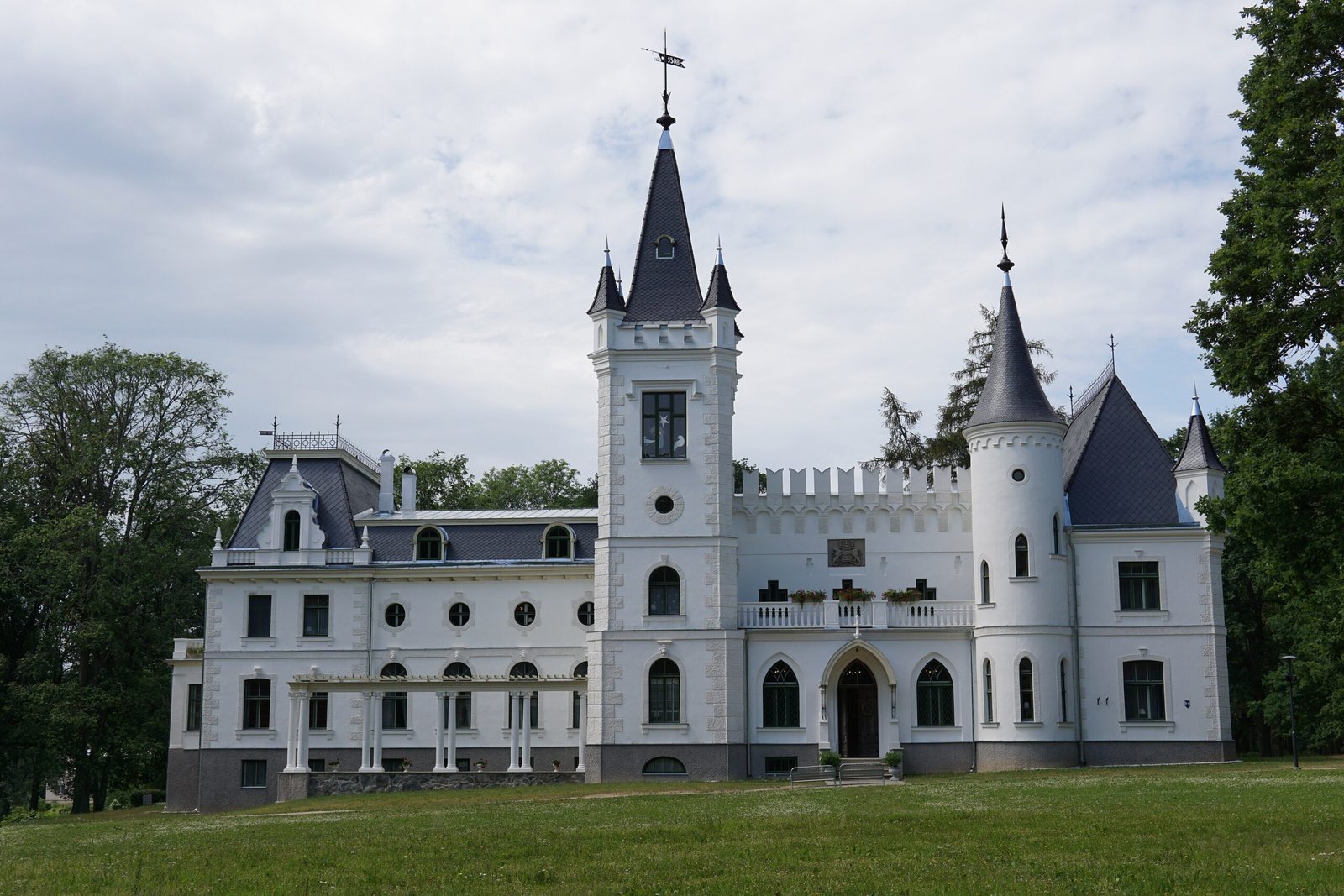
A Historicist mansion rebuilt in French Neo-Renaissance style after 1905, Stāmeriena Palace stands as an architectural landmark in Latvia’s Vidzeme region, shaped by aristocratic patronage, revolution, and the literary legacy of its most famous resident.
At a glance
Stāmeriena Palace was constructed between 1835 and 1843 in Historicist style for Johann Gottlieb von Wolff and his descendants. The original structure was destroyed during the 1905 Russian Revolution, then magnificently restored in 1908 by Baron Boris von Wolff in the French Neo-Renaissance manner. Today it functions as a museum and event venue, welcoming visitors to its restored grounds and landscape park.
History
The von Wolff family commissioned the palace’s initial construction in the mid-nineteenth century, establishing their seat in Vidzeme. Tragedy struck in 1905 when revolutionary turmoil consumed the structure in fire. Baron Boris von Wolff undertook an ambitious reconstruction, completing it in 1908 and transforming the building into a statement of refined Neo-Renaissance taste.
The palace remained in family hands through the 1930s, remarkably avoiding nationalization during Latvia’s agrarian reforms of the 1920s. Alexandra von Wolff-Stomersee (1894–1982) married twice at the palace: first to Andrei Pilar von Pilchau, to whom the building was gifted, and later to Sicilian writer Giuseppe Tomasi di Lampedusa, author of The Leopard, who resided there for several years following their 1932 marriage.
After World War II, Soviet authorities converted the palace into an agricultural technical school and later a state farm administration. Following Latvia’s independence in 1992, the building lay vacant for six years until private restoration began in 1998.
What you see
The palace exemplifies French Neo-Renaissance style, the result of Baron von Wolff’s 1908 reconstruction. Elegant proportions and refined detailing characterize the exterior, while the restored landscape park frames the composition in the Vidzeme countryside. Interior spaces have been carefully reinstated to reflect early twentieth-century aristocratic residence.
Cultural significance
Stāmeriena Palace represents one of Latvia’s finest expressions of Neo-Renaissance architecture. Its survival—both the 1905 fire and Soviet-era repurposing—makes it exceptional among Baltic manor houses. The literary connection through Lampedusa adds cultural resonance, linking this Latvian estate to twentieth-century Italian letters.
Key facts
- Country: Latvia
- City: Stāmeriena, Gulbene Municipality
- Region: Vidzeme
- Original construction: 1835–1843
- Rebuilt: 1908
- Coordinates: 57.2159°N, 26.8994°E
- Architectural style: French Neo-Renaissance
Practical information & getting there
The palace is located in Stāmeriena Parish, Gulbene Municipality, in northeastern Latvia’s Vidzeme region. Since 1998, it has been privately owned and restored, with the palace and surrounding landscape park open to visitors. Current opening hours and access arrangements should be confirmed before visiting.
Sources & resources
Find it on the map
See this place and what’s around it →📷 Become a Cultural Heritage Online photographer
Share your photos of places: they stay published under your name as the author. The more they're seen, the more you get noticed — and soon a contest will reward the most appreciated photos.
Log in or sign up free to add a photoIs this page about you?
This page is read by travellers and heritage enthusiasts who find it on Google. Tell us how you are connected to this place and we will take it from there.