
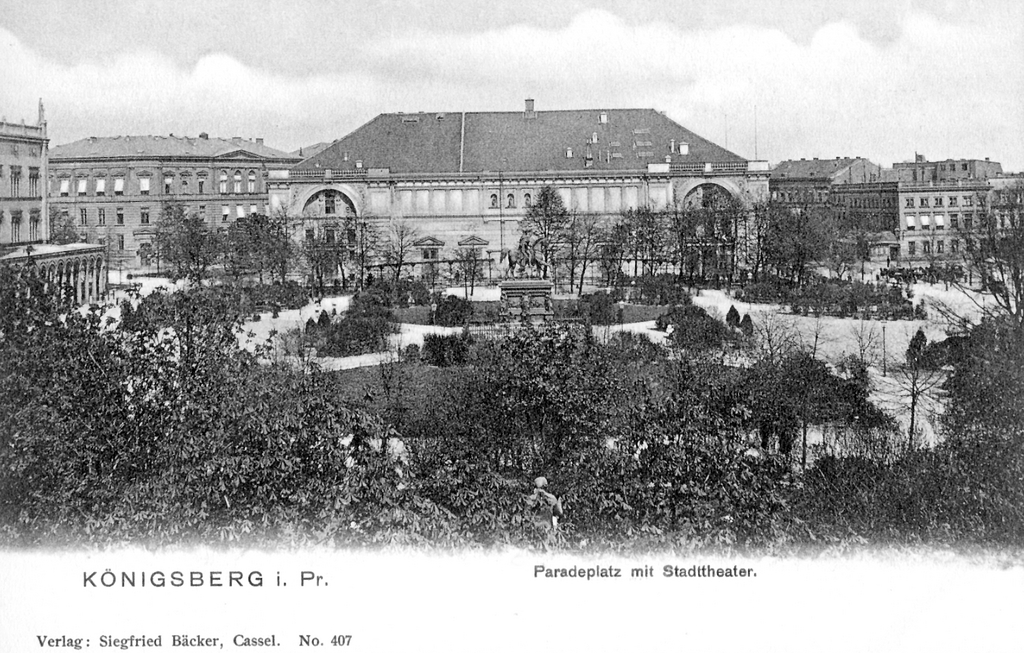
For over two centuries a stage on Paradeplatz carried the theatrical life of East Prussia, from carnival farces to Wagner’s baton and Bizet’s German premiere of Carmen.
At a glance
The Stadttheater Königsberg was the city’s municipal playhouse and opera house, built on Paradeplatz to a design by Johann Valerian Müller. Its foundation stone was laid in 1806. The building opened in 1808, burned within months, and reopened at the end of 1809. It stood until Allied air raids destroyed it in August 1944.
History
Theatre in Königsberg predates any building. Schoolboys staged comedies in the 16th century, English touring companies brought Shakespeare in 1618, and students performed the city’s first opera before Władysław IV Vasa in 1635. A permanent house arrived only in 1755, when Frederick the Great granted director Konrad Ernst Ackermann a plot and merchant Friedrich Saturgus funded a 300-seat theatre, Prussia’s first. Fire took that building in 1795; a replacement designed by Friedrich Gilly followed in 1800, itself rebuilt after another blaze in 1802. The municipal theatre proper began in 1806, when Friedrich von Schrötter laid its foundation stone on Paradeplatz, partly over the unfinished garrison church. Carl Steinberg opened it in March 1808 with La clemenza di Tito. It burned down within four months. Rebuilt, it reopened in December 1809 before the royal couple. Premieres followed steadily: William Tell in 1810, Fidelio and Der Freischütz in 1819, Faust in 1832. Richard Wagner served as Kapellmeister from 1836 to 1837 and married the actress Minna Planer there. Gas lighting arrived in 1854, electric light in 1903. The German premiere of Carmen opened in 1879 under Max Staegemann. War again intervened: the theatre became a hospital in 1914, reopened as an opera house in 1918, and merged with the New Playhouse into the East Prussian State Theatre in 1924. Der Rosenkavalier had its first performance there in 1927. The building burned out for the last time during the bombing of Königsberg in late August 1944.
What you see
Nothing of the Stadttheater survives above ground. Johann Valerian Müller’s building rose on Paradeplatz, absorbing foundations laid for a garrison church still under construction nearby. Contemporary accounts describe a foyer enlarged in 1893, with added restaurants, and a royal box that acquired its own documented history from 1809 onward. Repeated fires meant repeated rebuilding, so the structure that finally fell in 1944 was already a composite of several campaigns of repair.
Cultural significance
The theatre’s guest list reads like a history of German-language stage culture. Lessing, Schiller, Kleist and Kotzebue premiered or found early German productions here. Student corps from Littuania and Masovia policed the pit and mingled with touring singers, a social ritual peculiar to the house. Wagner’s brief tenure and marriage tie the building to opera’s wider story, while the 1879 Carmen staging marked the opera’s spread across German stages. Its destruction in 1944 removed a physical link to Königsberg’s cultural past that the city, now Kaliningrad, has never rebuilt.
Key facts
- Location: Paradeplatz, Königsberg (now Kaliningrad, Russia)
- Foundation stone laid: 1806, by Friedrich von Schrötter
- Architect: Johann Valerian Müller
- Opened: 9 March 1808; rebuilt after fire, reopened December 1809
- Notable figure: Richard Wagner, Kapellmeister 1836–1837
- German premiere of Bizet’s Carmen: 1879
- Merged into East Prussian State Theatre: 1924
- Destroyed: air raids on Königsberg, late August 1944
Practical information & getting there
No trace of the Stadttheater remains on the ground in present-day Kaliningrad. Visitors interested in the site’s history rely on archival photographs, theatre chronicles and local museum collections rather than a standing building. You will not find a ticket office or opening hours here, only the memory preserved in Königsberg’s cultural literature.
Sources & resources
Find it on the map
See this place and what’s around it →📷 Become a Cultural Heritage Online photographer
Share your photos of places: they stay published under your name as the author. The more they're seen, the more you get noticed — and soon a contest will reward the most appreciated photos.
Log in or sign up free to add a photoIs this page about you?
This page is read by travellers and heritage enthusiasts who find it on Google. Tell us how you are connected to this place and we will take it from there.