
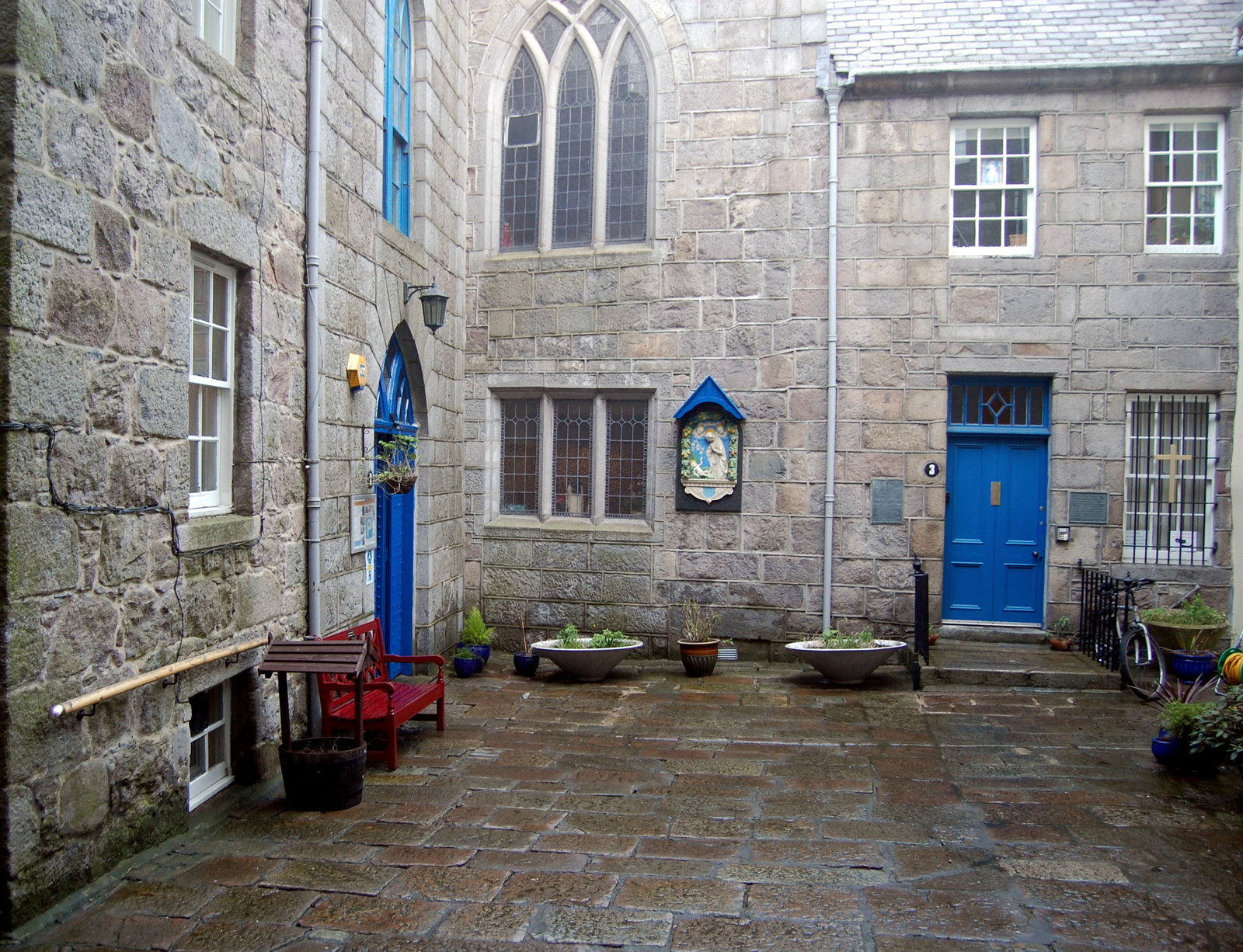
Aberdeen’s first permanent Roman Catholic church since the Reformation, this modest stone building on Justice Street marks the return of organised Catholic worship to the Scottish city after centuries of suppression.
At a glance
A category B listed building completed in 1804, St Peter’s stands in the heart of Aberdeen’s medieval centre, adjacent to St Andrew’s Cathedral. Its construction represented a significant moment in Scottish religious history.
History
Built between 1803 and 1804, St Peter’s Church was the first permanent Roman Catholic church to be constructed in Aberdeen following the Protestant Reformation. Its opening signified a watershed in religious tolerance and the gradual restoration of Catholic institutional life in Scotland. The church occupies a prominent location on Justice Street, between Peacock’s Close and Market Stance.
What you see
The building’s architectural character reflects early 19th-century Presbyterian-influenced church design adapted for Catholic worship. Stone construction and modest proportions distinguish the structure within its urban setting.
Cultural significance
St Peter’s represents the resilience of Catholic faith in Scotland and the gradual shift toward religious pluralism during the Georgian era. Its presence next to St Andrew’s Cathedral underscores Aberdeen’s evolving religious landscape and the coexistence of Christian traditions within one city centre.
Key facts
- Country: United Kingdom
- City: Aberdeen City, Scotland
- Coordinates: 57.1488, −2.092
- Built: 1803–1804
- Category B listed building
Practical information & getting there
St Peter’s is located on Justice Street in Aberdeen’s city centre, adjacent to St Andrew’s Cathedral. The church remains an active Catholic parish. For current visiting hours and information, contact the parish directly or visit the church during regular Mass times.
Sources & resources
Find it on the map
See this place and what’s around it →📷 Become a Cultural Heritage Online photographer
Share your photos of places: they stay published under your name as the author. The more they're seen, the more you get noticed — and soon a contest will reward the most appreciated photos.
Log in or sign up free to add a photoIs this page about you?
This page is read by travellers and heritage enthusiasts who find it on Google. Tell us how you are connected to this place and we will take it from there.