
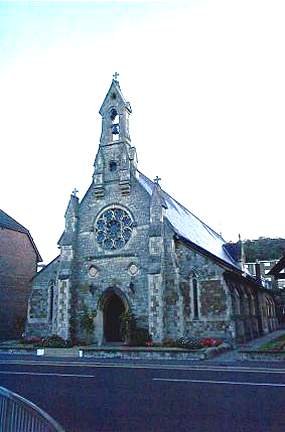
A Gothic Revival Catholic church built in the heart of Dover, designed by the renowned ecclesiastical architect E.W. Pugin during the Victorian flowering of religious architecture in England.
At a glance
St Paul’s Church is a Roman Catholic place of worship in central Dover, Kent. Completed in 1868, it represents a significant example of Gothic Revival design applied to a Catholic commission during a period of religious revival in Victorian England.
History
The church was constructed between 1867 and 1868, a time of expanding Catholic presence in England following the restoration of the Catholic hierarchy in 1850. E.W. Pugin, son of the celebrated Gothic Revival pioneer Augustus Pugin, brought his architectural expertise to this Dover commission, continuing his family’s influential work in ecclesiastical design.
What you see
St Paul’s exemplifies Gothic Revival principles in its design. The church stands on Maison Dieu Road, positioned north of Pencester Gardens in Dover’s town centre. Its architectural language draws on medieval Gothic forms—characteristic of Pugin’s approach to Catholic church design, which sought to revive authentic Christian architectural traditions.
Cultural significance
The church marks an important moment in Dover’s religious history and in the broader Victorian revival of Catholic institutional life in England. As a work by E.W. Pugin, it contributes to the body of mid-19th-century ecclesiastical architecture that shaped modern English church design and remains part of Kent’s architectural heritage.
Key facts
- Country: United Kingdom
- City: Dover, Kent
- Completed: 1868
- Architect: E.W. Pugin
- Coordinates: 51.12862, 1.3137
Practical information & getting there
St Paul’s Church is located on Maison Dieu Road in central Dover. For visiting hours, services, and current access information, contact the church directly or check local visitor resources for Dover.
Sources & resources
Find it on the map
See this place and what’s around it →📷 Become a Cultural Heritage Online photographer
Share your photos of places: they stay published under your name as the author. The more they're seen, the more you get noticed — and soon a contest will reward the most appreciated photos.
Log in or sign up free to add a photoIs this page about you?
This page is read by travellers and heritage enthusiasts who find it on Google. Tell us how you are connected to this place and we will take it from there.