

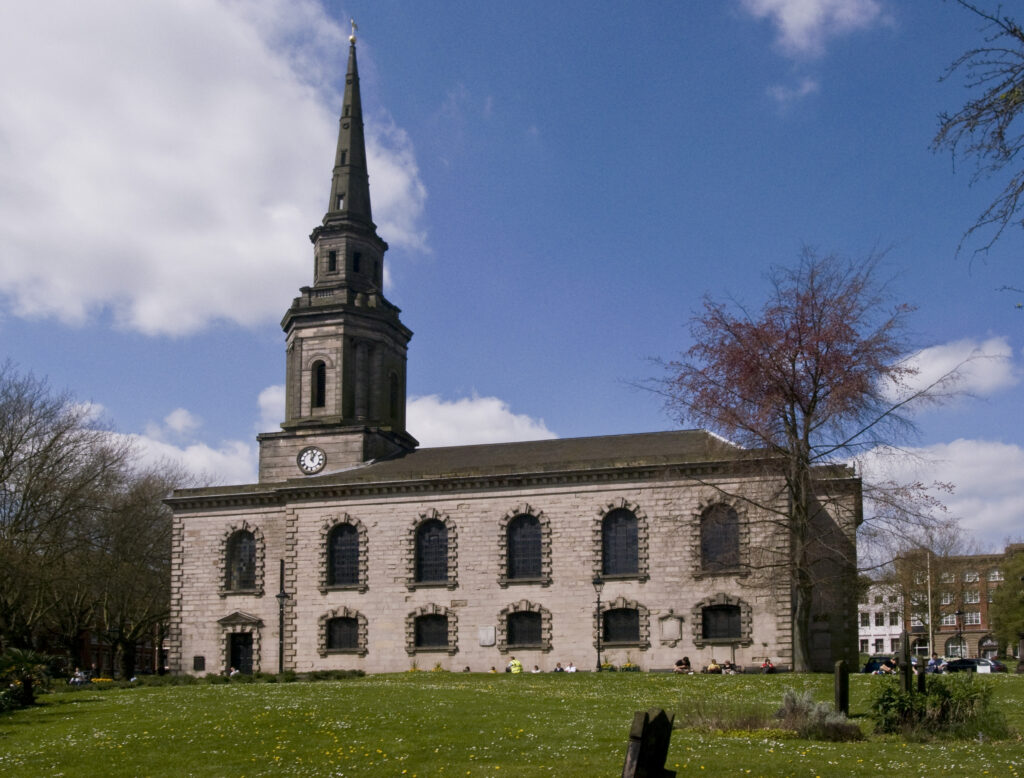
Birmingham’s last remaining Georgian church in a Georgian square, built as a chapel of ease when the town was growing faster than its parish church could hold.
At a glance
St Paul’s stands at the centre of St Paul’s Square in the Jewellery Quarter. An Act of Parliament of 1772 provided for two chapels of ease to St Martin’s, and St Paul’s, the second of them, was consecrated in 1779. Roger Eykyn of Wolverhampton was the surveyor. It became a parish church with its first vicar only in 1868. The building is listed Grade I (Historic England ID 1220815), sits in the Jewellery Quarter conservation area, and is on the Heritage at Risk Register. A roof restoration is under way, paid for by a Historic England grant and a local campaign.
Key facts
- Consecrated: 1779, a chapel of ease to St Martin’s
- Surveyor: Roger Eykyn of Wolverhampton, appointed in 1777 at 200 guineas
- Design: derived from Gibbs’s Book of Architecture and St Martin-in-the-Fields
- East window: 1785, by Francis Eginton after a design by Benjamin West
- Steeple: to the design of Francis Goodwin, from 1822, at a cost of £1097
- Parish church: 1868
- Listed Grade I; Historic England ID 1220815
- Bells: 13, cast by John Taylor Bellfounders in 2005
History
An Act of Parliament of 1772 set up two new chapels and burial grounds in the parish of St Martin’s: St Mary’s, consecrated in 1774, and St Paul’s, consecrated in 1779. Both were chapels of ease, with areas of the town assigned to them, and neither was a parish in its own right. Birmingham had about 31,000 people in 1770 and 50,000 by 1780, and St Martin’s churchyard had been full for centuries.
The trustees wanted a local surveyor rather than a London architect, and chose Roger Eykyn of Wolverhampton, who had worked as a master joiner, a nurseryman, a surveyor and a stonemason. He was appointed in March 1777 at 200 guineas. His design came from Gibbs’s Book of Architecture and from St Martin-in-the-Fields. The sittings were sold by subscription and then let at an annual rent: the number of sittings a subscriber received depended on how much he gave, and the money went to the building.
In 1785 a vestry meeting agreed a new east window by Francis Eginton, to a design by Benjamin West; it took six years to complete. In 1822 an indenture was signed for a steeple to the design of the London architect Francis Goodwin, at a cost of £1097, divided between nine subscribers. In 1841 the chapels were given designated areas and licensed to publish banns and carry out marriages, but they remained chapels of ease. St Paul’s became a parish church with its first vicar only in 1868.
What you see
A Georgian preaching box in a Georgian square, with the steeple of 1822 above it and the spire recorded from 1823. Inside, the east window was agreed in 1785 and made by Francis Eginton to a design by Benjamin West; it took six years to finish. The clock is by John Smith & Sons of Derby, and the tower holds thirteen bells, cast by John Taylor Bellfounders in 2005.
The church is open during daylight hours through the week. The square is what makes the building legible: a Georgian church at the centre, houses on three sides, and the workshops of the Jewellery Quarter behind them.
Practical information
- St Paul’s Square, Jewellery Quarter, Birmingham
- Open during daylight hours through the week
- Listed Grade I, and on the Heritage at Risk Register
- Roof restoration under way; the church is expected to remain fully open while the works go on
- The roof repair was estimated at £660,000
Getting there
The church stands in the middle of St Paul’s Square, in the Jewellery Quarter, a short walk north-west of Birmingham city centre.
Nearby
- St Chad’s Cathedral
- Birmingham School of Art
Sources
Find it on the map
See this place and what’s around it →📷 Become a Cultural Heritage Online photographer
Share your photos of places: they stay published under your name as the author. The more they're seen, the more you get noticed — and soon a contest will reward the most appreciated photos.
Log in or sign up free to add a photo