
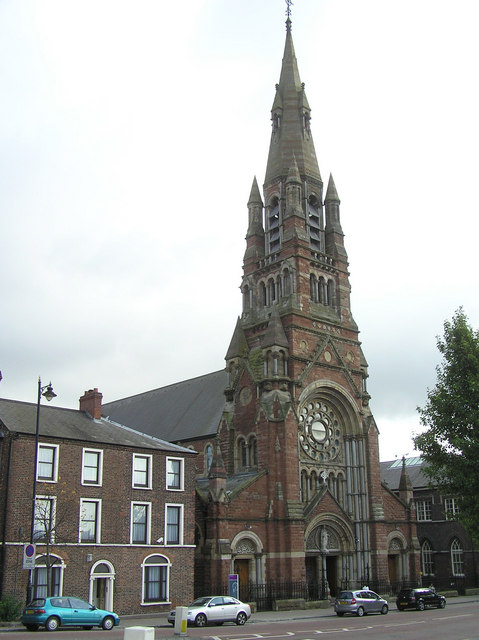
A Romanesque Revival Catholic church whose soaring tower and spire define the Donegall Street skyline, rebuilt in 1877 after its original foundation in 1815.
At a glance
St Patrick’s Church stands as one of Belfast’s prominent Catholic landmarks. The building’s distinctive architectural profile—a four-stage tower crowned by a spire—rises prominently from the west elevation, making it a notable presence in the city’s ecclesiastical landscape.
History
The first church dedicated to St Patrick was established on this site in 1815, serving the growing Catholic community of Belfast. The current structure, which opened in 1877, replaced the earlier building and reflects the expanded resources and ambitions of the parish during the Victorian era. As of 2024, the parish is served by a single priest, Eugene O’Neill—the first time in over two hundred years that just one cleric has been assigned to the parish.
What you see
The church exemplifies the Romanesque Revival style popular in 19th-century ecclesiastical architecture. Its most striking feature is the four-stage tower rising from the front west elevation, culminating in a spire that punctuates the Belfast skyline. The Romanesque vocabulary—characteristic of the revival movement—shapes the building’s aesthetic throughout.
Cultural significance
St Patrick’s Church remains a vital community and spiritual center for Belfast’s Catholic population. Its longevity and prominence in the city’s architectural identity reflect the deep roots of the Catholic faith in Northern Ireland and the parish’s enduring pastoral role across more than two centuries.
Key facts
- Location: Donegall Street, Belfast
- Country: United Kingdom
- City: Belfast
- Coordinates: 54.599, -5.9444
- First church on site: 1815
- Current building opened: 1877
- Architectural style: Romanesque Revival
Practical information & getting there
St Patrick’s Church is located on Donegall Street in central Belfast. For current opening hours, service times, and visitor information, consult the parish directly or visit the church’s official channels.
Sources & resources
Find it on the map
See this place and what’s around it →📷 Become a Cultural Heritage Online photographer
Share your photos of places: they stay published under your name as the author. The more they're seen, the more you get noticed — and soon a contest will reward the most appreciated photos.
Log in or sign up free to add a photoIs this page about you?
This page is read by travellers and heritage enthusiasts who find it on Google. Tell us how you are connected to this place and we will take it from there.