

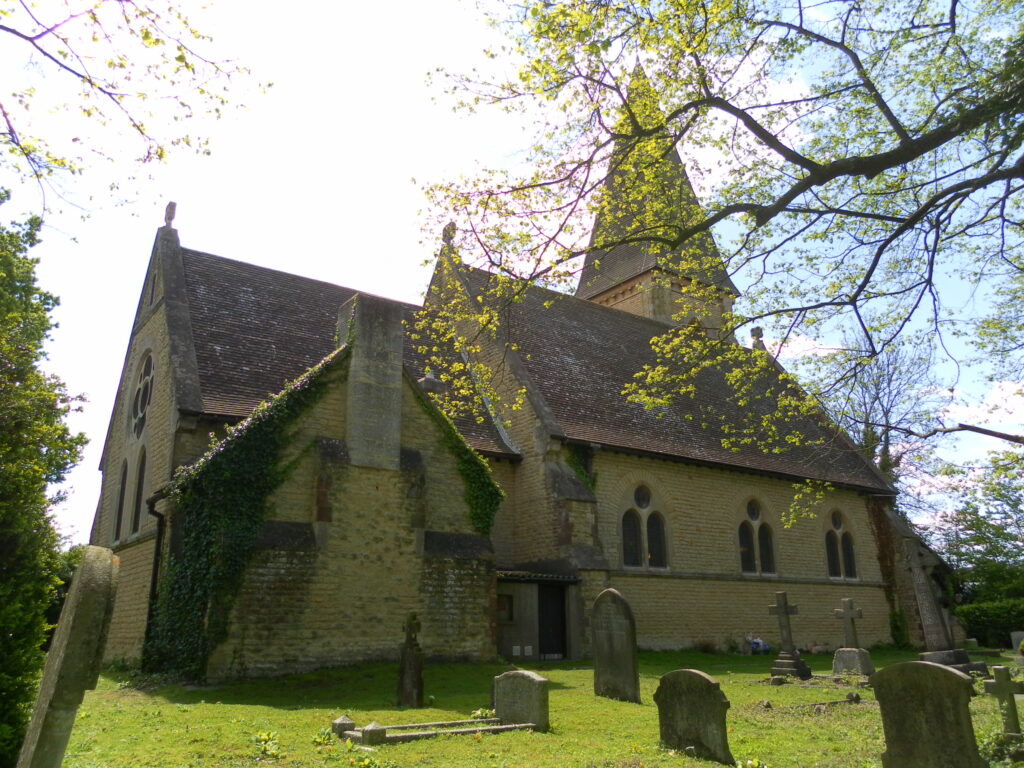
A Gothic Revival church designed by William Burges stands isolated among airport infrastructure, the sole survivor of a vanished village now consumed by Gatwick Airport’s sprawl.
At a glance
St Michael and All Angels Church is a Grade II* listed building in Lowfield Heath, a former village within the Borough of Crawley, West Sussex. Designed by architect William Burges, with its foundation stone laid on 15 July 1867 and consecrated on 1 December 1868, it served the local community until the village was dismantled for airport expansion. Today it stands as the only pre-airport structure remaining in the area.
History
William Burges designed the church to serve Lowfield Heath’s residents; its foundation stone was laid on 15 July 1867 and it was consecrated on 1 December 1868. As London Gatwick Airport expanded throughout the late twentieth century, the village was gradually appropriated for aviation-related development. Lowfield Heath became depopulated as structures were demolished to make way for airport facilities and related infrastructure.
The last Anglican service took place in 2004. In 2008, the church reopened under new stewardship as a Seventh-day Adventist place of worship, ensuring continued use of the historic building.
What you see
The church exemplifies the Gothic Revival style favored by William Burges, one of the nineteenth century’s most accomplished architects. Its design reflects the aesthetic principles of the movement, though the building’s setting has transformed entirely around it. Warehouses, depots and light industrial units now surround the structure—a stark contrast to its original village context.
Cultural significance
The Grade II* listing recognizes St Michael and All Angels as a particularly important building of more than special interest and national importance. Its significance extends beyond architecture to social and historical value: it is the only remaining structure from Lowfield Heath’s pre-airport era, making it a tangible link to a community that has entirely vanished. The church serves as a poignant reminder of how mid-twentieth-century infrastructure development reshaped the English landscape.
Key facts
- Designed by architect William Burges
- Consecrated in 1868
- Grade II* listed status
- Location: Lowfield Heath, Borough of Crawley, West Sussex, England
- Coordinates: 51.1458, -0.1797
- Last Anglican service held in 2004
- Now operates as a Seventh-day Adventist place of worship (from 2008)
Practical information & getting there
The church is located in Lowfield Heath, within the Borough of Crawley near London Gatwick Airport. For current opening times, services and access information, contact the Seventh-day Adventist congregation. The surrounding area contains airport infrastructure and commercial development rather than traditional village amenities.
The church stands on land that had been a duck pond and a damson orchard, given for the building by the Horley corn merchant William Dalton and by Joseph Montefiore, with the stone brought from a quarry in St Leonard’s Forest near Horsham.
Sources & resources
Find it on the map
See this place and what’s around it →📷 Become a Cultural Heritage Online photographer
Share your photos of places: they stay published under your name as the author. The more they're seen, the more you get noticed — and soon a contest will reward the most appreciated photos.
Log in or sign up free to add a photoIs this page about you?
This page is read by travellers and heritage enthusiasts who find it on Google. Tell us how you are connected to this place and we will take it from there.
This entry stays online and free either way — and a free account lets you add to it yourself.