
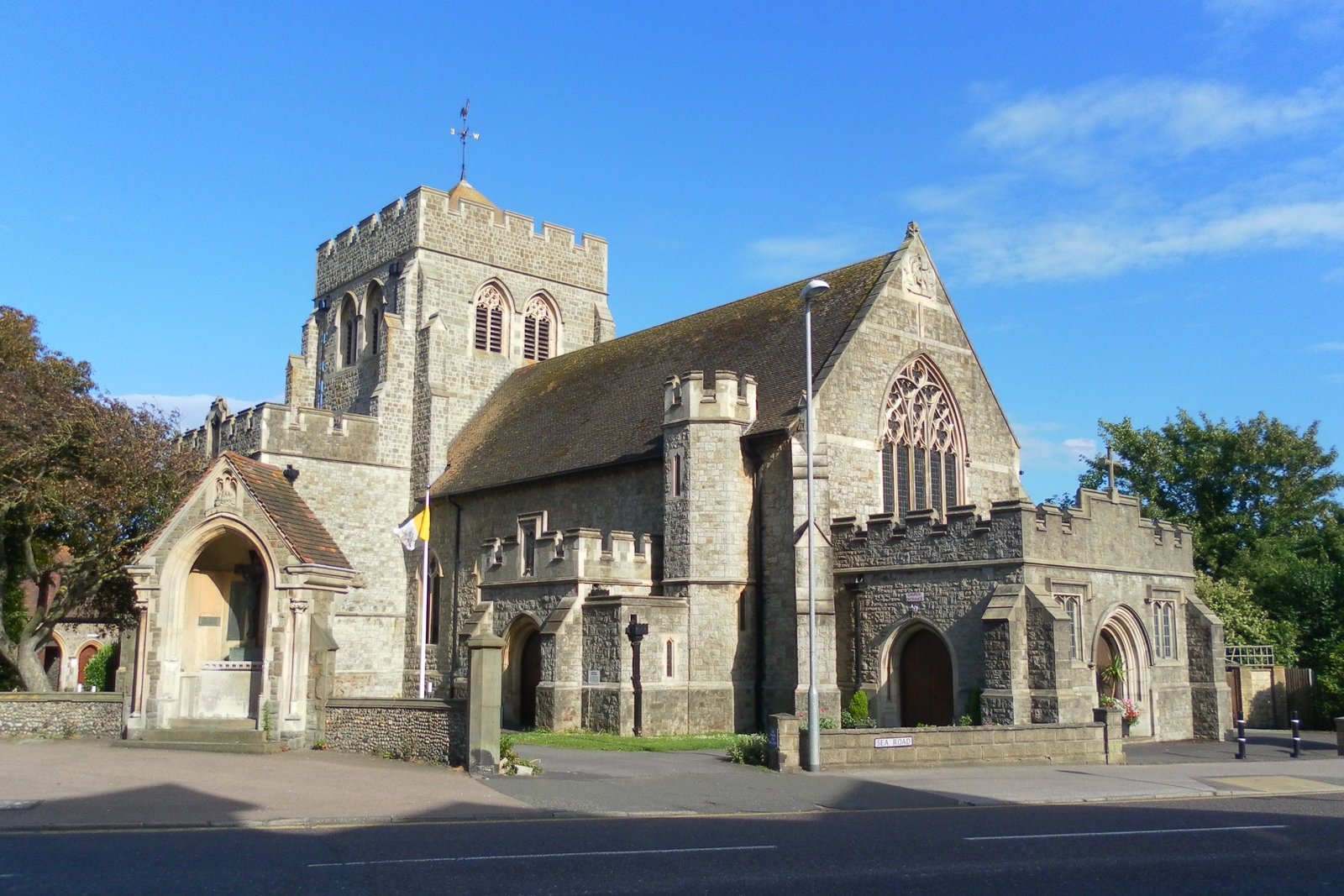
A Gothic Revival parish church in East Sussex, built in the early twentieth century to serve Bexhill’s growing Roman Catholic community.
At a glance
St Mary Magdalene’s Church stands at the heart of Bexhill-on-Sea, on the corner of Sea Road and Magdalen Road, opposite the railway station. Dedicated to Mary Magdalene, the church reflects the architectural tastes of its Edwardian era through pointed arches, ribbed vaults, and ornamental stonework.
History
The parish was founded in 1893, but the current church building was constructed in 1907. This timing reflects a broader expansion of Catholic worship across England following nineteenth-century emancipation. The railway station’s proximity shaped the church’s urban position, making it accessible to both residents and travelers.
What you see
Architect Arthur Young designed the church in the Gothic Revival style, which had dominated ecclesiastical architecture for decades. The building displays characteristic features of the movement: pointed-arch windows, stone detailing, and vertical emphasis. Its Grade II listing recognizes its architectural and historical merit within Bexhill’s townscape.
Cultural significance
The church exemplifies early twentieth-century Catholic institutional life in southern England. Its prominent location near the railway station underscores the role of transport infrastructure in shaping urban religious communities during an era of rapid suburban development.
Key facts
- Country: United Kingdom
- City: Bexhill-on-Sea, East Sussex
- Founded: 1893
- Built: 1907
- Architect: Arthur Young
- Style: Gothic Revival
- Designation: Grade II listed building
- Coordinates: 50.8414, 0.478
Practical information & getting there
The church is located at the corner of Sea Road and Magdalen Road, directly opposite Bexhill railway station, making it easy to reach by train or car. You can visit the church’s location and exterior year-round. For service times and visiting hours, contact the parish directly.
Sources & resources
Find it on the map
See this place and what’s around it →📷 Become a Cultural Heritage Online photographer
Share your photos of places: they stay published under your name as the author. The more they're seen, the more you get noticed — and soon a contest will reward the most appreciated photos.
Log in or sign up free to add a photoIs this page about you?
This page is read by travellers and heritage enthusiasts who find it on Google. Tell us how you are connected to this place and we will take it from there.