
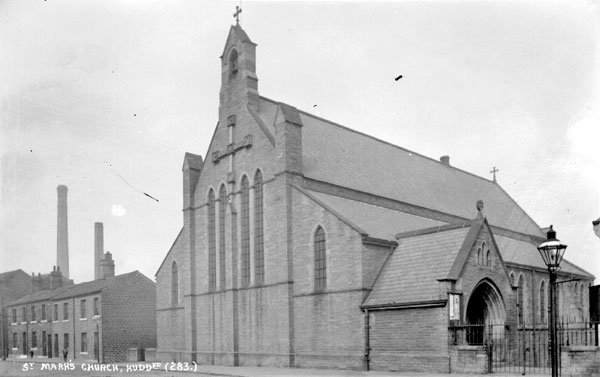
A Victorian Anglican parish church designed by William Swinden Barber to serve a rapidly expanding congregation in industrial West Yorkshire.
At a glance
St Mark’s Church stands on Old Leeds Road in Huddersfield, an architectural response to religious growth in the nineteenth century. Designed in 1886 and opened in 1887, the building served the Church of England until its sale in 2001, when it was repurposed as office space.
History
The church was created when the parish of St Peter’s was subdivided to accommodate a swelling congregation. William Swinden Barber, the architect, designed the building to meet this pressing spiritual and social demand.
Over its century as a working church, St Mark’s hosted notable clergy. Canon Percy Holbrook earned particular affection among parishioners, while Reverend Jonas Pilling endured a prolonged conflict with his congregation. Reverend Robert Alfred Humble died under mysterious circumstances; Reverend Joseph Miller, formerly a Congregational minister, gained renown as an eloquent preacher.
The Church of England sold the building in 2001, marking the end of its ecclesiastical use.
Cultural significance
St Mark’s embodies the expansion of Anglican provision in industrial Yorkshire during the nineteenth century. The succession of vicars—celebrated, controversial, and tragic—reflects the human drama of parish ministry in this period.
Key facts
- Country: United Kingdom
- City: Kirklees (Huddersfield)
- Architect: William Swinden Barber
- Designed: 1886
- Opened: 1887
- Coordinates: 53.6494, −1.7764
Practical information & getting there
The former church is now a private office building on Old Leeds Road. It is not open to the public.
Sources & resources
Find it on the map
See this place and what’s around it →📷 Become a Cultural Heritage Online photographer
Share your photos of places: they stay published under your name as the author. The more they're seen, the more you get noticed — and soon a contest will reward the most appreciated photos.
Log in or sign up free to add a photoIs this page about you?
This page is read by travellers and heritage enthusiasts who find it on Google. Tell us how you are connected to this place and we will take it from there.