
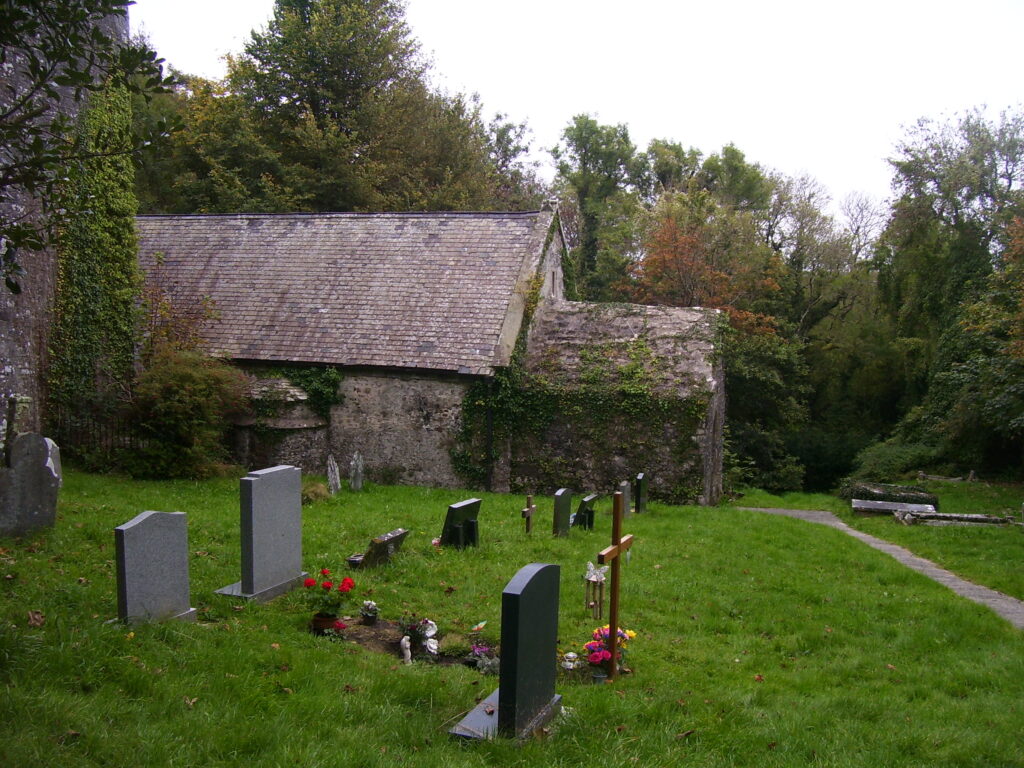

A small church among trees about two kilometres west of Tenby, with a tall Pembrokeshire tower, medieval wall paintings that were hidden under whitewash, and three springs in the churchyard that people once visited for cures. Declared at risk in 2021, it was repaired between 2023 and 2026 and is open again.
At a glance
St Lawrence’s stands just off the B4318 west of Tenby, in the community of St Florence. The chancel and nave go back to the twelfth or thirteenth century; a transept, a porch and a south chapel were added in the fourteenth and fifteenth centuries, and the large tower, with its battlemented parapet, in the fifteenth century or a little later. Inside are a limestone font of about 1200, a bell dated to 1350 that pre-dates the tower, and fragments of medieval wall painting. The building was declared at risk in 2021 because of water damage. In 2023 the charity Friends of Friendless Churches took it into its care, and a repair programme costing about £600,000, followed by conservation of the wall paintings, was completed in 2026.
Key facts
- Where: off the B4318, Gumfreston, Tenby, Pembrokeshire SA70 8RA, Wales (grid reference SN 109 011)
- Built: chancel and nave 12th–13th century; north transept and porch 14th century; south chapel 14th–16th century; tower 15th–16th century
- Restored: 1869, under the architect Thomas Graham Jackson; structural repairs 2023–2024 and wall-painting conservation 2025–2026 by Friends of Friendless Churches
- Materials: limestone rubble walls, slate roofs; the tower is limewashed
- Protection: listed Grade II* (Cadw reference 5958); the three wells in the churchyard are listed separately (reference 17130) and recorded as Grade II
- Owner: Friends of Friendless Churches, a charity founded in 1957 that cares for redundant churches in England and Wales
- Coordinates: 51.676800, -4.736070 · open in Google Maps
History
The oldest fabric is the chancel, with its arch, which the heritage records place in the twelfth or thirteenth century; the nave is probably of the same age. Over the following three centuries the church grew piece by piece: a north transept and a porch in the fourteenth century, a south chapel, and finally the tower. The bell is older than the tower that holds it, having been dated to 1350, and the tower walls contain a medieval columbarium, a set of nesting holes for pigeons built into the masonry. The sanctuary floor carries ledger stones of the early seventeenth century.
In the nave a wall painting came to light in 1980 in a semicircular recess on the north wall. It has been read either as St Lawrence, the church’s patron, or as a “Christ of the Trades”, the figure of Christ surrounded by the tools of everyday work, a warning against labouring on the Sabbath; both subjects are rare in Welsh medieval painting, and the Friends describe this one as among only a handful known in Wales. During the recent repairs further painted fragments emerged from beneath water-damaged plaster.
The church was restored in 1869 by Thomas Graham Jackson, later a leading Victorian architect. By the twenty-first century damp, ivy and a failing concrete tower roof had put it in danger of ruin, and in 2021 it was declared at risk. Friends of Friendless Churches took ownership in 2023 with a grant from the National Heritage Memorial Fund, which met the largest share of the cost; Cadw’s Heritage at Risk scheme contributed £212,932, and a restricted legacy left by a member of the charity made the work possible. The contractor Tree & Sons began work in October 2023: the ivy was removed root by root, cement pointing was raked out, the roofs of chancel, nave, porch and south chapel were stripped and re-slated with new timbers, the concrete roof of the tower was replaced by a timber one, and the tower was repointed and limewashed. A non-breathable yellow emulsion was taken off the interior walls. The conservation of the wall paintings followed, from autumn 2025 to spring 2026.
What you see
The photograph looks across the churchyard at the body of the church: a long, low building of grey rubble stone under a roof of slate, with a plain gable at the near end and a curved projection breaking the wall below it. To the left the tower rises above the roofline, in this view still wrapped in ivy from base to top; today it is bare, harled and limewashed. Headstones stand in the grass, some old and leaning, some new, and a path runs along the right-hand edge of the picture and drops away towards the trees.
That slope matters. The churchyard falls away below the church, and at its lower edge lie the three wells for which Gumfreston is known: one of plain spring water, said to be good for the legs; one iron-rich, credited with curing the hands and arms; and one sulphurous, for the eyes. The archaeological record describes two of them as chalybeate. The wells are older than the church and were once visited with offerings of bent pins; the heritage record notes that nails are still thrown into the water on Easter Sunday. Inside the church, look for the square-headed windows in the south wall of the nave, the chamfered square bowl of the font, and the recess on the north wall that holds the painting.
Practical information
- Following the repairs, the Friends aim to open the church every Friday, Saturday and Sunday from 10 am to 4 pm until 31 October 2026; the arrangements depend on local volunteers, so check with the charity before travelling.
- During September 2026 the church also opened on Saturdays for heritage open days, with talks by a local historian on 19 and 26 September.
- Admission is free; the charity relies on donations for the upkeep of its churches.
- The wells lie at the bottom of the churchyard, down a slope from the church.
Getting there
Gumfreston lies on the B4318 about two kilometres west of Tenby, on the road towards Sageston and Carew. There is a small car park by the church. Tenby has a railway station on the Pembroke Dock branch, with connections to Swansea.
Nearby
- Tenby, a walled medieval harbour town with its town walls and St Mary’s Church, 2 km to the east.
- Carew Castle and tidal mill, about 7 km to the north-west.
- Manorbier Castle, on the coast about 5 km to the south-west.
Sources
- Friends of Friendless Churches, St Lawrence’s, Gumfreston, Pembrokeshire: address, dating of the building and tower, bell, font, columbarium, ledger stones, wall painting, the three wells, the 2023 vesting and the opening hours.
- Friends of Friendless Churches, Gumfreston: 70% complete and Gumfreston: update on repairs: the contractor and the repair programme from October 2023, the tower roof, the limewash, the removal of emulsion, the funding.
- Coflein (Royal Commission on the Ancient and Historical Monuments of Wales), NPRN 300432: dating by phase, the 1869 restoration by Thomas Graham Jackson, the 2021 at-risk declaration, the paintings that emerged during repairs.
- Heneb (Dyfed Archaeology), PRN 3687: Grade II* listing, dating of each part, font of about 1200, bell dated 1350, wall painting uncovered in 1980, the wells and the Easter Sunday custom.
- Church in Wales, Church Heritage Record 3665: Cadw references, description of the building, the recess with the painting, the wells at the bottom of the churchyard.
- The Pembrokeshire Herald, Discover the secrets of a 900-year-old church at Gumfreston this September: the September 2026 open days and talks, the cost of the works, the Cadw grant, the conservation of the paintings.
- Wikidata Q17743385: coordinates.
Find it on the map
See this place and what’s around it →📷 Become a Cultural Heritage Online photographer
Share your photos of places: they stay published under your name as the author. The more they're seen, the more you get noticed — and soon a contest will reward the most appreciated photos.
Log in or sign up free to add a photo