

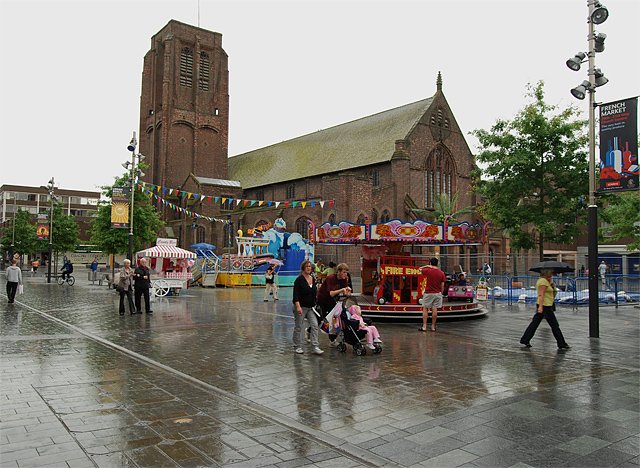
A Grade II listed Anglican church rebuilt after wartime destruction, St Helens Minster has served as the town’s parish church since 1926, designed by architect W. D. Caröe in a prominent civic position.
At a glance
St Helels Minster is the parish church of St Helens, Merseyside, and an active congregation within the Diocese of Liverpool. The present building dates from the interwar period, though sacred space has occupied this site for at least four centuries. It stands as a visible anchor in the town centre.
History
A chapel existed on this site from at least the 16th century. In 1816, the chapel was doubled in size to serve the growing community. Disaster struck in 1916 when the enlarged building burnt down entirely. After the First World War, the church was reconstructed under the direction of architect W. D. Caröe. The new building rose between 1920 and 1926, establishing the structure that stands today.
What you see
Designed by W. D. Caröe, the 1920s church reflects the architect’s approach to Anglican sacred space. The building occupies a prominent position in the town, contributing to St Helens’s civic character.
Cultural significance
St Helens Minster represents the town’s post-war rebuilding and continued religious life. Its designation as a Grade II listed building recognizes its architectural and historical importance to the English heritage record.
Key facts
- Country: United Kingdom
- City: St Helens, Merseyside
- Architect: W. D. Caröe
- Completed: 1926
- Heritage listing: Grade II listed building (National Heritage List for England)
- Coordinates: 53.4516, −2.735
Practical information & getting there
St Helens Minster is located in the town centre of St Helens, Merseyside. As an active parish church, it welcomes visitors. For current service times and visiting information, contact the Diocese of Liverpool or check the church’s local website.
Sources & resources
Find it on the map
See this place and what’s around it →📷 Become a Cultural Heritage Online photographer
Share your photos of places: they stay published under your name as the author. The more they're seen, the more you get noticed — and soon a contest will reward the most appreciated photos.
Log in or sign up free to add a photoIs this page about you?
This page is read by travellers and heritage enthusiasts who find it on Google. Tell us how you are connected to this place and we will take it from there.