
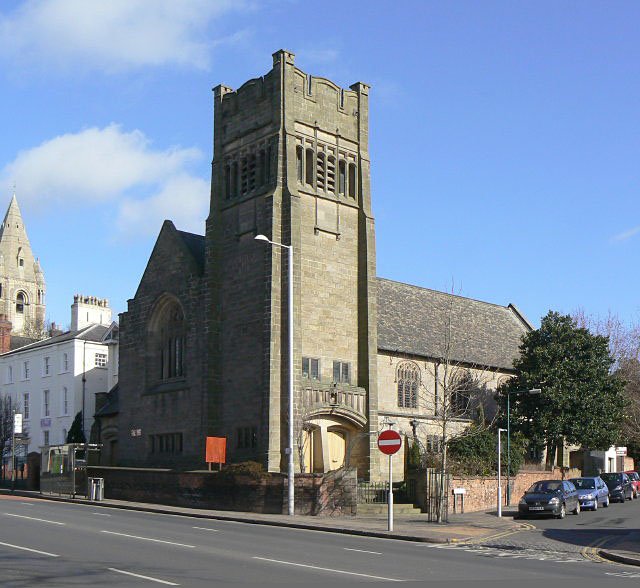
A Victorian Presbyterian church built in Nottingham at the turn of the twentieth century, St Columba’s reflects the architectural ambitions and religious diversity of the Industrial Era.
At a glance
St Columba’s Church stands at the intersection of Mansfield Road and Villa Road in Nottingham. Designed by the architects Brewill and Baily, the building was completed in 1900 and served the Presbyterian community for half a century before changing hands repeatedly through the twentieth century.
History
Founded in 1896 as a daughter church to St Andrew’s Presbyterian Church, also in Nottingham, St Columba’s was a deliberate expansion of Presbyterian worship in the city. Construction by Brewill and Baily began that same year and was finished by 1900. The church remained in Presbyterian hands until 1946, when it merged with St Andrew’s United Reformed Church and the buildings were sold. The Emanuel Full Gospel Church occupied the site by 1950, followed by the Church of Christ Scientist in 1956. Since 2009, the Sri Raja Sahib Nabh Kanwal Trust has used the buildings.
What you see
The structure reflects late Victorian ecclesiastical design by Brewill and Baily, a firm active in designing religious buildings across the Midlands. The church’s position at a prominent road junction suggests its importance as a civic landmark in the surrounding residential neighbourhood.
Cultural significance
St Columba’s exemplifies the expansion of non-conformist Protestant denominations in English industrial cities during the nineteenth century. Its multiple congregational occupancies reveal the shifting religious landscape and adaptation of Victorian sacred spaces to contemporary needs.
Key facts
- Country: United Kingdom
- City: Nottingham
- Founded: 1896
- Completed: 1900
- Architects: Brewill and Baily
- Coordinates: 52.9652, −1.1508
Practical information & getting there
St Columba’s Church is located at the Mansfield Road and Villa Road intersection in Nottingham. For current opening times and access information, contact the Sri Raja Sahib Nabh Kanwal Trust directly, as the building remains in private use.
Sources & resources
Find it on the map
See this place and what’s around it →📷 Become a Cultural Heritage Online photographer
Share your photos of places: they stay published under your name as the author. The more they're seen, the more you get noticed — and soon a contest will reward the most appreciated photos.
Log in or sign up free to add a photoIs this page about you?
This page is read by travellers and heritage enthusiasts who find it on Google. Tell us how you are connected to this place and we will take it from there.