
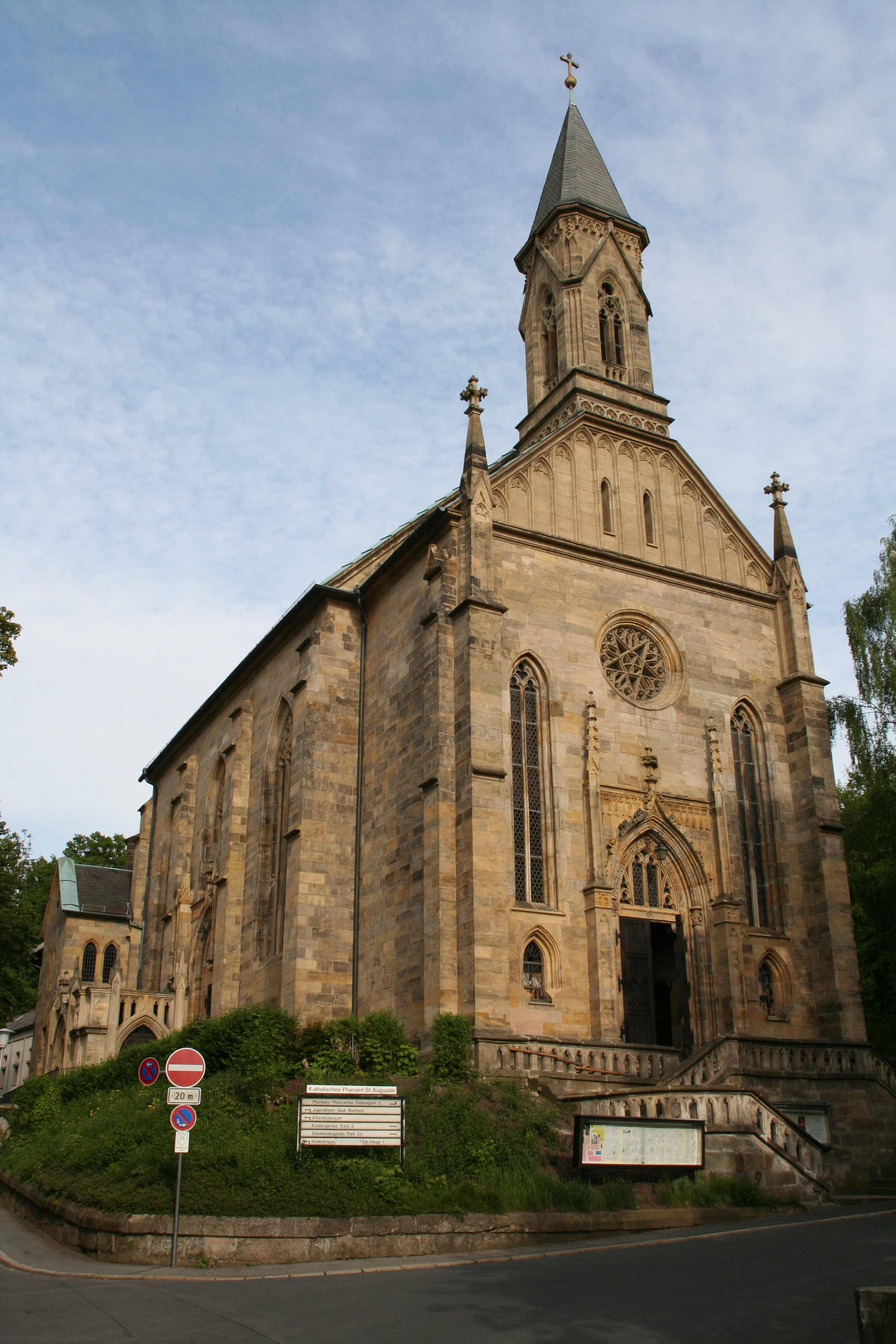
A Gothic Revival parish church built in the 1850s for the Roman Catholic Archdiocese of Bamberg, remodelled mid-century and housing the crypts of a Catholic branch of European nobility.
At a glance
St. Augustin stands in Coburg as a testament to 19th-century religious architecture and the complex history of Bavaria’s ruling families. The church belongs to the Archdiocese of Bamberg and reflects both Victorian-era Gothic sensibility and post-1960 liturgical modernization.
History
Construction began in 1856 and concluded in 1860, a period of expanding Catholic institutional presence in Protestant-majority Bavaria. The church underwent significant remodelling in 1960 following Vatican II liturgical reforms that reshaped Catholic worship across Europe. Beneath the church lies a crypt containing the remains of fifteen members of the Koháry branch of the House of Saxe-Coburg and Gotha—the Catholic lineage of a ducal dynasty that had long been Protestant.
What you see
The original design employed Gothic Revival vocabulary, characteristic of 19th-century ecclesiastical taste. The 1960 remodelling substantially altered the interior to accommodate modern liturgical practice, though the external Gothic forms remain legible.
Cultural significance
St. Augustin embodies the religious and dynastic complexities of 19th-century German history. Its crypt records the spiritual allegiance of Catholic nobility within a predominantly Protestant region, while its architectural evolution mirrors the transformative impact of Vatican II on European church design.
Key facts
- Country: Germany
- City: Coburg, Bavaria
- Built: 1856–1860
- Archdiocese: Bamberg
- Remodelled: 1960
- Crypt residents: 15 members of the Koháry branch, House of Saxe-Coburg and Gotha
- Coordinates: 50.26027778, 10.96861111
Practical information & getting there
St. Augustin is located in Coburg, a town in northern Bavaria near the Thuringian border. The church is accessible by road and rail; Coburg has direct train connections to major German cities including Bamberg and Nuremberg.
Sources & resources
Find it on the map
See this place and what’s around it →📷 Become a Cultural Heritage Online photographer
Share your photos of places: they stay published under your name as the author. The more they're seen, the more you get noticed — and soon a contest will reward the most appreciated photos.
Log in or sign up free to add a photoIs this page about you?
This page is read by travellers and heritage enthusiasts who find it on Google. Tell us how you are connected to this place and we will take it from there.