
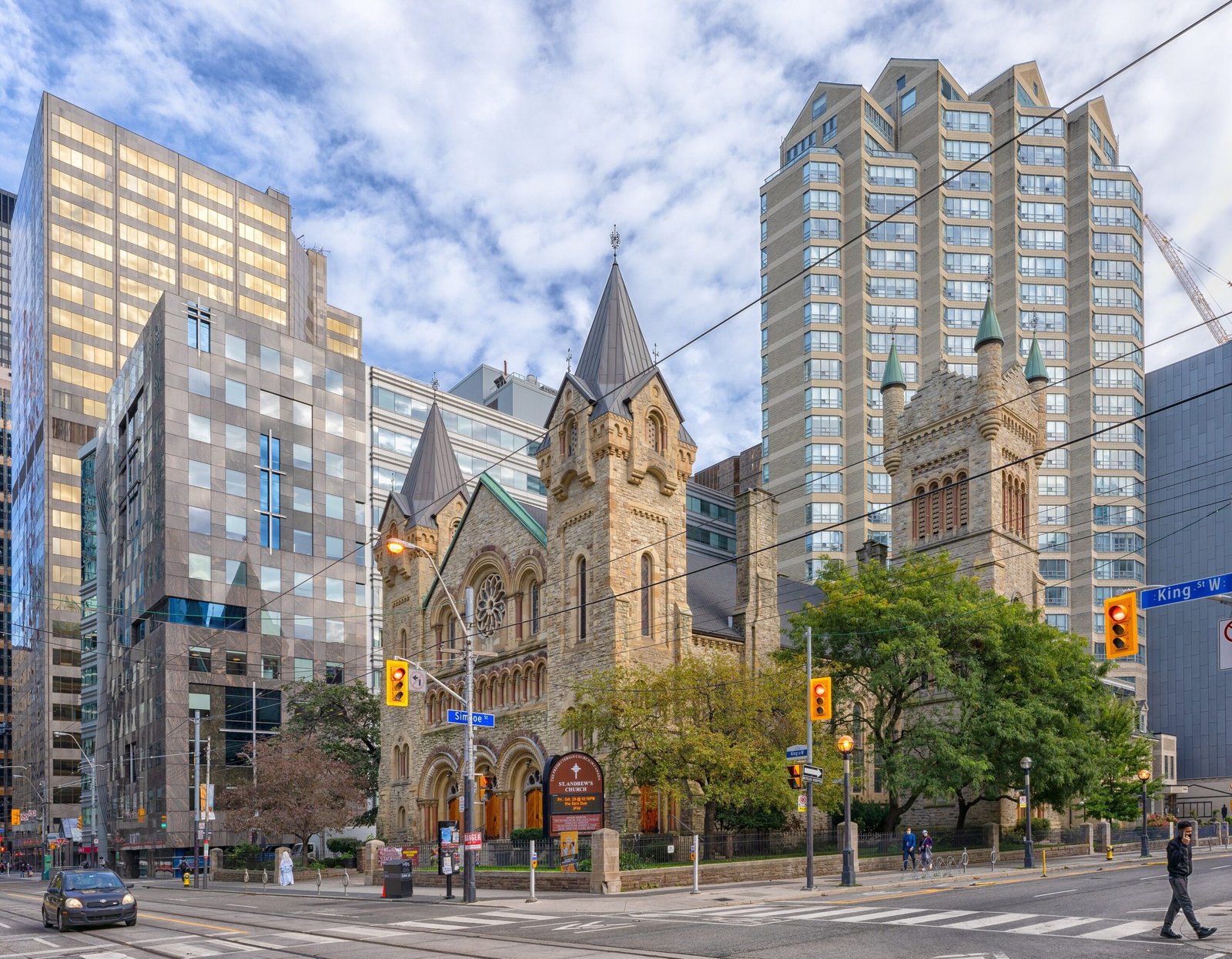
A landmark Presbyterian church in Toronto’s downtown, designed by William George Storm and completed in 1876, exemplifying the Romanesque Revival style.
At a glance
St. Andrew’s Church occupies a prominent corner site in Toronto’s downtown core, at King Street West and Simcoe Street. Built in the mid-nineteenth century, it stands as a significant example of Victorian-era ecclesiastical architecture and remains active in the city’s religious and cultural life.
History
The church was designed by William George Storm, a prominent Canadian architect of the period, and completed in 1876. Its construction reflected the growth and prosperity of Toronto during the late Victorian era, when major institutions commissioned ambitious public buildings to anchor their neighbourhoods.
What you see
Storm designed St. Andrew’s in the Romanesque Revival style, a choice that conveyed solidity, permanence, and spiritual authority. The style is marked by rounded arches, sturdy masonry, and decorative detailing characteristic of Victorian interpretations of medieval architecture.
Cultural significance
As a Presbyterian church of historic importance, St. Andrew’s has served the Toronto community for nearly 150 years. Its downtown location and architectural distinction make it a landmark recognizable to residents and visitors, contributing to the character of one of Canada’s most important urban centres.
Key facts
- Country: Canada
- City: Toronto, Ontario
- Architect: William George Storm
- Completed: 1876
- Style: Romanesque Revival
- Denomination: Presbyterian
- Coordinates: 43.647°N, 79.386°W
Practical information & getting there
St. Andrew’s Church is located at the corner of King Street West and Simcoe Street in downtown Toronto, easily accessible by public transit. The church remains in active use; visitors are advised to check ahead regarding visiting hours and any special services or events.
Sources & resources
Find it on the map
See this place and what’s around it →📷 Become a Cultural Heritage Online photographer
Share your photos of places: they stay published under your name as the author. The more they're seen, the more you get noticed — and soon a contest will reward the most appreciated photos.
Log in or sign up free to add a photoIs this page about you?
This page is read by travellers and heritage enthusiasts who find it on Google. Tell us how you are connected to this place and we will take it from there.