
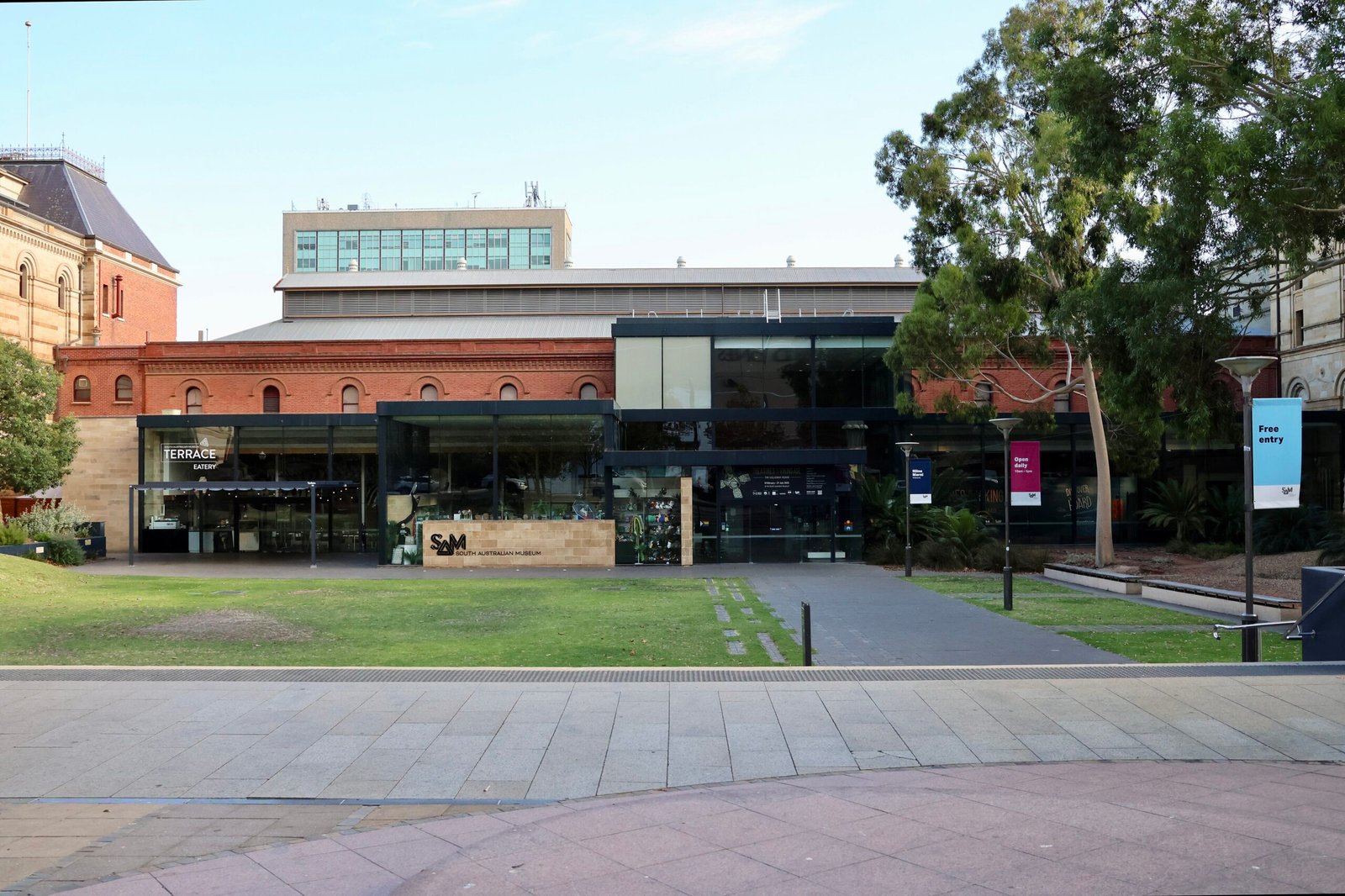
A major natural history institution housing the world’s largest collection of Australian Aboriginal cultural artefacts, alongside significant polar exploration records and over three million animal specimens.
At a glance
The South Australian Museum occupies a prominent position on North Terrace within Adelaide’s cultural precinct. It functions as both a public museum and active research institution, drawing researchers and visitors to explore Australia’s natural and cultural heritage.
History
Founded in 1856, the museum grew to become a centre for Australian scientific inquiry. Its collections reflect the institution’s long engagement with polar exploration: the Australian Polar collection preserves artefacts from pioneering Antarctic expeditions led by South Australian scientists and explorers, a legacy now presented in the museum’s dedicated gallery.
What you see
The museum occupies a complex of buildings positioned within the Adelaide Parklands. Its architecture frames multiple gallery spaces dedicated to distinct collections, from ethnographic materials to natural specimens and research archives.
Cultural significance
The museum holds unparalleled holdings of Aboriginal Australian cultural materials—the world’s largest such collection. Its marine mammal collection represents the most comprehensive in Australia. The institution’s research library supports scholars working across natural history, archaeology, and Indigenous studies, extending its influence beyond its walls.
Key facts
- Country: Australia
- City: Adelaide, South Australia
- Founded: 1856
- Coordinates: -34.920783, 138.603017
- Collections: World’s largest Aboriginal cultural collection; over 3 million animal specimens; approximately 50,000 fossil specimens; significant mineral holdings; specialised Antarctic exploration artefacts
- Research library with reference works and specialised publications
Practical information & getting there
The museum is located on North Terrace in Adelaide’s cultural precinct. For current visiting hours, admission details, and exhibition information, consult the museum’s official website or contact the institution directly.
Sources & resources
Find it on the map
See this place and what’s around it →📷 Become a Cultural Heritage Online photographer
Share your photos of places: they stay published under your name as the author. The more they're seen, the more you get noticed — and soon a contest will reward the most appreciated photos.
Log in or sign up free to add a photoIs this page about you?
This page is read by travellers and heritage enthusiasts who find it on Google. Tell us how you are connected to this place and we will take it from there.