
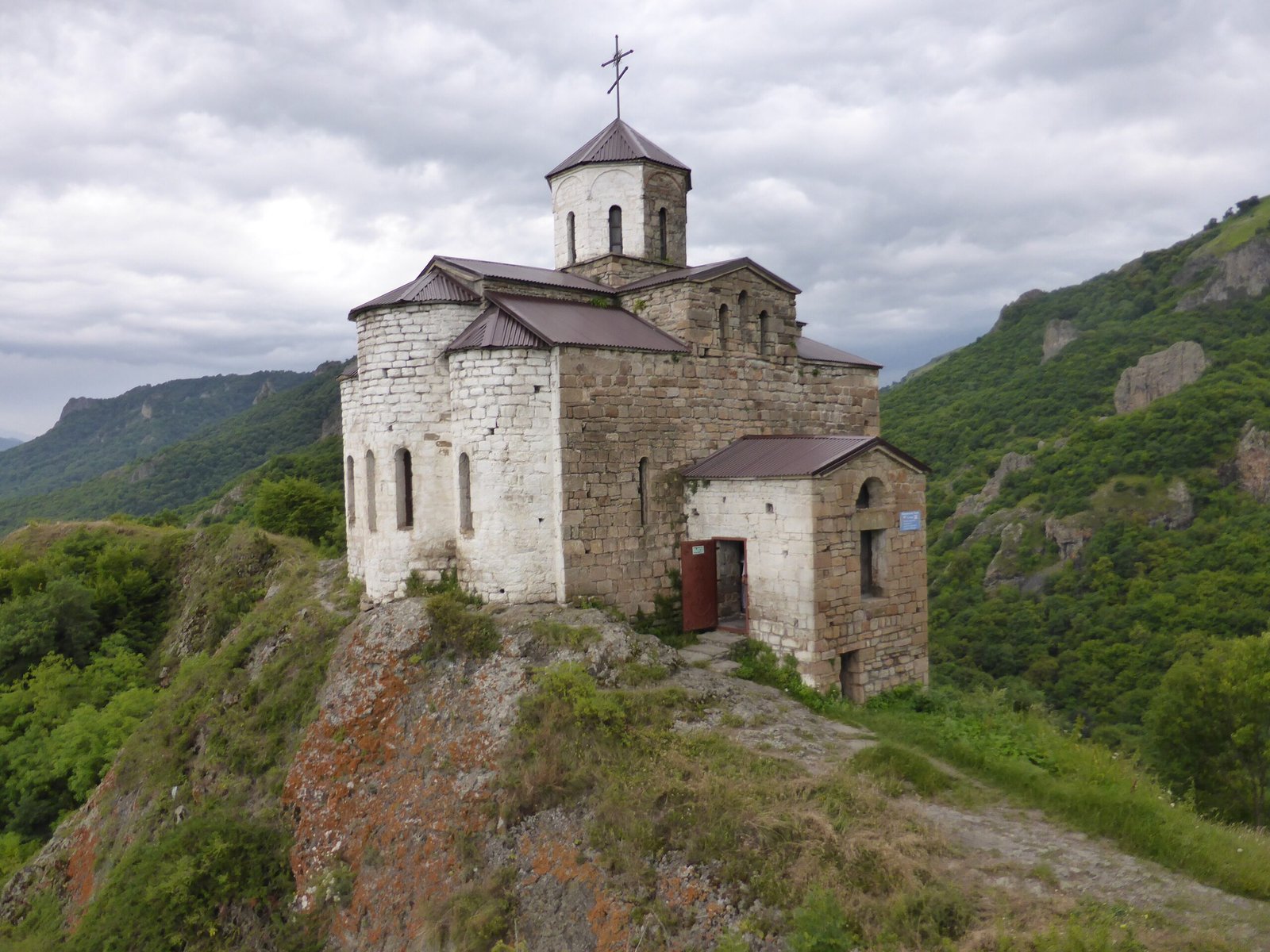
On a spur above the Kuban River stands one of Alania’s earliest surviving churches, a modest cross-domed structure built by builders who never signed their work.
At a glance
Shoana Church sits on the southeastern spur of Mount Shoana, on the Kuban’s left bank, near the confluence with the Teberda River. It stands about 7 km north of Karachayevsk, overlooking the Ossetian village of Kosta Khetagurov. The building follows a cross-domed, inscribed-cross plan, a smaller relative of the nearby North Zelenchuk Church.
History
The slope beneath the church was once densely settled. Remains of older buildings and burials, some inside the church itself, still mark the ground. Historians Vinogradov and Beletsky argue local builders copied the North Zelenchuk pattern but worked with greater technical freedom. No written record fixes an exact date. Fragments of fresco, comparable to a second paint layer at Senty Church, point instead to the late tenth or early eleventh century, after Alania’s return to Christianity around 950. By the late nineteenth century the church served the Alexander-Athos monastery; it was replastered, reroofed and its chapels rebuilt. In 2007 villagers carried out unauthorized repairs, stripping later plaster and exposing original medieval painting beneath, though part of that surface was lost in the process. An arson attack in April 2011 was extinguished before the interior or icons suffered damage.
What you see
Three apses, narrower than the naves they close, open into a cross-domed interior carried on four square pillars. Three-stage arches rise to a cupola set on an octahedral tholobate pierced by eight windows. Two closed, vaulted narthexes flank the north and south ends. Walls combine sandstone-and-lime blocks with rubble-concrete fill, plinthite reserved for the arches alone, a Georgian and Byzantine convention. Window heads are cut from single stones rather than shaped in brick. Scaffolding holes still pockmark the masonry. In one, a sawn-off timber remains, left by builders who could not free it. Decoration stays spare: a stone-tile cornice, plinthite banding on the drum, occasional cornices over windows. Traces of exterior plaster survive between some tiles. Inside, surviving plasterwork once carried painted ornament, and later graffiti in Greek, Arabic, Georgian, Armenian and Russian, along with North Caucasian tamga signs, overlay the older layers.
Cultural significance
Shoana belongs to the third documented phase of Alanian church-building, following the Central Zelenchuk, Senty and North Zelenchuk churches. Its close copying of North Zelenchuk offers historians a rare, dated benchmark for tracing how a single architectural idea moved between builders. The mixed inscriptions layered across its walls, spanning several languages and centuries, register a long, shifting sequence of visitors and faiths. In 2016 Russia issued a silver commemorative coin bearing the church’s image, a small but telling sign of its standing in national heritage.
Key facts
- Location: Mount Shoana, Karachay-Cherkessia Republic, Russia
- Plan: cross-domed, inscribed cross, related to North Zelenchuk Church
- Dimensions: length and height both approximately 12.9 m; western façade width 8.9 m
- Presumed construction: late 10th–early 11th century
- Heritage status: listed cultural heritage site
Practical information & getting there
The church stands about 7 km north of Karachayevsk, above Kosta Khetagurov village. You reach the site by road along the Kuban valley, then a walk up the spur. No formal visitor infrastructure is described in available sources, so check locally before travelling.
Sources & resources
Find it on the map
See this place and what’s around it →📷 Become a Cultural Heritage Online photographer
Share your photos of places: they stay published under your name as the author. The more they're seen, the more you get noticed — and soon a contest will reward the most appreciated photos.
Log in or sign up free to add a photoIs this page about you?
This page is read by travellers and heritage enthusiasts who find it on Google. Tell us how you are connected to this place and we will take it from there.