

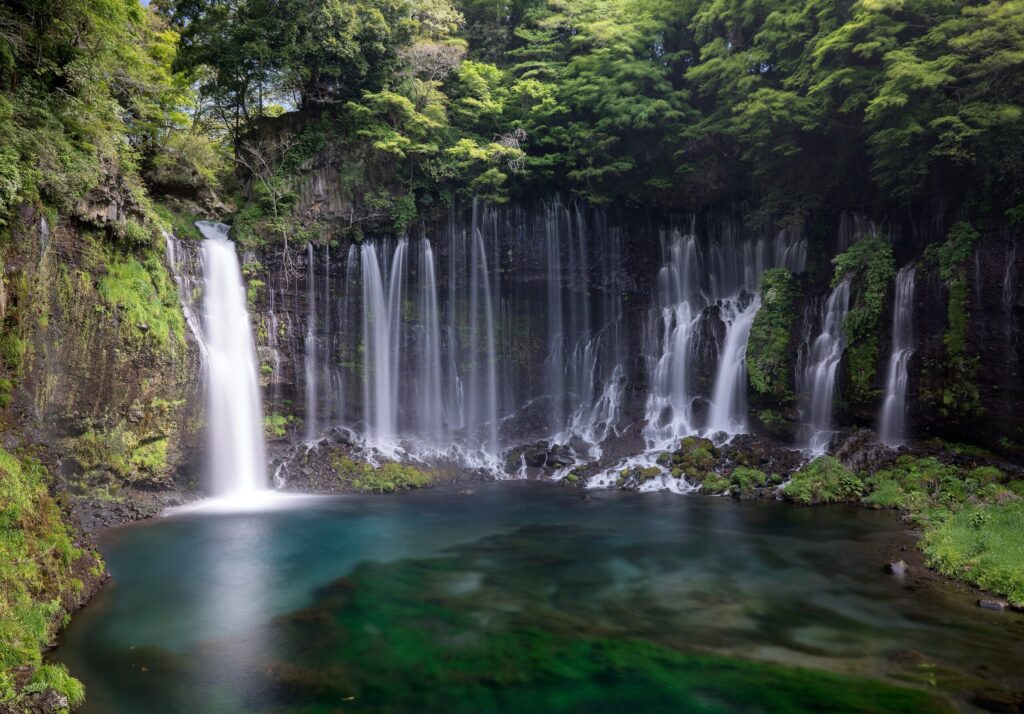
A cascading waterfall near Mount Fuji, Shiraito Falls descends in delicate strands across volcanic rock, creating one of Japan’s most photographed natural spectacles.
At a glance
Shiraito Falls flows near Mount Fuji in Shizuoka Prefecture’s Fujinomiya district. The waterfall’s name means “white silk thread,” aptly describing its characteristic appearance as water flows in thin rivulets down a 20-metre lava cliff some 150 metres wide in total.
History
The falls have long been a landmark in the Mount Fuji region, drawing visitors and artists throughout Japan’s modern era. Limited historical records are publicly available about the site’s earliest significance.
What you see
Water cascades down a permeable volcanic rock wall in numerous fine threads rather than a single powerful stream. The delicate effect creates an ethereal quality, particularly striking during spring snowmelt and after heavy rainfall when flow increases. The surrounding landscape frames the falls within the broader volcanic geography of the Mount Fuji area.
Cultural significance
Shiraito Falls represents a distinctive natural phenomenon within Japan’s volcanic landscape. The site has become an important destination for nature photography and cultural tourism, valued for its aesthetic qualities and geological interest.
Key facts
- Location: Fujinomiya, Shizuoka Prefecture, Japan
- Coordinates: 35.3125°N, 138.5889°E
- Name meaning: “White silk thread” (白糸の滝)
Practical information & getting there
The falls are accessible via Fujinomiya, a town on the southern approach to Mount Fuji. Check local weather and water conditions before visiting; seasonal water flow varies significantly. The site is popular year-round with photographers.
Shiraito no Taki and its surroundings are designated National Places of Scenic Beauty and National Natural Monuments, and are one of the 25 constituent properties of the Mount Fuji World Heritage site.
Sources & resources
Find it on the map
See this place and what’s around it →📷 Become a Cultural Heritage Online photographer
Share your photos of places: they stay published under your name as the author. The more they're seen, the more you get noticed — and soon a contest will reward the most appreciated photos.
Log in or sign up free to add a photoIs this page about you?
This page is read by travellers and heritage enthusiasts who find it on Google. Tell us how you are connected to this place and we will take it from there.
This entry stays online and free either way — and a free account lets you add to it yourself.