
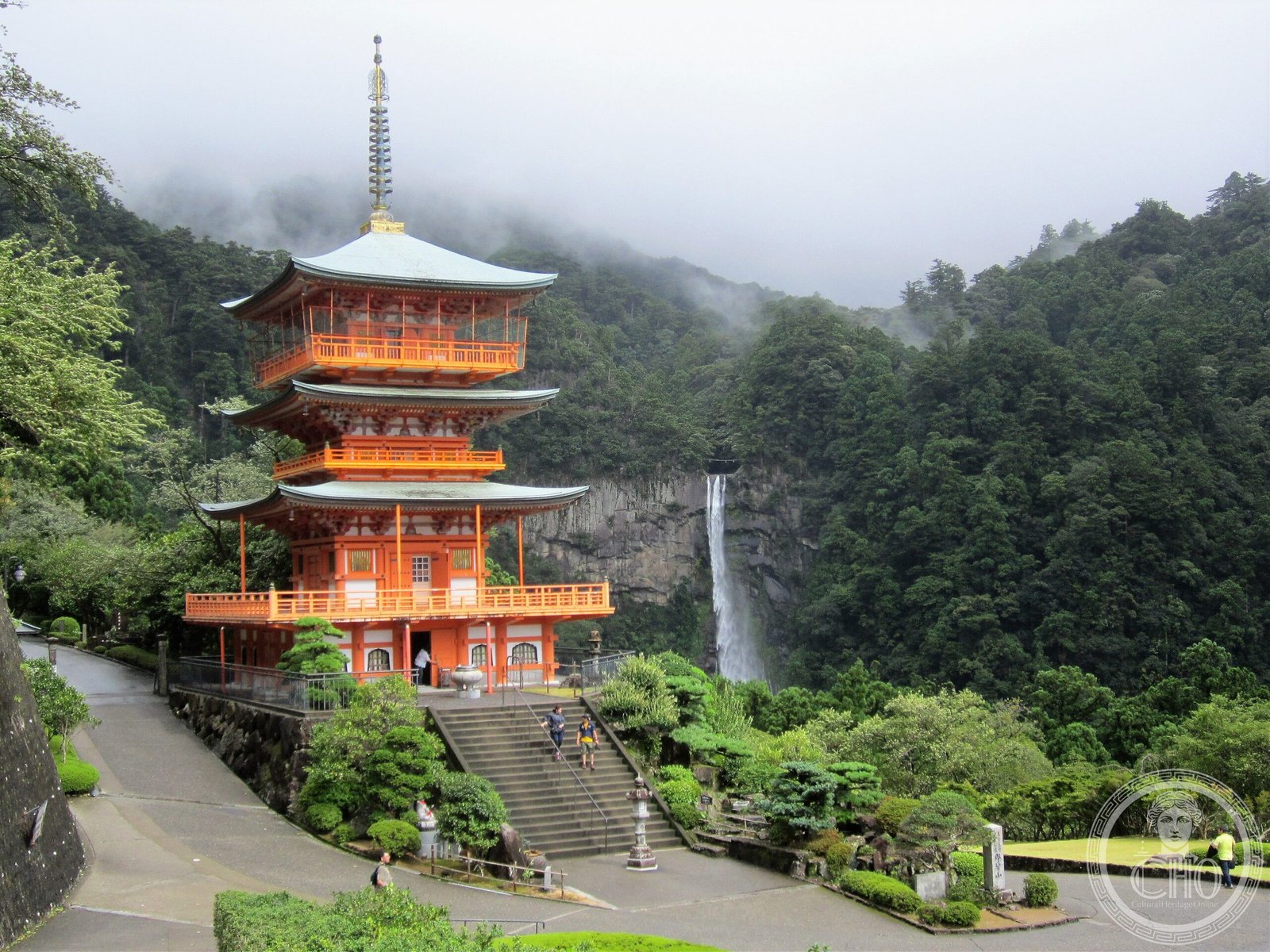
A clifftop Buddhist temple that bridges two faiths. Seiganto-ji stands where sacred waterfalls meet centuries of spiritual pilgrimage, serving as the opening gateway to one of Asia’s oldest devotional routes.
At a glance
Seiganto-ji—the Temple of Crossing the Blue Shore—is a Tendai Buddhist sanctuary perched above Nachi Falls in the Kii Mountains. Built intentionally beside the cascading waters, the temple occupies a site long honored as a place of nature worship. It holds the distinction of being the first stop on the Saigoku Kannon Pilgrimage, one of East Asia’s most significant devotional circuits.
History
According to legend, the temple was founded by Ragyō Shōnin, a monk from India. The precise dating remains unclear, but the temple’s location—chosen deliberately for its proximity to Nachi Falls—suggests it emerged from pre-Buddhist veneration of the natural site. Seiganto-ji became integral to the Kumano Sanzan shrine complex, a nexus of pilgrimage and spiritual practice in the mountain region. During Japan’s Meiji Restoration, the government forcibly separated Shinto and Buddhism. Seiganto-ji survived this upheaval as one of the few remaining jingū-ji, or shrine temples, that retained its dual religious character and function.
What you see
The temple’s main hall is classified as an Important Cultural Property by the Japanese government, reflecting its architectural and historical significance. The structure commands views of the sacred waterfall and surrounding mountain landscape. The setting itself—a fusion of human craftsmanship and dramatic natural scenery—defines the temple’s visual and spiritual power.
Cultural significance
Seiganto-ji anchors the Saigoku Kannon Pilgrimage, a route tracing devotion to Avalokiteśvara across thirty-three temples. The temple represents a rare surviving example of jingū-ji tradition, embodying Japan’s complex religious heritage where Buddhism and Shinto coexist. Its UNESCO designation in 2004 recognized this significance within the broader Sacred Sites and Pilgrimage Routes of the Kii Mountain Range.
Key facts
- Country: Japan
- Prefecture: Wakayama
- Coordinates: 33.6694°N, 135.8898°E
- UNESCO World Heritage Site: 2004 (Sacred Sites and Pilgrimage Routes in the Kii Mountain Range)
- Main hall status: Important Cultural Property of Japan
- First station on the Saigoku Kannon Pilgrimage
Practical information & getting there
Seiganto-ji is accessible from Wakayama Prefecture in the Kii Peninsula region. The temple welcomes pilgrims and visitors year-round. For current hours, admission details, and directions from nearby towns, consult local tourism resources or the temple directly.
Sources & resources
Find it on the map
See this place and what’s around it →📷 Become a Cultural Heritage Online photographer
Share your photos of places: they stay published under your name as the author. The more they're seen, the more you get noticed — and soon a contest will reward the most appreciated photos.
Log in or sign up free to add a photoIs this page about you?
This page is read by travellers and heritage enthusiasts who find it on Google. Tell us how you are connected to this place and we will take it from there.