
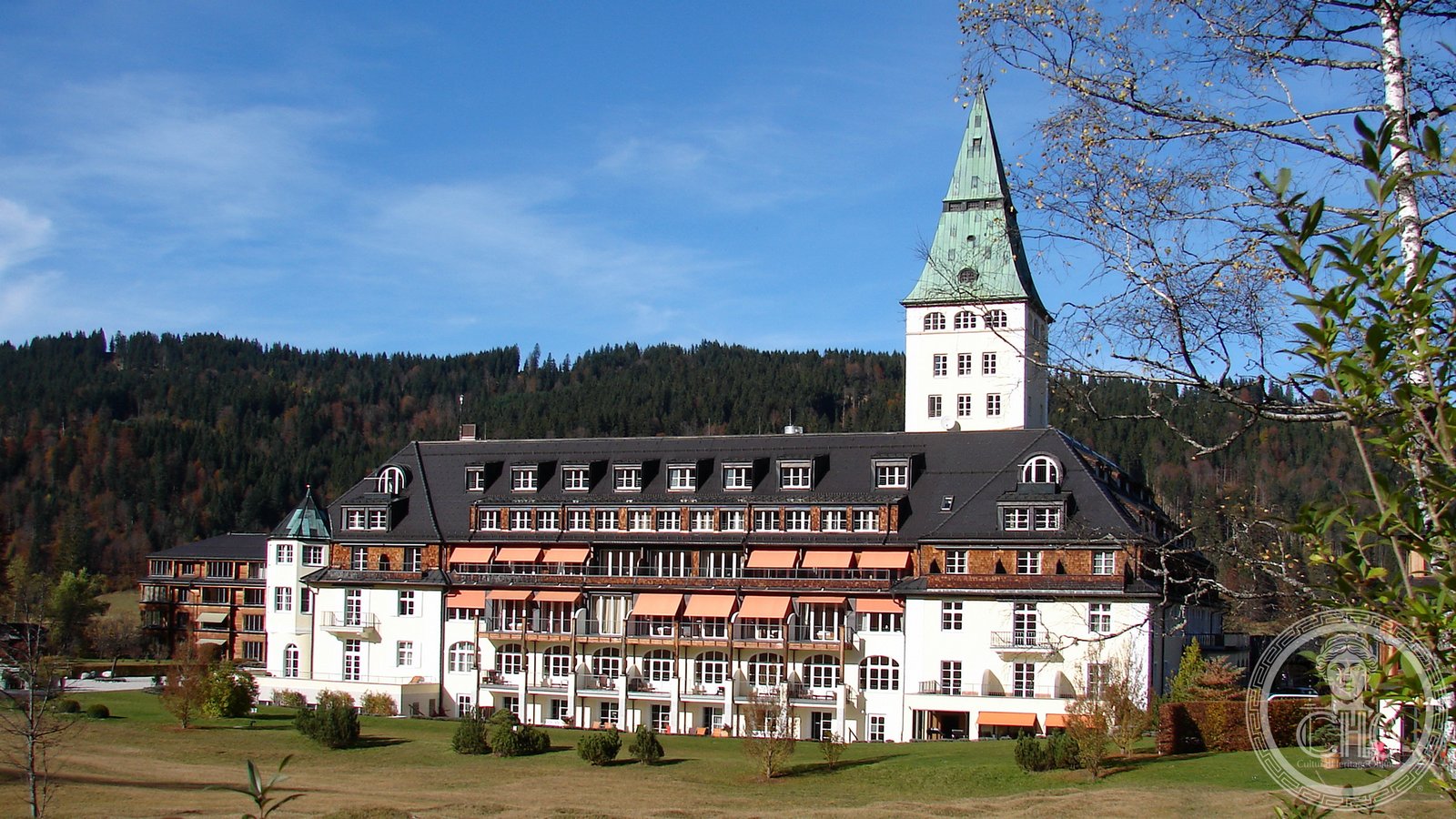
A philosopher’s retreat in the Bavarian Alps, built for music and contemplation in 1916 — later a home for camp survivors, a chamber-music shrine, and twice a G7 summit venue.
At a glance
Schloss Elmau lies in a high valley below the Wetterstein mountains, near Krün in Bavaria. Built during the First World War as a communal retreat, it has been many things — a cultural commune, a refuge, a concert hall — and is now a luxury spa and cultural hotel whose isolation has made it a favourite for world summits.
History
The castle was built between 1914 and 1916 by the philosopher and theologian Johannes Müller with the architect Carl Sattler, and opened at Pentecost 1916 as a retreat for communal living, music and intellectual exchange — monumental but plain, with 150 rooms and a concert hall. From 1947 it served, remarkably, as a home for displaced survivors of the concentration camps, run by the American Jewish Joint Distribution Committee.
From 1957 Elmau became renowned for chamber music, hosting the Amadeus Quartet, Benjamin Britten, Yehudi Menuhin and Alfred Brendel, and the writers’ group Gruppe 47. After a major fire in 2005 the landmarked building was rebuilt in 2007 by Müller’s grandson, Dietmar Mueller-Elmau, as a spa and cultural hideaway. It hosted the G7 summits of June 2015 and June 2022.
What you see
The house keeps Sattler’s monumental simplicity — a broad hipped roof, a tower and long corridors built around its concert hall — set against a backdrop of alpine peaks.
The 2007 rebuilding preserved the historic silhouette while adding the spas and pavilions of a modern resort.
Cultural significance
Elmau is a building with an unusually layered conscience: conceived as a utopian retreat, it became a shelter for the persecuted, then a temple of music, then a stage for global politics. Its story compresses the whole difficult twentieth century of Germany into one alpine valley.
Key facts
- Built: 1914–1916, by Johannes Müller with architect Carl Sattler
- 1947: home for displaced concentration-camp survivors
- Music: chamber-music centre from 1957 (Amadeus Quartet, Britten, Menuhin, Brendel)
- Rebuilt: 2007, after the 2005 fire, by Dietmar Mueller-Elmau
- Summits: hosted the G7 in 2015 and 2022
Practical information & getting there
Schloss Elmau is near Klais/Krün, between Garmisch-Partenkirchen and Mittenwald; the nearest station is Klais, on the Munich–Mittenwald line. It operates as a hotel; concerts are a regular part of its programme.
Sources & resources
- Schloss Elmau — A German History: schloss-elmau.de/en/hotels/history
- The German Government — The history of Schloss Elmau: bundesregierung.de
- Washington Post — “The wild history of the Bavarian castle hosting the G-7 summit”
- The Irish Times — “Schloss Elmau, the luxury Bavarian hotel with a complicated history”
Find it on the map
See this place and what’s around it →📷 Become a Cultural Heritage Online photographer
Share your photos of places: they stay published under your name as the author. The more they're seen, the more you get noticed — and soon a contest will reward the most appreciated photos.
Log in or sign up free to add a photoIs this page about you?
This page is read by travellers and heritage enthusiasts who find it on Google. Tell us how you are connected to this place and we will take it from there.