
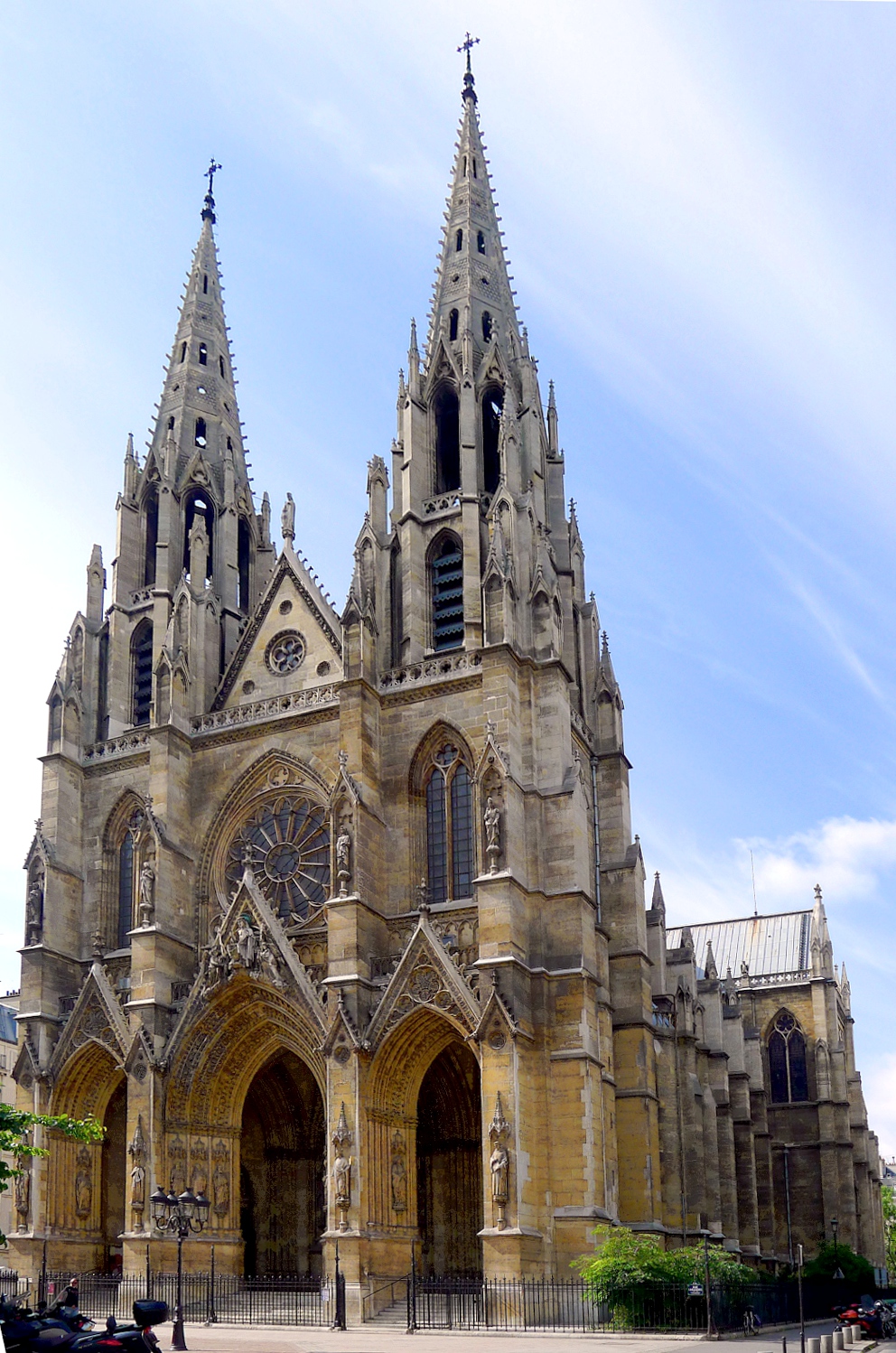
Paris’s pioneering neo-Gothic church, named for the queen who brought Christianity to the Franks, stands as an architectural threshold between revival and modernity.
At a glance
Built between 1846 and 1856 on the Rue Las Cases in the 7th arrondissement, Sainte-Clotilde was the first church in Paris to embrace the neo-Gothic style. Its twin spires and pointed arches marked a decisive moment in French architectural taste, and the church attracted major artistic talent—most notably the composer César Franck, who served as organist for thirty years.
History
The basilica takes its name from Saint Clotilde, the wife of King Clovis I, founder of the Frankish kingdom. According to tradition, Clotilde persuaded her husband to convert to Christianity as a condition of their marriage in 496, a union that would prove pivotal to the Christianization of Western Europe. The church’s construction in the mid-nineteenth century thus honored a figure central to French spiritual and political identity.
What you see
The basilica’s twin spires rise distinctly above the Paris streetscape, characteristic of the Gothic Revival aesthetic that dominated European church architecture of the era. Pointed arches, ribbed vaults, and ornamental stonework signal the style’s debt to medieval precedent, yet the execution and scale reflect nineteenth-century ambitions and engineering.
Cultural significance
Sainte-Clotilde stands as a watershed in Parisian taste. Its pioneering neo-Gothic language influenced subsequent ecclesiastical and civic architecture across the city. The church’s association with César Franck—one of France’s greatest composers—adds to its cultural resonance; visitors may reflect on the music that emerged from its organ bench during the Romantic era.
Key facts
- Location: Rue Las Cases, 7th arrondissement, Paris, France
- Coordinates: 48.858333° N, 2.319167° E
- Construction: 1846–1856
- Architectural style: Neo-Gothic
- Notable resident: Composer César Franck (organist for 30 years)
Practical information & getting there
Sainte-Clotilde is accessible by public transport in central Paris. The 7th arrondissement is well connected by Metro, bus, and the Seine’s Left Bank quays. Opening hours and visitor information are best confirmed through the parish office or official Paris tourism resources.
Sources & resources
Find it on the map
See this place and what’s around it →📷 Become a Cultural Heritage Online photographer
Share your photos of places: they stay published under your name as the author. The more they're seen, the more you get noticed — and soon a contest will reward the most appreciated photos.
Log in or sign up free to add a photoIs this page about you?
This page is read by travellers and heritage enthusiasts who find it on Google. Tell us how you are connected to this place and we will take it from there.