
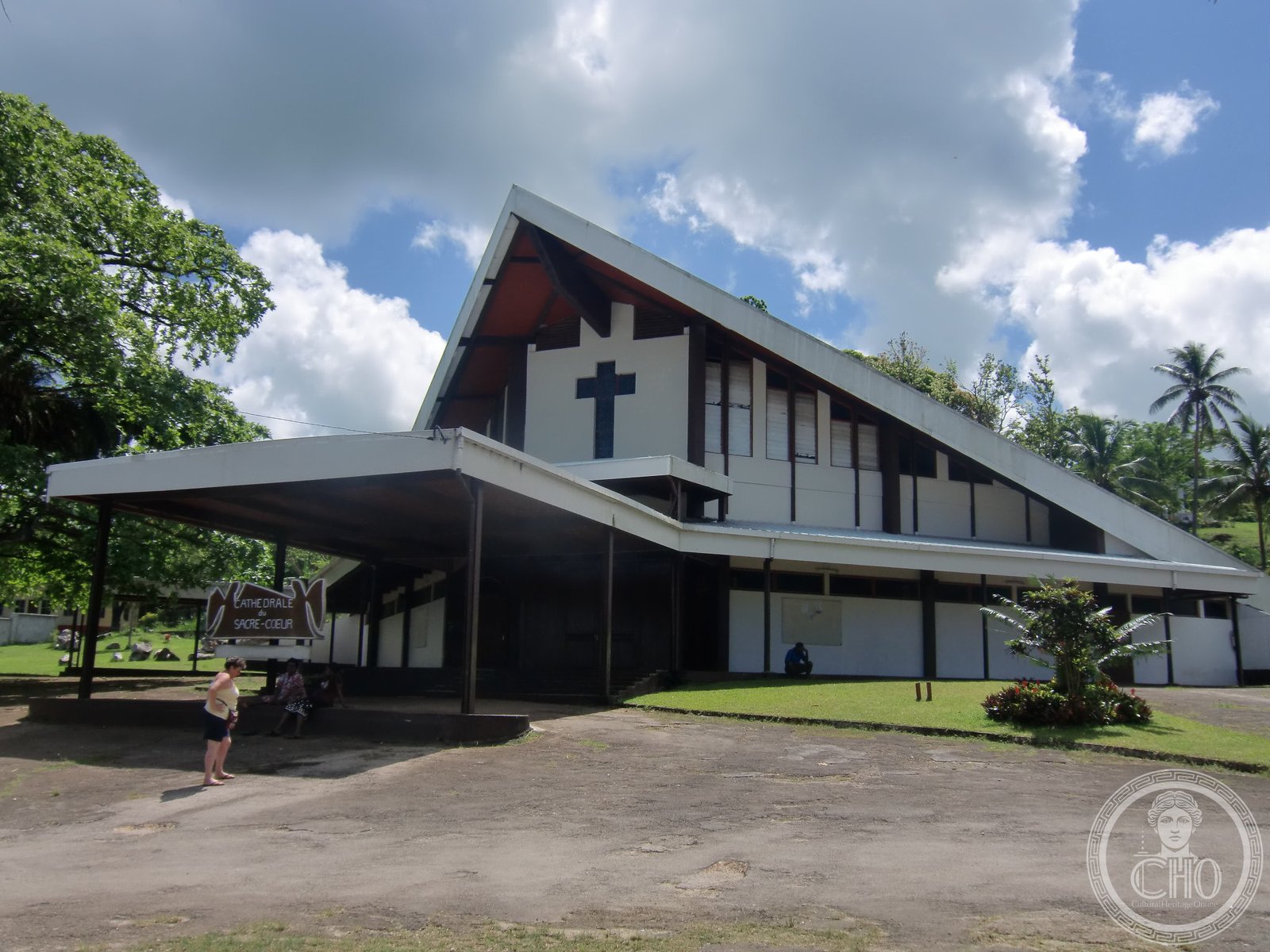
At Port Vila, capital of Vanuatu, the Sacred Heart Cathedral, a modern-style building, is the seat of the Catholic diocese of Port-Vila; neither the exact year of building or consecration, nor the name of an architect, nor the materials used are documented with certainty, though one unverified tourist source places its construction between the 1950s and 1960s. The first permanent Catholic mission in the New Hebrides was founded in 1887 at Mele, on the island of Efate, by Father Le Forestier and three other Marist missionaries; the circumscription was erected as the apostolic prefecture of the New Hebrides in 1901, with Isidore-Marie-Victor Douceré as first prefect, raised to an apostolic vicariate on 22 March 1904 and finally to the diocese of Port-Vila on 21 June 1966, by Pope Paul VI. The New Hebrides became an Anglo-French condominium in 1906, a dual colonial administration unique in the world, in which the French government supported the French-language Catholic missions while the British supported the English-language Protestant, Presbyterian and Anglican ones, a linguistic and cultural division that the sources say persists among ni-Vanuatu people to this day; no source, however, describes this cathedral specifically as the institutional symbol of the French and Catholic side of the condominium, a plausible but undocumented reading of the building itself. Among the bishops who have followed one another are Michel Visi, the first native ni-Vanuatu bishop, in office from 1996–97 to 2007, and the present bishop Jean Bosco Baremes, a Marist, installed on 18 November 2009; the diocese covers the whole of Vanuatu, suffragan to the archdiocese of Nouméa, in New Caledonia, with about 13% of the population Catholic according to a 2022 figure. No pope has ever visited Vanuatu or this cathedral: the Oceanian stops of John Paul II’s journeys took in Fiji and the Solomon Islands, while Pope Francis’s of 2024 took in Indonesia, Papua New Guinea, Timor-Leste and Singapore, not Vanuatu. Cyclone Pam, category 5, struck Port Vila on 13 March 2015, damaging by some estimates between 50 and 90% of the country’s homes, schools, churches and commercial buildings, with churches used as evacuation centres and the diocese setting up a disaster response committee; no source, however, confirms specific damage to this cathedral, either from Cyclone Pam or from the later Cyclone Harold of 2020, also category 5.
About Sacred Heart Cathedral
In Port Vila, the capital of Vanuatu, Sacred Heart Cathedral, a modern-style building, serves as the seat of the Roman Catholic Diocese of Port-Vila; no source confirms the exact year of construction or consecration, an architect’s name, or its building materials, though one unverified tourism source places its construction between the 1950s and 1960s. The first permanent Catholic mission in the New Hebrides was founded in 1887 at Mele, on Efate island, by Fr. Le Forestier and three other Marist missionaries; the jurisdiction was erected as the Apostolic Prefecture of the New Hebrides in 1901, elevated to an Apostolic Vicariate in 1904, and finally to the Diocese of Port-Vila on 21 June 1966 by Pope Paul VI.
Key facts
- 1887: the first permanent Catholic mission founded nearby at Mele, Efate
- 21 June 1966: elevated to the seat of the Diocese of Port-Vila
- 1906: the New Hebrides becomes a unique Anglo-French colonial condominium, splitting Catholic and Protestant missionary spheres along national lines
- 1996/97-2007: Michel Visi becomes the first native Ni-Vanuatu bishop
- No pope has ever visited Vanuatu or this cathedral
- 13 March 2015: Cyclone Pam devastates Port Vila, though no confirmed damage to the cathedral itself is documented
History
Rooted in a Marist mission founded in 1887, this cathedral became the seat of Vanuatu’s Catholic diocese in 1966, standing as the institutional heir to the French, Catholic half of one of colonial history’s stranger arrangements — the Anglo-French Condominium of the New Hebrides, which split the archipelago’s mission field, language, and schooling along national lines well into the 20th century. Despite Category 5 cyclones repeatedly battering Port Vila and no pope ever setting foot in Vanuatu, the cathedral’s own modern building history remains, remarkably, undocumented in any source found.
What you see
A modern-style cathedral with an angular roofline stands on Rue Bougainville in central Port Vila; beyond its general modern character, no documented source describes its specific architectural details, materials, or design history.
Practical information
- Opening hours: generally open daily outside services; check current hours before visiting
- Address: Rue Bougainville, Port Vila, Efate Island, Vanuatu
Getting there
The cathedral stands on Rue Bougainville in central Port Vila. GPS: 17°44′05″S, 168°18′55″E.
Nearby
- Christ Church, Tebakor — Port Vila’s Anglican parish church, with its own separate colonial-era history
Sources
- Wikipedia (English and French) — “Cathédrale du Sacré-Cœur, Port Vila” and “Roman Catholic Diocese of Port-Vila”
- Wikipedia — “History of Vanuatu” and “Catholic Church in Vanuatu”
- Caritas and Agenzia Fides — coverage of the Catholic Church’s response to Cyclone Pam, 2015
- Catholic-Hierarchy.org and GCatholic.org — Diocese of Port-Vila listings
Find it on the map
See this place and what’s around it →📷 Become a Cultural Heritage Online photographer
Share your photos of places: they stay published under your name as the author. The more they're seen, the more you get noticed — and soon a contest will reward the most appreciated photos.
Log in or sign up free to add a photo