
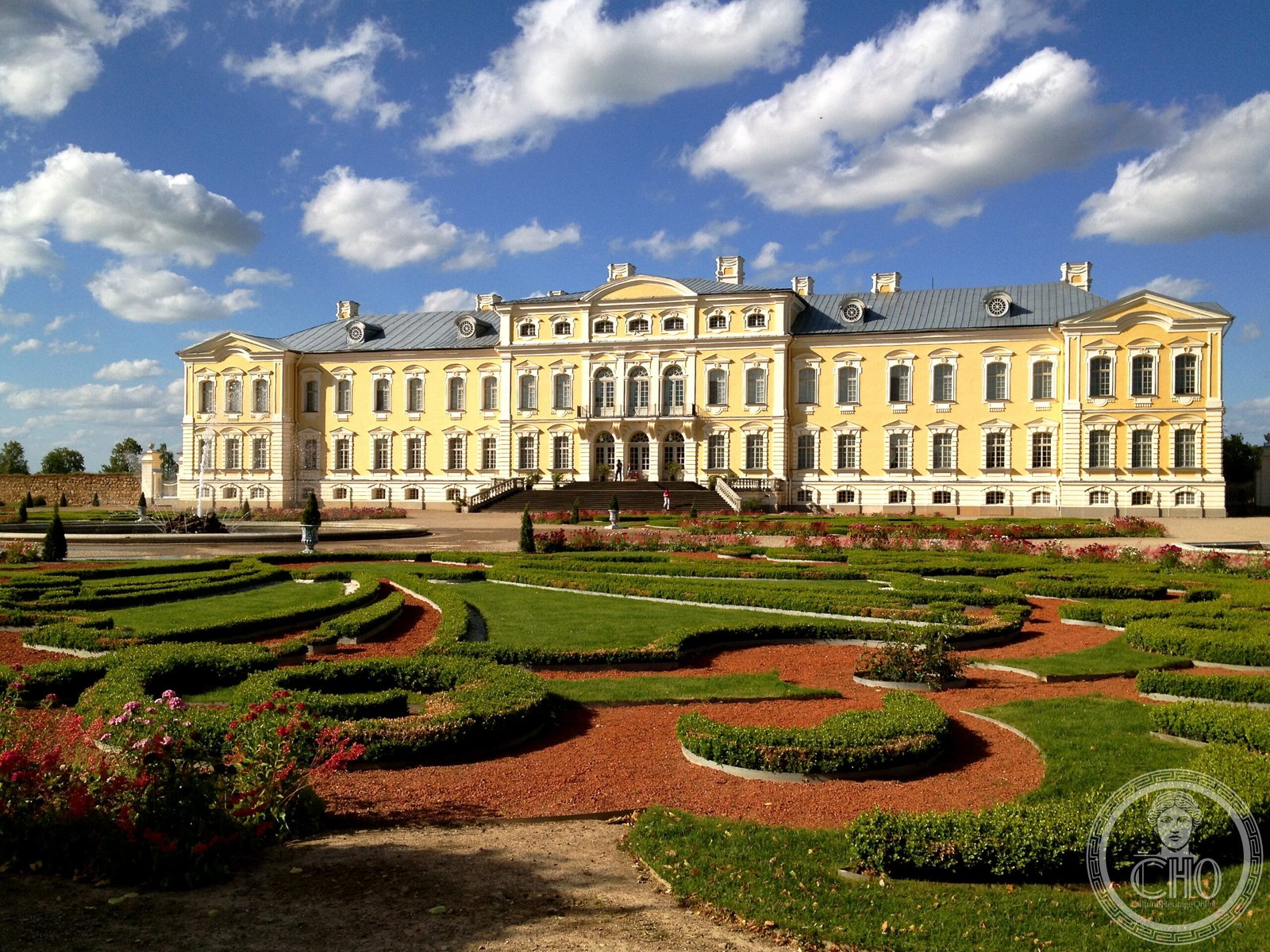
Rundāle Palace is an 18th-century Baroque and Rococo palace in Pilsrundāle, Latvia, designed by the Italian architect Bartolomeo Rastrelli for Ernst Johann von Biron, Duke of Courland and favourite of Empress Anna of Russia. Built between 1736 and 1740, with interior decoration completed in the 1760s, it is considered the finest example of Baroque architecture in the Baltic states and is sometimes called the Versailles of Latvia.
At a glance
- Type
- Baroque-Rococo palace and formal gardens
- Period
- Built in two campaigns: 1736–1740 and 1764–1770
- Style
- Baroque exterior, Rococo state rooms
- Location
- Pilsrundāle, Bauska Municipality, Latvia
- Architect
- Bartolomeo Rastrelli
- Coordinates
- 56.4133° N, 24.0248° E
Overview
Rundāle Palace was the summer residence of Ernst Johann von Biron, the most powerful man at the Russian imperial court during the reign of Empress Anna. Designed by Bartolomeo Rastrelli — the same architect who later created the Winter Palace in St Petersburg — the building displays the full vocabulary of high Baroque palatial architecture. Today it functions as a museum and is one of Latvia’s most visited cultural destinations.
History
Construction began in 1736 under Rastrelli’s direction, and the main palace structure was completed within four years. Work stopped after the palace coup of 20 November 1740, when Duke Ernst Johann was arrested and exiled. He was pardoned in 1762 and returned to Courland in January 1763; a second building campaign ran from 1764 to 1770. The stucco decoration of the state rooms was carried out between 1765 and 1768 by the Berlin sculptor Johann Michael Graff and his workshop, with ceiling paintings by the Italian painters Francesco Martini and Carlo Zucchi, both brought from Saint Petersburg. The palace passed through various owners after Courland was annexed by Russia in 1795, suffering damage during the Napoleonic Wars and later periods of neglect. A restoration programme began in 1972, when the Rundāle Palace Museum was founded, and is still under way: with the palace itself close to finished, the museum has been turning to the auxiliary buildings of the ensemble.
What you see
The palace ensemble comprises sixteen buildings with a total floor area of 14,249.2 m². Oak panelling was made for thirty-three rooms and sculptural decoration for twenty-seven. The Gold Hall — the central throne room — features gilded stucco reliefs, painted allegorical ceilings, and parquet floors typical of imperial Rococo interiors. The formal French garden was laid out alongside the palace between 1736 and 1740 and restored from a project drawn up in 1975–1977. Its rose garden holds 2,230 rose varieties, of which 600 are historical. A smaller Italian garden flanks the east wing.
Cultural significance
Rundāle Palace represents the westernmost reach of Russian imperial Baroque taste and stands as the primary monument of the Duchy of Courland’s cultural ambition. Its ongoing restoration — one of the largest heritage conservation projects in the Baltic states — has become an international model for recovering 18th-century decorative arts. Since 2021 the site has been on Latvia’s UNESCO Tentative List as the “Rundāle Palace Ensemble with a Garden and Forest Park”, a step towards a World Heritage nomination.
Practical information
- Address
- Pilsrundāle, Bauska Municipality, LV-3921, Latvia
- Hours
- Open daily; seasonal hours vary — check official website at rundale.net
- Admission
- Ticketed; combined palace + garden tickets available
Getting there
Rundāle Palace is located approximately 77 km south of Riga, near the town of Bauska. Regular bus services connect Riga’s Central Bus Station with Bauska (about 1 hour 20 minutes); local taxis or a short bicycle ride cover the remaining 12 km to the palace. Guided tours from Riga are widely available. Drivers follow the A7 highway towards Bauska, then follow signs to Pilsrundāle.
Sources & resources
- Rundāle Palace Museum — official site
- UNESCO World Heritage Centre — Tentative List entry
- Wikipedia — Rundale Palace
- Cultural Heritage Online — world heritage index
Find it on the map
See this place and what’s around it →📷 Become a Cultural Heritage Online photographer
Share your photos of places: they stay published under your name as the author. The more they're seen, the more you get noticed — and soon a contest will reward the most appreciated photos.
Log in or sign up free to add a photoIs this page about you?
This page is read by travellers and heritage enthusiasts who find it on Google. Tell us how you are connected to this place and we will take it from there.