
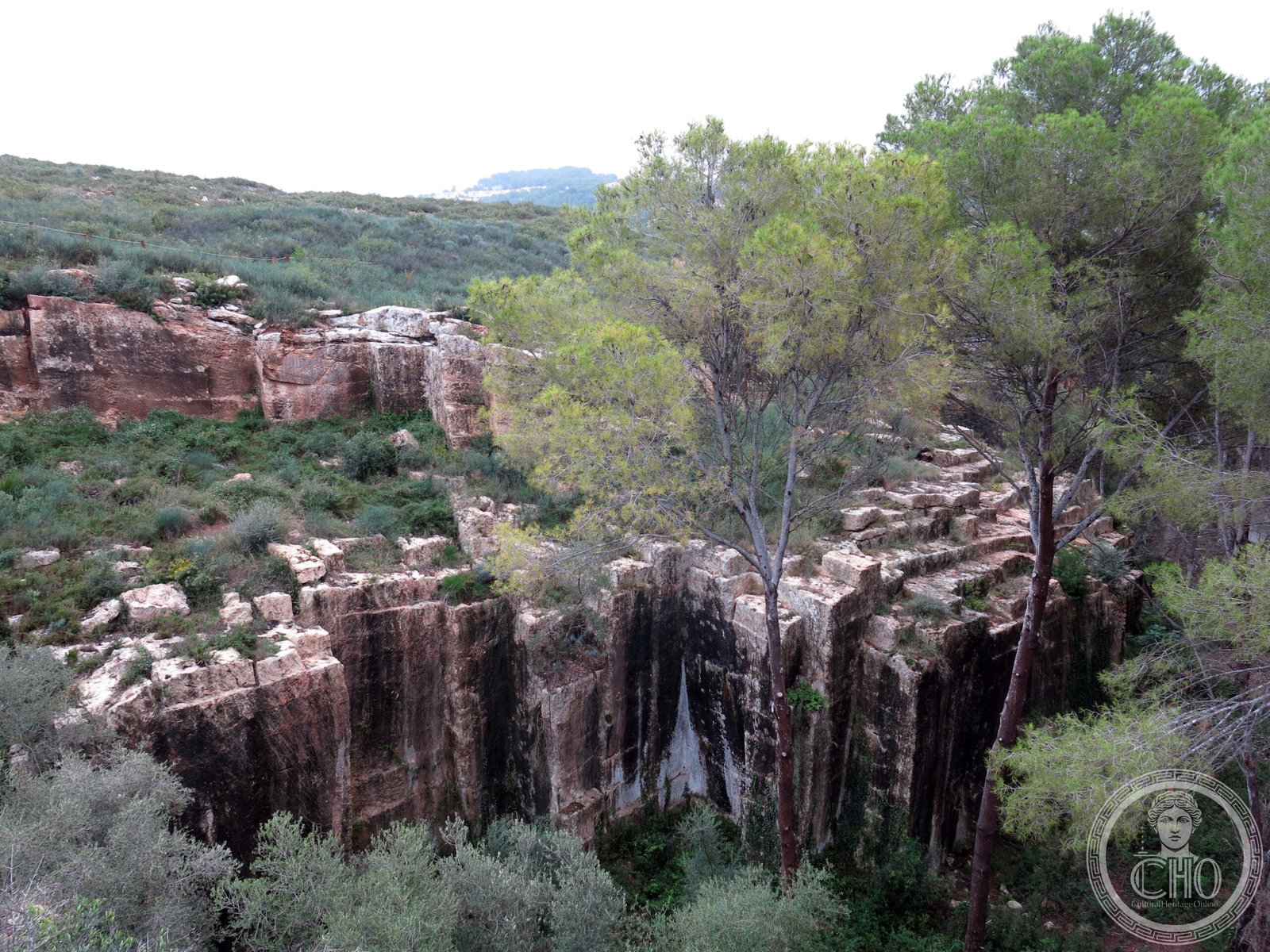
An ancient limestone extraction site that supplied stone for Tarraco’s greatest monuments, from temples to the medieval cathedral, leaving behind a dramatic landscape scarred by systematic Roman engineering.
At a glance
El Mèdol is the largest of six Roman quarries surrounding ancient Tarraco (modern Tarragona), capital of the province Hispania Citerior. Over 200 metres wide and 10–40 metres deep, it extracted roughly 50,000 cubic metres of “Soldo” Miocene limestone—stone ranging from white to pink with golden veining—transported along a 6-kilometre route to the city’s construction sites via the nearby Roman Via Augusta.
History
Quarrying began during the Roman Republic and continued through the Imperial period as Tarraco expanded into one of Hispania’s most important cities. The site’s proximity to the Via Augusta, a major imperial communication artery connecting Barcelona and Tarragona, made it an ideal source for the city’s building programme. Extraction continued into the medieval period, supplying limestone for structures including the Cathedral of Santa Tecla.
What you see
The quarry’s most distinctive feature is the “witness column”—a pillar of intact original rock left standing in the centre, a common marker in Roman extraction sites. The layered limestone faces reveal the systematic methods of removal. The pale stone, unsuitable for detailed architectural carving, served adequately for larger structural elements and ashlar facing throughout medieval Tarragona.
Cultural significance
El Mèdol demonstrates the vast infrastructure required to build and maintain an important Roman provincial city. It illuminates the practical economics of construction—quarrying, transport, and labour—that underpinned Tarraco’s monumental ambitions. The site connects directly to the Via Augusta, one of Rome’s most strategically important roads, showing how imperial logistics shaped settlement patterns and resource extraction across Hispania.
Key facts
- Location: Tarragona, Spain
- Coordinates: 41.137°N, 1.340°E
- Dimensions: Over 200m wide; 10–40m deep
- Stone type: “Soldo” Miocene limestone (white, pink, and golden tones)
- Volume extracted: Approximately 50,000 cubic metres
- UNESCO status: Included in the archaeological complex of Tarraco World Heritage Site
Practical information & getting there
The quarry is accessible from National Road 340 (which follows the route of the Roman Via Augusta between Barcelona and Tarragona) or from the AP-7 motorway via La Mora. It lies just 6 kilometres from Tarragona’s ancient centre, making it easily reached from the city by car or, with advance planning, by local transport.
Sources & resources
- Roman quarry of El Mèdol – Wikipedia
- Cultural Heritage Online
Find it on the map
See this place and what’s around it →📷 Become a Cultural Heritage Online photographer
Share your photos of places: they stay published under your name as the author. The more they're seen, the more you get noticed — and soon a contest will reward the most appreciated photos.
Log in or sign up free to add a photoDo you manage this place?
This page is read by travellers and heritage enthusiasts who find it on Google. Keep it accurate — and make it work for you. Free for non-profit heritage institutions.