

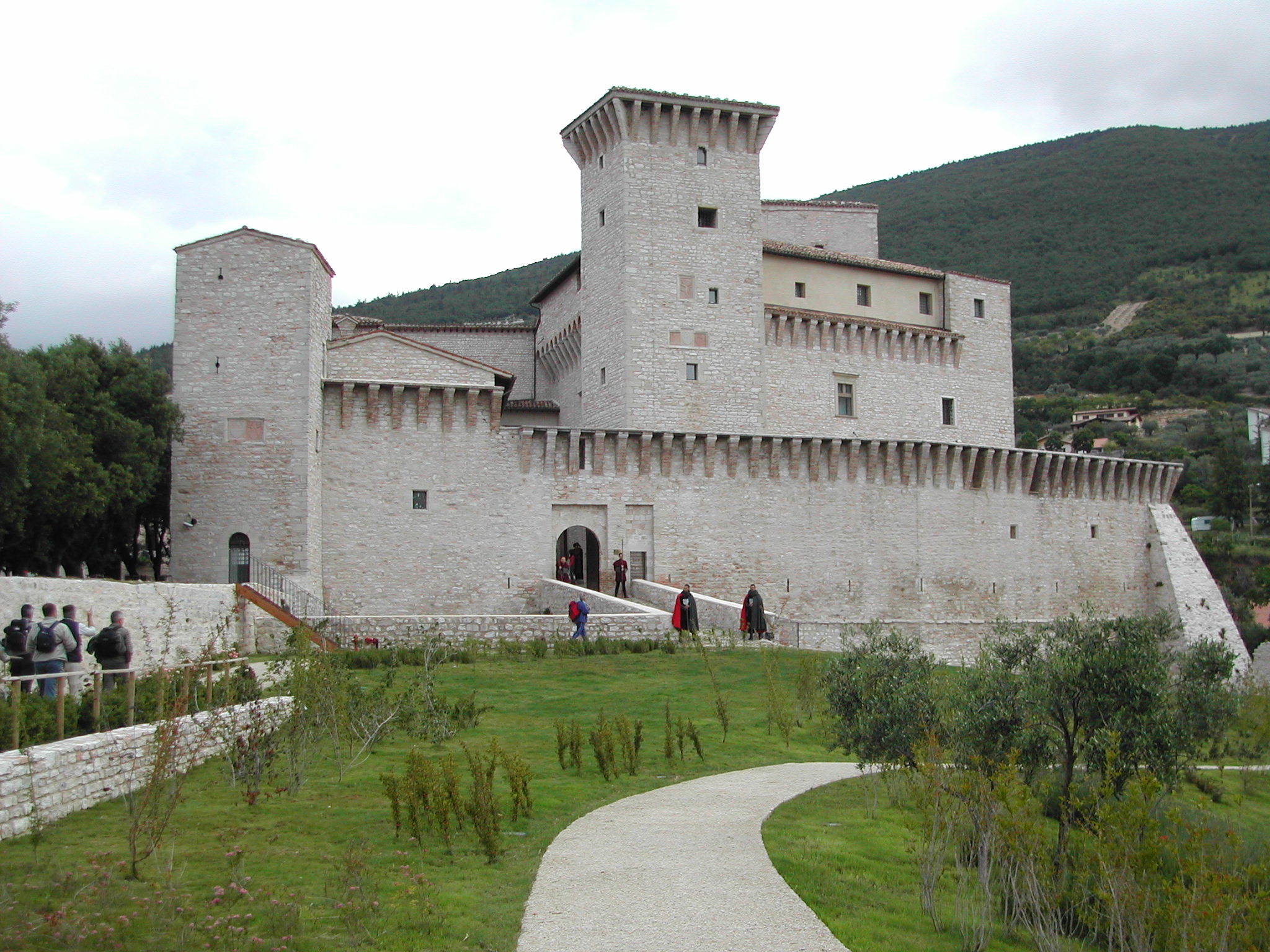
Rocca Flea is a fortified palace in Gualdo Tadino, Umbria, central Italy, located in the upper part of the hill on which the town lies, at coordinates 43.233° N, 12.789° E. The complex is one of the best-preserved examples of medieval military architecture in inland Umbria, dominating the surrounding valley with its towers and defensive walls, and today serves as the principal civic museum of Gualdo Tadino.
At a glance
- Type
- Fortified palace (rocca)
- Period
- Medieval, with subsequent restorations (11th–14th century)
- Style
- Central Italian military architecture
- Location
- Gualdo Tadino, Province of Perugia, Umbria
- Coordinates
- 43.2330° N, 12.7885° E
Overview
Rocca Flea stands on the highest point of Gualdo Tadino, a medieval hill town that grew along the ancient Via Flaminia connecting Rome to Rimini. The fortification’s commanding position allowed it to survey the Appennine passes and the Casentino valley below. Today the rocca houses a significant archaeological and ceramic collection, making it simultaneously a monument of military heritage and a repository of Umbrian artistic production across the centuries.
History
The origins of Rocca Flea are linked to early medieval fortification of the hill above Gualdo Tadino, a strategic point controlling routes through the central Apennines. The complex was expanded and reinforced during the communal period of the 12th and 13th centuries, when Gualdo Tadino allied variously with Assisi, Perugia, and the Holy Roman Empire. The name derives from the nearby river Flebeo, later called Feo, and appears in documents from the twelfth century. Like many Umbrian ròcche, the structure passed through Papal, Perugian, and communal control before becoming civic property in the modern era.
What you see
Visitors enter through the original gateway into a walled compound formed by residential towers, curtain walls, and an inner courtyard. The interiors house the Museo Civico di Gualdo Tadino, which displays prehistoric and Roman finds from the surrounding territory alongside an important collection of Umbrian Renaissance maiolica — the local ceramic tradition that flourished in Gualdo Tadino from the 15th century onward. The panoramic views from the rocca’s towers over the Topino valley and the Apennine ridge are among the finest in inland Umbria.
Cultural significance
Rocca Flea is the principal monument of Gualdo Tadino and an important node in the network of medieval fortifications that punctuate the Umbrian Apennines. Its ceramic collection preserves a significant chapter in the history of Italian decorative arts, documenting a local tradition that distinguished Gualdo Tadino’s workshops from the better-known centres of Deruta and Faenza.
Practical information
- Address
- Via della Rocca, Gualdo Tadino, Province of Perugia, Umbria
- Museum
- Museo Civico di Gualdo Tadino — archaeological and ceramic collections
Getting there
Gualdo Tadino is served by the FCU (Ferrovia Centrale Umbra) rail line connecting Perugia to Sansepolcro; the station is at the foot of the hill. By car, take the E45 superstrada and exit at Gualdo Tadino. The rocca is a short uphill walk from the town centre. Perugia and Assisi are approximately 40 kilometres to the south-west.
Sources & resources
Museo Civico Rocca Flea — Polo Museale Città di Gualdo Tadino
See the place
In the 16th century the rocca became the residence of the papal legates; in 1888 it was turned into the city prison, and since 1999 it has housed the Museo Civico.
Find it on the map
See this place and what’s around it →
Advertisement. Pictured, from the Cleveland Museum of Art (CC0) and not for sale: a parure of about 1850, a Lalique brooch, a Castellani bangle. How we handle this
📷 Become a Cultural Heritage Online photographer
Share your photos of places: they stay published under your name as the author. The more they're seen, the more you get noticed — and soon a contest will reward the most appreciated photos.
Log in or sign up free to add a photo