

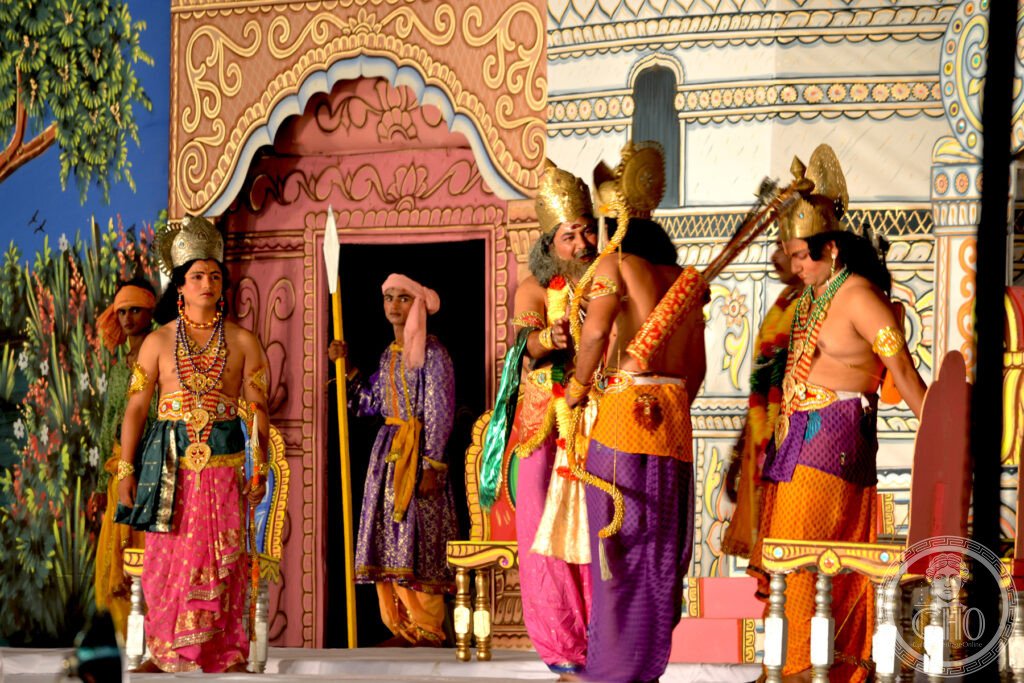
A dramatic folk re-enactment of the life of Rama from the ancient Hindu epic Ramayana, staged annually during Navaratri by local communities across India and the global diaspora.
In UNESCO’s words
Ramlila, literally “Rama’s play”, is a performance of then Ramayana epic in a series of scenes that include song, narration, recital and dialogue. It is performed across northern India during the festival of Dussehra, held each year according to the ritual calendar in autumn. The most representative Ramlilas are those of Ayodhya, Ramnagar and Benares, Vrindavan, Almora, Sattna and Madhubani. This staging of the Ramayana is based on the Ramacharitmanas, one of the most popular storytelling forms in the north of the country. This sacred text devoted to the glory of Rama, the hero of the Ramayana, was composed by Tulsidas in the sixteenth century in a form of Hindi in order to make the Sanskrit epic available to all. The majority of the Ramlilas recount episodes from the Ramacharitmanas through a series of performances lasting ten to twelve days, but some, such as Ramnagar’s, may last an entire month. Festivals are organized in hundreds of settlements, towns and villages during the Dussehra festival season celebrating Rama’s return from exile. Ramlila recalls the battle between Rama and Ravana and consists of a series of dialogues between gods, sages and the faithful. Ramlila’s dramatic force stems from the succession of icons representing the climax of each scene. The audience is invited to sing and take part in the narration. The Ramlila brings the whole population together, without distinction of caste, religion or age. All the villagers participate spontaneously, playing roles or taking part in a variety of related activities, such as mask- and costume making, and preparing make-up, effigies and lights. However, the development of mass media, particularly television soap operas, is leading to a reduction in the audience of the Ramlila plays, which are therefore losing their principal role of bringing people and communities together.
Official description, UNESCO Intangible Cultural Heritage List — Ramlila, the traditional performance of the Ramayana
At a glance
Ramlila, literally 'Rama's play', is a performance of the Ramayana epic staged as a series of scenes combining song, narration, recital and dialogue. Performed across northern India during the autumn festival of Dussehra, it brings together the whole population without distinction of caste, religion or age. The audience participates by singing and taking part in the narration, while all villagers spontaneously contribute by playing roles or engaging in related activities such as mask- and costume-making, preparing make-up, effigies and lights.
Origins & history
Ramlila is based on the Ramcharitmanas, a sacred text composed by Tulsidas in the sixteenth century. Tulsidas wrote this work in a form of Hindi to make the Sanskrit epic of the Ramayana accessible to all. The most representative Ramlilas are those of Ayodhya, Ramnagar, Benares, Vrindavan, Almora, Sattna and Madhubani.
The practice
Most Ramlilas present episodes from the Ramcharitmanas through performances lasting ten to twelve days, though some, such as Ramnagar's, extend for an entire month. The dramatic force stems from a succession of icons representing the climax of each scene. Ramlila consists of dialogues between gods, sages and the faithful, and recalls the battle between Rama and Ravana. Festivals are organized in hundreds of settlements, towns and villages during the Dussehra festival season.
Cultural significance
Ramlila plays a vital role in bringing people and communities together. However, the development of mass media, particularly television soap operas, is reducing audiences for Ramlila performances and diminishing their principal function as a unifying community experience.
Key facts
- Country: India
- Inscribed: 2008
- UNESCO list: Representative List of the Intangible Cultural Heritage of Humanity
- UNESCO reference: 00110
- UNESCO vocabulary: Epic poetry; Theatre
- Map: Ayodhya — the locality named in UNESCO’s official description of this element
Where to experience it
Ramlila performances flourish across northern India during the autumn festival of Dussehra, with the most representative versions staged in Ayodhya, Ramnagar, Benares, Vrindavan, Almora, Sattna and Madhubani. These sacred dramas, lasting ten to twelve days or sometimes an entire month, transform hundreds of settlements, towns and villages into performance spaces where the entire population gathers regardless of caste, religion or age. Audiences participate actively in the narration, while villagers contribute spontaneously through roles, mask- and costume-making, and preparation of effigies and lights. Visitors during Dussehra can witness how these performances keep communities together through the dramatic retelling of Rama's victory over Ravana.
Sources & resources
- UNESCO — official element page: Ramlila, the traditional performance of the Ramayana
- UNESCO — open data record: Intangible Heritage List, reference 00110
- UNESCO — official video: UNESCO film on this element — embedded on this page
- UNESCO — official photograph: Performed in hundreds of towns and villages across northern India, the Ramlila celebrates Rama, the hero of the Ramayana epic. The audience plays a pivotal role in these collective events by assisting the actors to get prepared, and by their singing and spontaneous acting. — Sangeet Natak Akademi, New Delhi
- Reference — Wikipedia (secondary): Ramlila — consulted as a secondary reference, not as confirmation
- Cultural Heritage Online: Our archive and city guides

Find it on the map
See this place and what’s around it →📷 Become a Cultural Heritage Online photographer
Share your photos of places: they stay published under your name as the author. The more they're seen, the more you get noticed — and soon a contest will reward the most appreciated photos.
Log in or sign up free to add a photo