

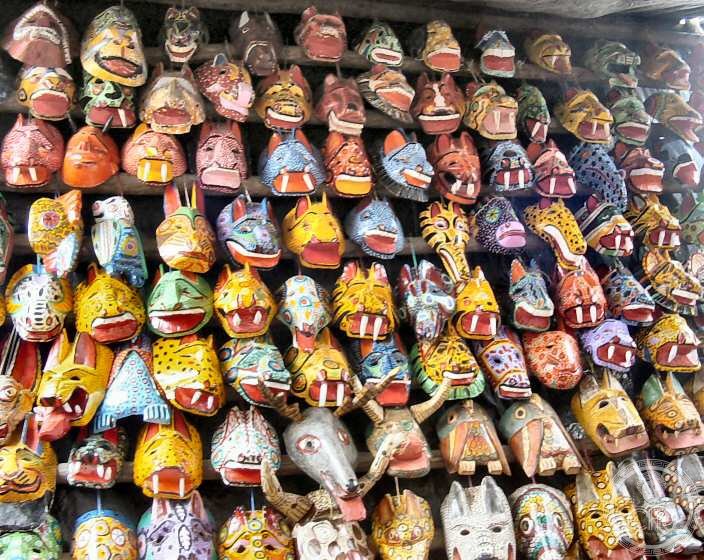
A K’iche’ Maya song-dance-drama performed annually in Rabinal since before Spanish colonization, blending movement, music, and masked performance to tell of conflict between neighboring cities.
In UNESCO’s words
The Rabinal Achí is a dynastic Maya drama, which developed in the fifteenth century and a rare example of preserved pre-Hispanic traditions. It comprises myths of origin and addresses popular and political subjects concerning the inhabitants of the region of Rabinal, expressed through masked dance, theatre and music. The oral and written narrative is presented by a group of characters, who appear on a stage representing Maya villages, such as Kajyub’, the regional capital of the Rabinaleb’ in the fourteenth century. The narrative, divided into four acts, centres on a conflict between two major political entities in the region. The main characters are two princes, the Rabinal Achí and the K’iche Achí.The other characters are the king of Rabinaleb’, Job’Toj, and his servant, Achij Mun Achij Mun Ixoq Mun, who has both male and female traits, the green-feathered mother, Uchuch Q’uq’ Uchuch Raxon, and thirteen eagles and thirteen jaguars who represent the warriors of the fortress of Kajyub’. K’iche’ Achí is captured and put on trial for attempting to steal Rabinaleb’ children, a grave violation of Maya law. Since colonization in the sixteenth century, the Rabinal Achí dance has been performed on Saint Paul’s day on 25 January. The festival is coordinated by members of cofradías, local brotherhoods responsible for running the community. By taking part in the dance, the living enter into “contact” with the dead, the rajawales, represented by masks. Recalling their ancestors is not simply a means of perpetuating the heritage of the past. It is also a vision of the future, since one day the living will join their ancestors. The impact of armed conflict especially in the departamentos of Rabinal and K’iche has almost led to the disappearance of this dance. Today, it is especially threatened by the precarious economic state of the custodians and the community as a whole. It is also confronted with folklorization and trivialization, which seriously threaten the transmission of knowledge and values associated to the performance of this drama tradition.
Official description, UNESCO Intangible Cultural Heritage List — Rabinal Achí dance drama tradition
At a glance
The Rabinal Achí is a Maya drama that developed in the fifteenth century and stands as a rare surviving example of pre-Hispanic tradition. Combining masked dance, theatre, and music, it presents myths of origin and addresses popular and political subjects through the stories of its main characters: two princes, the Rabinal Achí and the K'iche Achí, along with a king, servants, and warriors represented by eagles and jaguars. The narrative unfolds across four acts, centring on conflict between two major political entities in the region.
Origins & history
The tradition emerged in the fifteenth century as a dynastic Maya drama. Since colonization in the sixteenth century, the Rabinal Achí has been performed annually on Saint Paul's day, 25 January. The festival is coordinated by members of cofradías, local brotherhoods responsible for running the community. Through this long performance history, the work has remained a connection between the living and the dead, represented by masks worn during the drama.
The practice
The performance takes place on a stage representing Maya villages, with the regional capital Kajyub' at its centre. Masked performers embody characters including princes, a king, servants with both male and female traits, and thirteen eagles and thirteen jaguars representing fortress warriors. The drama is presented as an oral and written narrative divided into four acts. By wearing masks of the rajawales, or ancestors, living performers enter into contact with the dead during the performance.
Cultural significance
For the community, performing the Rabinal Achí connects the living with their ancestors and offers a vision of the future, since one day the living will join those they remember. The tradition transmits knowledge and values central to Maya identity. Today the drama faces serious threats: armed conflict has nearly led to its disappearance, while economic hardship among custodians and the community endangers its continuation. Folklorization and trivialization also threaten the transmission of its associated knowledge and values.
Key facts
- Country: Guatemala
- Inscribed: 2008
- UNESCO list: Representative List of the Intangible Cultural Heritage of Humanity
- UNESCO reference: 00144
- UNESCO vocabulary: Dance; Masks; Theatre
- Map: Rabinal — the locality named in UNESCO’s official description of this element
Where to experience it
The Rabinal Achí is performed in the region of Rabinal, where members of local cofradías coordinate the annual presentation on Saint Paul's day, January 25. On this occasion, the community gathers to enact the four-act drama featuring masked dancers who represent Maya princes, kings, and warriors. Through this performance, participants enter into contact with their ancestors, the rajawales, whose presence is embodied in the masks—a practice that connects the living with the dead and affirms continuity with Maya heritage and the future.
Sources & resources
- UNESCO — official element page: Rabinal Achí dance drama tradition
- UNESCO — open data record: Intangible Heritage List, reference 00144
- UNESCO — official video: UNESCO film on this element — embedded on this page
- UNESCO — official photograph: Photograph of this element — Gonzalo Martin Astuzias — Ministerio de Cultura y Deportes / GMA PRO
- Reference — Wikipedia (secondary): Rabinal Ach%C3%AD — consulted as a secondary reference, not as confirmation
- Cultural Heritage Online: Our archive and city guides

Find it on the map
See this place and what’s around it →📷 Become a Cultural Heritage Online photographer
Share your photos of places: they stay published under your name as the author. The more they're seen, the more you get noticed — and soon a contest will reward the most appreciated photos.
Log in or sign up free to add a photo