
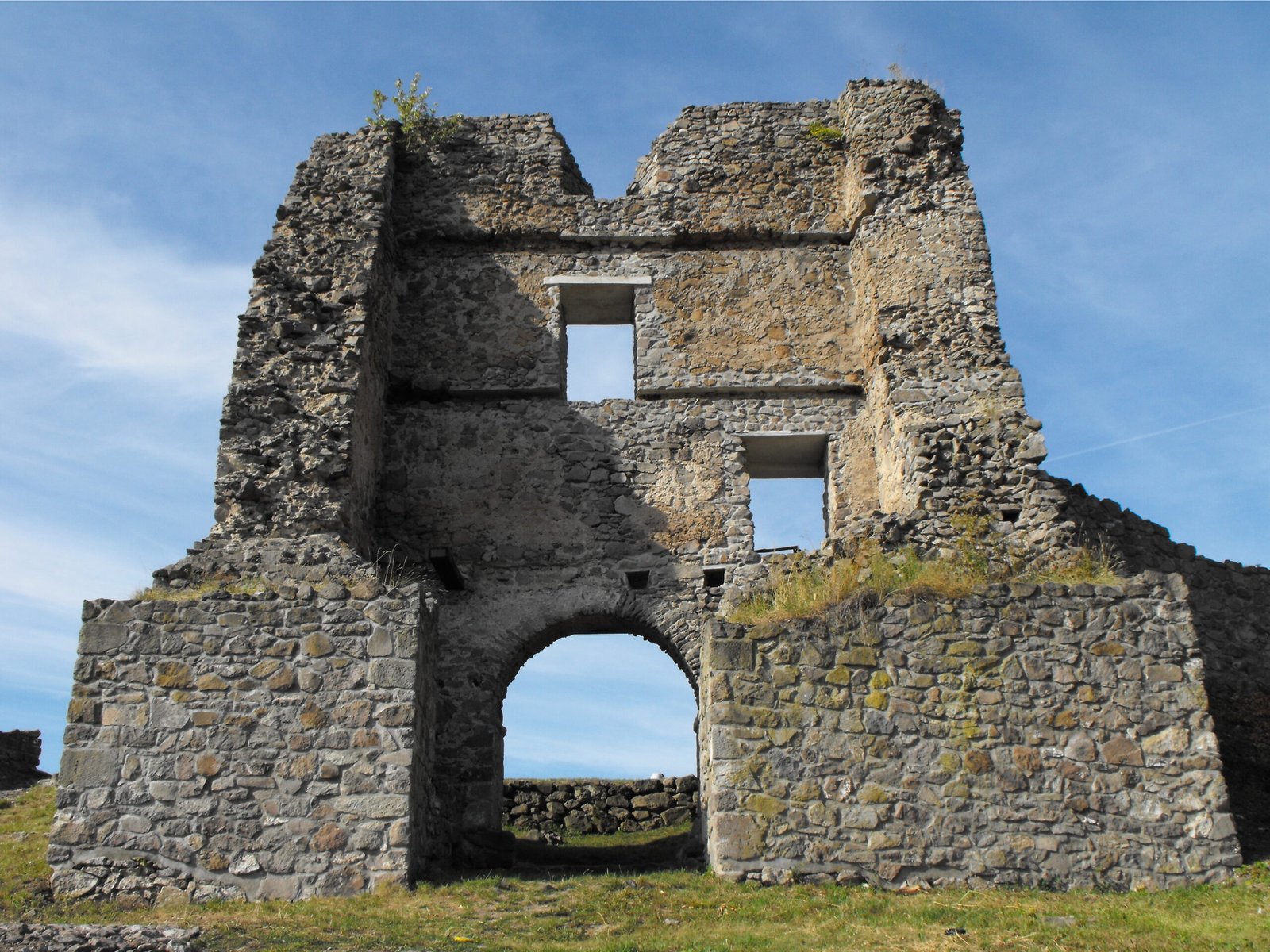
The ruins of one of medieval Europe’s largest castles sprawl across a forested hill above the Hron River, their massive stone walls bearing witness to nine centuries of frontier warfare, royal ambition, and dynastic power.
At a glance
Pustý hrad covers 76,000 m² across two fortified compounds—the Upper Castle and Lower Castle—positioned on a strategic hilltop that dominated central Slovakia. Originally called Zvolen Castle or Old Zvolen, it served as the regional seat of Zólyom County within the Kingdom of Hungary before its destruction by fire in 1452.
History
Human settlement on this hill dates to the late Stone Age (Baden culture), followed by Bronze and Iron Age occupation. The medieval castle was founded in the 9th century as a Slavic stronghold.
King Béla III of Hungary ordered the construction of the original stone keep in the 12th century, positioned at 571 m elevation. A century later, as Mongol invasions threatened the region, royal stonemason master Bertold oversaw an unprecedented expansion: both castle compounds were surrounded by massive fortifications and a 206-metre defensive wall was built in the saddle between them.
The 14th century brought significant development under the Balassa family. Count Doncs, a noble warrior-diplomat serving Charles I of Hungary, expanded the Lower Castle with Gothic-style buildings inspired by his travels to France. A four-storey tower was added to the Upper Castle’s entrance gate, and the northern section became known as Doncs’ Castle.
The castle declined after the 15th-century conflicts between John Hunyadi and John Jiskra of Brandýs. Fire destroyed much of Pustý hrad during a 1452 siege, probably set by Hunyadi’s troops. A watchtower erected in the 16th century was the last major structure built on the site.
What you see
The Upper Castle’s 12th-century keep once reached 50 meters high, dominating the hilltop. The Lower Castle contained a 20-by-20-metre residential tower—among Central Europe’s largest domestic buildings of its era—alongside a palace, water tank, and terraced courtyard.
Excavations since 1992 have revealed successive phases of construction and destruction. Prehistoric finds include Lusatian bronze treasures, Kyjatice pottery fragments, and Roman imports, layered beneath medieval foundations. The saddle wall and fortification systems demonstrate sophisticated 13th-century military engineering.
Cultural significance
Pustý hrad illustrates the shift from early medieval strongholds to sophisticated feudal administrative centers. Its scale reflects the strategic importance of controlling Slovakia’s river valleys during the Hungarian kingdom’s expansion and defence against external threats.
The castle’s archaeological layers document continuity from prehistoric settlement through Roman trade networks to medieval statecraft—a compressed history of Central European power and settlement patterns.
Key facts
- Location: Southern Zvolen, central Slovakia
- Coordinates: 48.5569° N, 19.1097° E
- Area: 76,000 m² (Upper Castle 3.5 ha; Lower Castle 0.65 ha)
- Founded: 9th century (Slavic period); major stone construction 12th–14th centuries
- Destroyed: 1452 (fire during siege)
- Keep elevation: 571 m above sea level
Practical information & getting there
Pustý hrad is located on a forested hill in the southern part of Zvolen. Recent reconstructions and excavations (ongoing since 1992) have made the site easily accessible. You can reach it from central Zvolen; local tourism information can provide current access details and opening hours.
Sources & resources
Find it on the map
See this place and what’s around it →📷 Become a Cultural Heritage Online photographer
Share your photos of places: they stay published under your name as the author. The more they're seen, the more you get noticed — and soon a contest will reward the most appreciated photos.
Log in or sign up free to add a photoIs this page about you?
This page is read by travellers and heritage enthusiasts who find it on Google. Tell us how you are connected to this place and we will take it from there.