
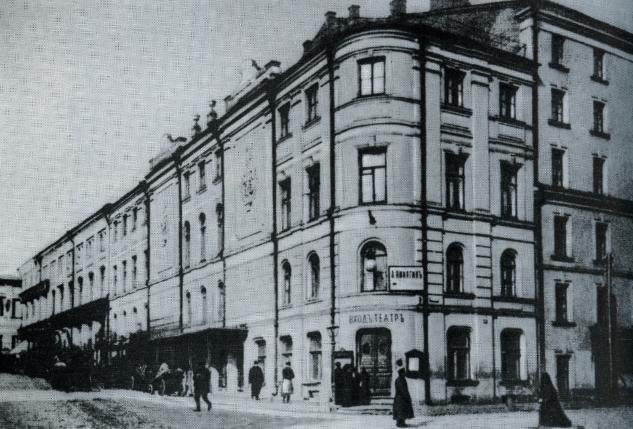
Founded in 1885 by the industrialist Savva Mamontov, this private operatic enterprise reshaped Russian musical theatre from a country estate north of Moscow to the stages of the capital itself.
At a glance
The Private Opera was not a building but a company, one that moved between venues as its fortunes shifted. It began at the Abramtsevo estate, later settling into Moscow’s Solodovnikov Theatre and then the Paradis, a house still standing today as the Mayakovsky Theater.
History
Mamontov organised the troupe himself. He staged the operas, conducted the orchestra, and trained singers, paying every expense from his own pocket. The company’s first Moscow home was the Solodovnikov Theatre on Bolshaya Dmitrovskaya street, built in 1894–1895 by the merchant and patron Gavrila Solodovnikov. That building later burned. The company then relocated to the Paradis theatre at 19/13 Bolshaya Nikitskaya Street. In 1899 Mamontov was arrested on embezzlement charges tied to the Yaroslavl railway, an accusation the historical record treats as unjust. Without him, the enterprise carried on under a new name, the Private Opera Society, until 1904.
What you see
No single structure defines the Private Opera; its architecture is really a sequence of borrowed and purpose-built stages. The Solodovnikov Theatre offered the company its first proper Moscow house before fire ended that chapter. Mamontov later assembled land across from Theatre Square for a far grander scheme, a civic center pairing an opera hall with a luxury hotel, and appointed the architect William Walcot to lead it. The arrest halted his involvement, and the site was finished without a theatre at all, becoming instead the Hotel Metropol under the Petersburg Insurance Company.
Cultural significance
Few private ventures left so deep a mark on Russian opera. The company premiered a run of Rimsky-Korsakov works, among them Sadko, Mozart and Salieri, Boyarinya Vera Sheloga, The Tsar’s Bride, The Tale of Tsar Saltan, and Kashchey the Immortal. It also staged Mussorgsky’s Khovanshchina and Boris Godunov, alongside Glinka, Borodin, Serov, Tchaikovsky, and Rubinstein. These were not safe revivals. Many pieces were new, untested, and championed by Mamontov when the imperial theatres showed little interest. The venue’s association with figures like Chaliapin and Rachmaninoff, noted in period accounts, cemented its reputation as a laboratory for modern Russian stagecraft.
Key facts
- Founded: 1885, by Savva Mamontov
- Original base: Abramtsevo Estate, near Moscow
- Moscow venues: Solodovnikov Theatre (1894–1895), later the Paradis theatre
- Present-day site: Mayakovsky Theater, 19/13 Bolshaya Nikitskaya Street
- World premieres included works by Rimsky-Korsakov and other Russian composers
- Renamed Private Opera Society, 1899–1904
Practical information & getting there
The company itself no longer exists, but its Moscow trail is walkable. The former Paradis theatre survives on Bolshaya Nikitskaya Street as the Mayakovsky Theater, near coordinates 55.7606, 37.6492. You can also visit the site of the Solodovnikov Theatre on Bolshaya Dmitrovka, though the original building is gone. Central Moscow’s metro network puts both locations within easy reach of Theatre Square.
Sources & resources
Find it on the map
See this place and what’s around it →📷 Become a Cultural Heritage Online photographer
Share your photos of places: they stay published under your name as the author. The more they're seen, the more you get noticed — and soon a contest will reward the most appreciated photos.
Log in or sign up free to add a photoIs this page about you?
This page is read by travellers and heritage enthusiasts who find it on Google. Tell us how you are connected to this place and we will take it from there.