
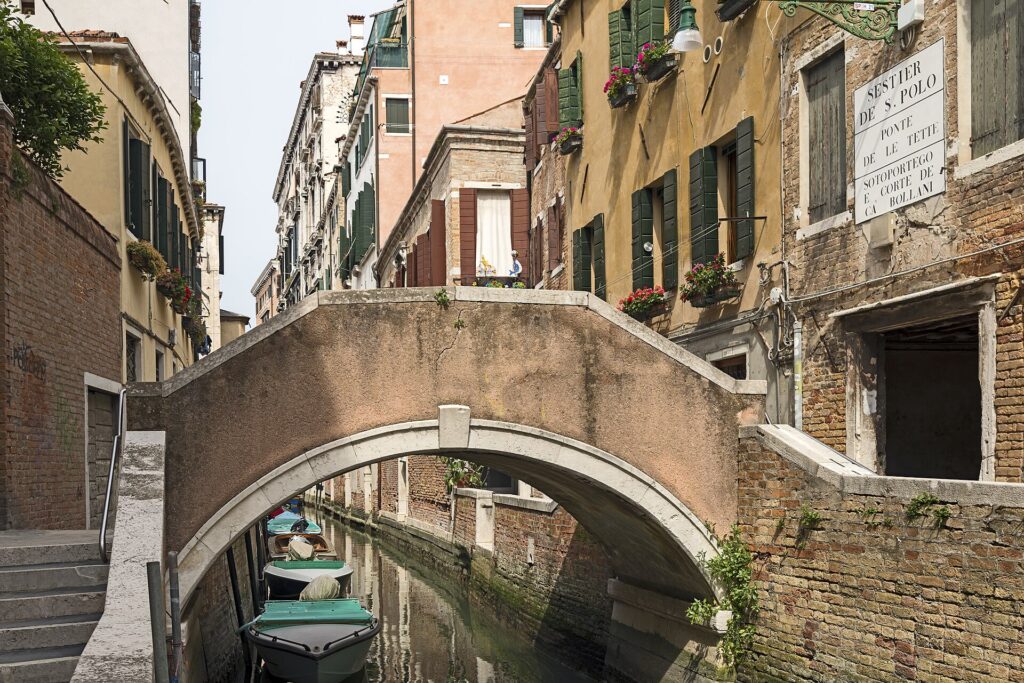
A small bridge over the Rio de San Cassan, with a street sign that tourists photograph and few translate. It marks the boundary of the quarter to which the Republic confined its registered prostitutes.
At a glance
The bridge joins the Fondamenta de la Stua, in Santa Croce, to the Fondamenta de le Tette, in San Polo. In the late fourteenth century the authorities moved the women registered as prostitutes out of San Matteo di Rialto and into this district, chosen because it stood away from any church. The quarter took its name from Ca’ Rampani, the house of the Rampani family, who had come from Ravenna around the tenth century; Nicolò Rampani, an official of the Republic, died in 1349 and left his property here to the city.
What you see
A short stone span with brick and stone haunches and plastered bands, replacing an earlier timber bridge. On the wall the white nizioleto gives the name in Venetian, without explanation. The houses on the two fondamente are ordinary and low, which is the point: this was working ground, not a monument, and it has stayed unimproved.
Why it matters
Venetian chronicles record an order, given by Lorenzo Venier as Common Advocate, that the women were to stand at the windows in summer and in the lit ground-floor porticoes in winter, with their breasts uncovered, to draw the attention of men passing. The bridge is named after that instruction. It is a piece of legislation about bodies and about the streets, written down and still legible on a wall — which is a harder thing to look at than a palace, and a truer record of how the city was governed.
Practical information
- A public bridge on an ordinary route, crossable at any hour, free
- Nothing is signposted or interpreted on site beyond the street name
Getting there
Waterbus to San Stae or Rialto Mercato, then about seven minutes on foot through the Carampane.
Sources
- Conoscere Venezia, Ponte de le Tette sul Rio de San Cassan — on the sestieri, the Rampani, the relocation from San Matteo di Rialto and the order attributed to Lorenzo Venier
Editorial text © Cultural Heritage Online, 2026. Video filmed and narrated on site by Andrea Manzo.
Find it on the map
See this place and what’s around it →
📷 Become a Cultural Heritage Online photographer
Share your photos of places: they stay published under your name as the author. The more they're seen, the more you get noticed — and soon a contest will reward the most appreciated photos.
Log in or sign up free to add a photo