

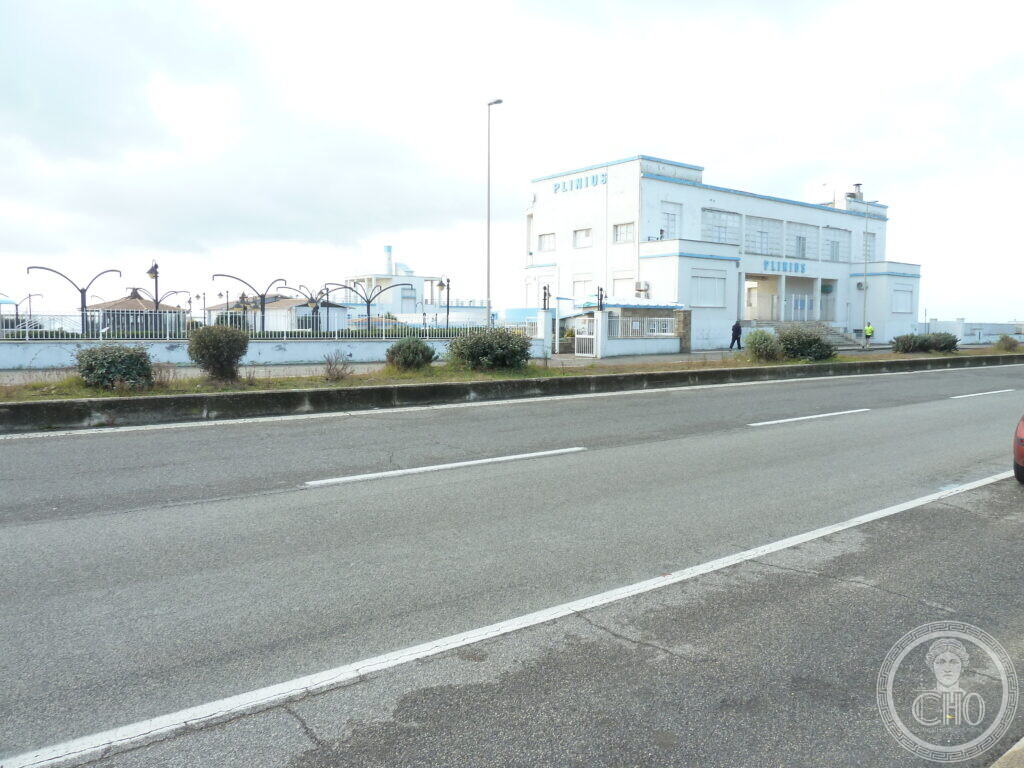
A rationalist bathing establishment on the seafront at Lido di Ostia, designed in the 1930s and partly rebuilt after war damage. Its surviving buildings are among the most distinctive pieces of rationalist seaside architecture on the coast near Rome.
At a glance
The Plinius stands on Via delle Quinqueremi at Lido di Ostia Levante, in the coastal district of Rome. The building that remains is a white two-storey structure with the name PLINIUS on its facade, reached by a broad stairway from the road. Published accounts describe an establishment of “signorile” character, designed as part of the planned development of the Ostia seafront in the early 1930s.
Key facts
- Where: Via delle Quinqueremi, Lido di Ostia Levante, Roma
- What: Building
- When: Designed in 1933; rebuilt in 1946 after war damage
- GPS: 41.7232, 12.2935 · Open in Google Maps
History
The development of this stretch of the Ostia seafront followed the decision in 1931 to extend Lungomare Duilio towards the east and to give up the industrial port proposed in the 1916 master plan. In 1933 the Capitania di Porto of Civitavecchia issued a competition for three bathing establishments in the area, requiring high-quality services and a recognisably “signorile” character. The Plinius, designed by the architect Leopoldo Botti in 1933, was one of the first three, together with La Pineta and the Rex.
The original complex was built in masonry with a reinforced concrete structure. It had a large entrance building on the land side, a circular pavilion towards the sea, and a pier connecting them; at the two ends of the lot were small service blocks. The 590 wooden cabins had to be dismantled at the end of each season and stored under the pier. To preserve the view of the sea required by the rules, Botti used the roughly two-metre difference in level between the seafront road and the beach to place the cabins.
During the Second World War the land building was destroyed. It was rebuilt with simplifications in 1946. The contributor records the date as 1935 and identifies the architect as Leopoldo Botti; published accounts date the project to 1933.
What you see
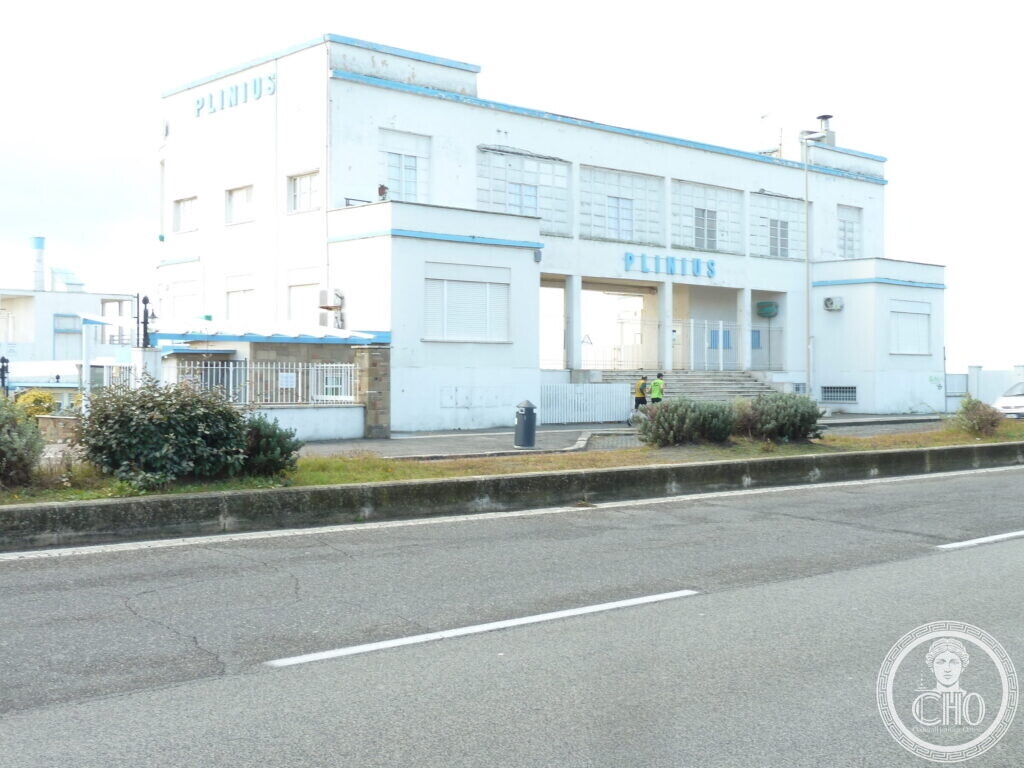
The photograph shows the long, white land building set back from the road behind a low wall with bushes. The word PLINIUS is painted across the upper facade. A central stairway leads up from the street to the building. The facade has a blue-trimmed upper level with horizontal bands of windows; two small figures in bright vests stand near the gate. In a second, more frontal view, the same stairway entrance and the fence are visible. The glass-block ends and the clock described in early accounts are no longer present on the photographed building.
Do you know more about this place?
If you know a date, a name, a document, a plaque or a photograph that tells its story, write to Sofia through the contact page. What arrives with a source goes into this page, with your name as the contributor.
Nearby
- The white apartment block at Domus the Terrace, Ostia — a residential building in the same Lido di Ostia district
Gallery
Sources
- Biblioteche di Roma, Occhio al territorio: architettura moderna ad Ostia, gli stabilimenti balneari (1): date of design, architect, original plan, materials, cabin numbers, war damage and reconstruction
- Turismo Roma, Storia della balneazione e nascita degli stabilimenti: context of 1930s bathing establishments at Ostia, including the Plinius
- OpenStreetMap, Stabilimento Balneare Plinius: address
- Stefano Vigolo, photographs and notes to the editorial staff (2026): identification of the subject and the 2010 photographs. Not a published source
Find it on the map
See this place and what’s around it →📷 Become a Cultural Heritage Online photographer
Share your photos of places: they stay published under your name as the author. The more they're seen, the more you get noticed — and soon a contest will reward the most appreciated photos.
Log in or sign up free to add a photoIs this page about you?
This page is read by travellers and heritage enthusiasts who find it on Google. Tell us how you are connected to this place and we will take it from there.
This entry stays online and free either way — and a free account lets you add to it yourself.