
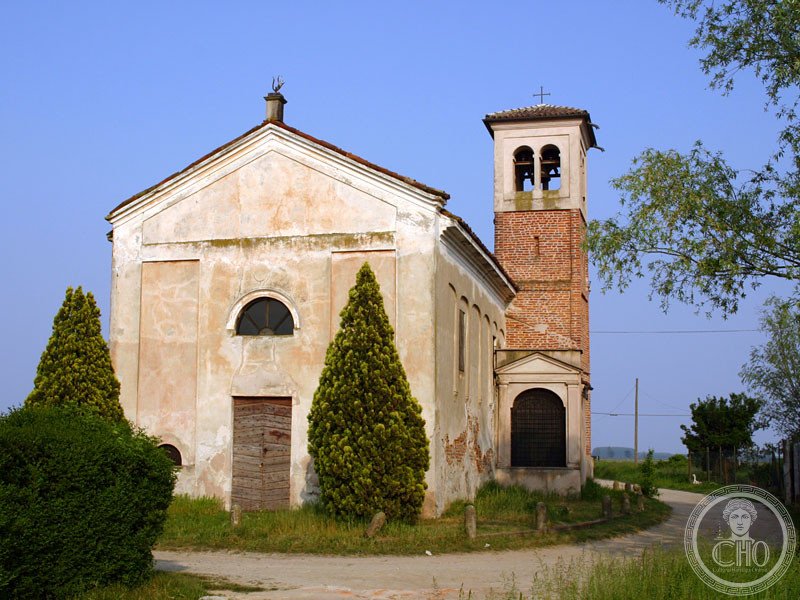
A Romanesque parish church from the early 11th century preserves its original apse decoration and houses significant examples of medieval Novara painting.
At a glance
The Pieve di San Giovanni Battista stands outside Vespolate along the ancient road connecting Vespolate to Tornaco. Built in the first quarter of the 11th century, this Romanesque structure originally functioned as a three-nave church with baptistery and surrounding cemetery. Despite extensive modifications across subsequent centuries, the building retains significant historical and artistic value.
History
Constructed in the early 11th century, the pieve served as a baptistery church for the surrounding territory. Its position on an ancient trade route reflects its importance as a religious and community center. Over the centuries, repeated remodeling altered much of the original structure, yet key Romanesque elements survived.
What you see
The church’s western facade and southern bell tower, positioned behind a small chapel-ossuary, define its exterior profile. The semicircular apse preserves the original Romanesque decoration of paired hanging arches—a distinctive feature of the period’s architectural vocabulary. The interior, substantially reworked, retains the three-nave arrangement of its original design.
Cultural significance
The pieve houses precious artistic testimonies of Novara painting from the fourteenth and fifteenth centuries. These works document regional artistic traditions during the late medieval period. The building itself exemplifies the Romanesque style characteristic of Piemontese religious architecture in the early Middle Ages.
Key facts
- Address: Strada Provinciale 8, 29079 Vespolate
- Coordinates: 45.352128, 8.6761519
- Official website: vespolateonline.it
Practical information
Opening hours and ticket prices change through the year, so we do not republish them here: the current ones are on vespolateonline.it. What does not change is where it is: Strada Provinciale 8, 29079 Vespolate, at 45.352128, 8.6761519.
Getting there
The pieve is located outside Vespolate, on the Strada Provinciale 8. You can reach it via the ancient route that historically connected Vespolate to Tornaco.
Sources & resources
Find it on the map
See this place and what’s around it →📷 Become a Cultural Heritage Online photographer
Share your photos of places: they stay published under your name as the author. The more they're seen, the more you get noticed — and soon a contest will reward the most appreciated photos.
Log in or sign up free to add a photoIs this page about you?
This page is read by travellers and heritage enthusiasts who find it on Google. Tell us how you are connected to this place and we will take it from there.