

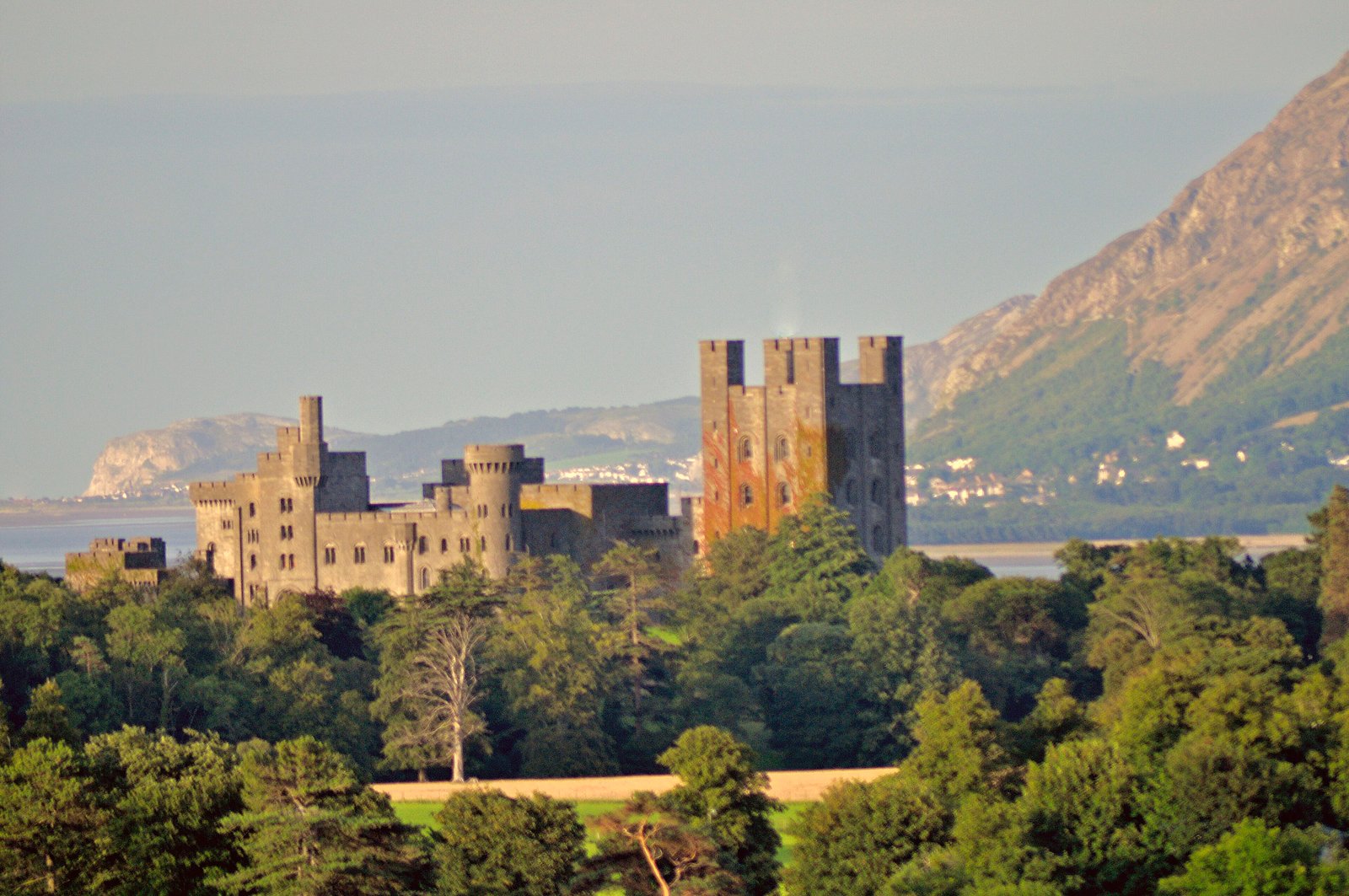
A Neo-Norman country house in North Wales that stands as architect Thomas Hopper’s masterwork, built on wealth derived from slavery and slate mining, now home to an internationally significant art collection.
At a glance
Penrhyn Castle is a Grade I listed Romanesque Revival country house near Bangor, Wales. Designed by Thomas Hopper between 1822 and 1837, it ranks among Britain’s finest revivalist castles. The castle served as a summer residence for the Douglas-Pennant family and hosted royal and political guests. It passed to the National Trust in 1951.
History
The Penrhyn Estate traces its origins to Ednyfed Fychan; a fortified manor house was erected on the site in the 15th century by Gwilym ap Griffith. In the 1780s, the 1st Baron Penrhyn—elevated to the peerage in 1783—commissioned Samuel Wyatt to reconstruct the medieval structure. Penrhyn’s wealth stemmed from slave plantations in the West Indies; he opposed abolition efforts and later benefited from the Slavery Abolition Act of 1833.
Upon Lord Penrhyn’s death in 1808, his second cousin George Hay Dawkins inherited the estate and adopted the surname Dawkins-Pennant. From 1822 to 1837, Dawkins-Pennant engaged Thomas Hopper to rebuild the house as a Neo-Norman castle. Like his predecessor, Dawkins-Pennant served on the West India Committee and received compensation for enslaved people upon emancipation.
In 1840, the estate passed to Edward Gordon Douglas through marriage to Dawkins-Pennant’s daughter Juliana. Elevated to the peerage as the 1st Baron Penrhyn of the second creation in 1866, Douglas and his son George expanded slate mining at Penrhyn Quarry. Their anti-union stance precipitated the Great Strike of 1900–1903, Britain’s longest industrial dispute. The National Trust acquired the castle in 1951.
What you see
Thomas Hopper’s design epitomizes Romanesque Revival architecture, with castle-like forms executed in authentic masonry. The building reads as a medieval fortress reimagined for 19th-century aesthetics and comfort. Its exterior conveys strength and historical authority through crenellations, towers, and arched openings.
The interior was enhanced by Lord Penrhyn’s creation of a major art collection, which provided the setting for entertaining distinguished guests including Queen Victoria, the Prince of Wales, and William Ewart Gladstone. Works by Palma Vecchio and Canaletto feature prominently, conferring international significance on the collection.
Cultural significance
Penrhyn Castle exemplifies the ambitions of 19th-century industrial magnates to legitimize their wealth through grand architecture and art patronage. It documents the entanglement of British country-house culture with colonial slavery and the exploitation of workers. In recent decades, the National Trust has engaged the castle’s complex history, making it a focal point in discussions of heritage and historical accountability.
Key facts
- Location: Llandygai, Bangor, Gwynedd, North Wales, United Kingdom
- Coordinates: 53.2259, −4.0946
- Architect: Thomas Hopper (1822–1837 reconstruction)
- Style: Romanesque Revival (Neo-Norman)
- Listing: Grade I
- Current custodian: National Trust (acquired 1951)
Practical information & getting there
Penrhyn Castle is located near Bangor in North Wales. As a National Trust property, visiting hours, admission fees, and access details are available through the National Trust website. The castle remains primarily a summer residence setting and requires advance planning for a visit.
Sources & resources
Find it on the map
See this place and what’s around it →📷 Become a Cultural Heritage Online photographer
Share your photos of places: they stay published under your name as the author. The more they're seen, the more you get noticed — and soon a contest will reward the most appreciated photos.
Log in or sign up free to add a photoIs this page about you?
This page is read by travellers and heritage enthusiasts who find it on Google. Tell us how you are connected to this place and we will take it from there.