

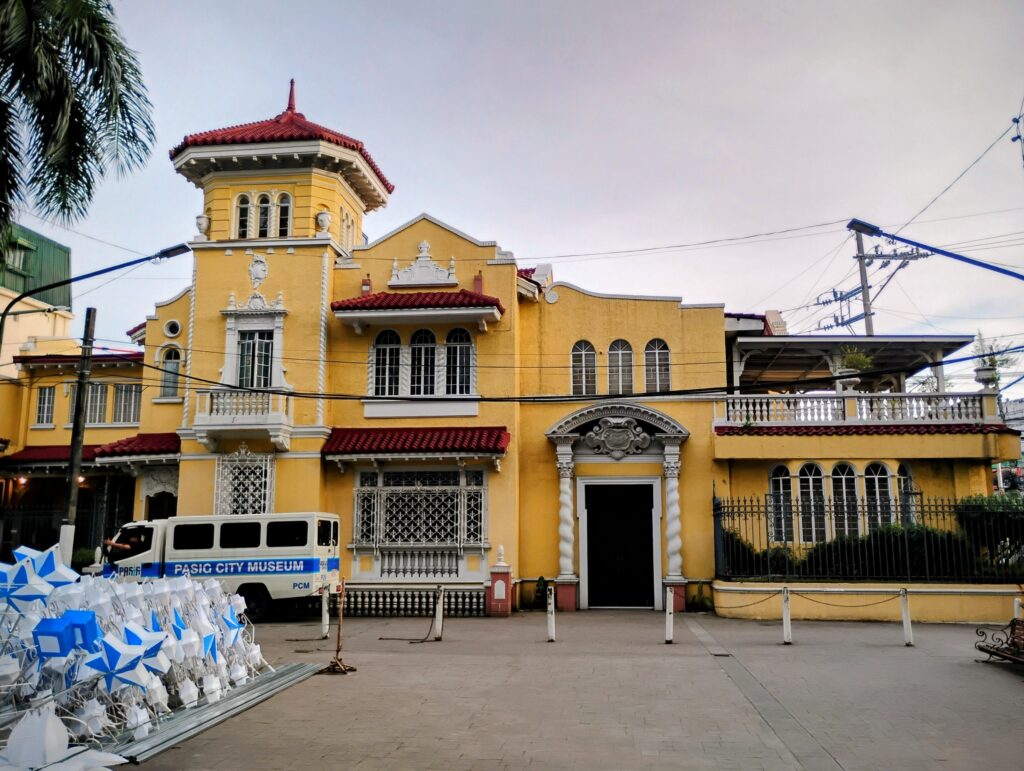
A Spanish-Baroque mansion transformed into a museum, tracing Pasig’s history through carefully curated collections and architectural splendour.
At a glance
The Pasig City Museum occupies the Concepcion Mansion, a landmark structure completed in 1937 in the heart of Pasig’s poblacion. Originally built as a private residence, it now serves as the city’s primary repository for historical artefacts and narratives spanning Pasig’s development.
History
Don Fortunato Cabrera Concepcion, mayor of Pasig from 1918 to 1921, commissioned this mansion as a gift to his wife, Victoria. Architect Felizardo M. Dimanlig, a native of Pasig, designed and completed the structure in 1937. The building reflects the cultural aspirations of Pasig’s early twentieth-century elite. Following its construction, the mansion eventually transitioned to public use, establishing itself as the city’s principal museum dedicated to local heritage.
What you see
The mansion exemplifies Spanish-Baroque architectural principles, showcasing decorative elements and spatial arrangements characteristic of the period. The building’s design merges colonial influences with local sensibilities, creating a distinctive domestic structure. Positioned at one end of Plaza Rizal in Barangay San Jose, the museum’s location underscores its civic importance within Pasig’s urban fabric.
Cultural significance
The museum functions as Pasig’s institutional memory, displaying objects and narratives that illuminate successive phases of the city’s historical evolution. Beyond its curatorial mission, the Concepcion Mansion itself represents early twentieth-century Manila society’s architectural ambitions and the role of local leadership in shaping urban culture.
Key facts
- Country: Philippines
- City: Pasig, Metro Manila
- Completed: 1937
- Architect: Felizardo M. Dimanlig
- Original owner: Don Fortunato Cabrera Concepcion (mayor 1918–1921)
- Coordinates: 14.5609, 121.0762
Practical information & getting there
The museum is located in Pasig’s poblacion district at Plaza Rizal, Barangay San Jose. For current opening hours, admission details, and visiting information, consult the museum directly or local tourism resources.
Japanese forces used the mansion as a headquarters and a prison during the Second World War, and on 19 February 1945 the American flag was raised on its tower, the day Pasig marks as its Liberation Day.
Frequently Asked Questions
What is the Pasig City Museum?
It is the city museum of Pasig, in Metro Manila, housed in the Concepcion Mansion — a Spanish-Baroque mansion completed in 1937 in the heart of Pasig’s poblacion. Originally a private residence, it is now the city’s primary repository for historical artefacts and narratives spanning Pasig’s development.
Who built the Concepcion Mansion?
Don Fortunato Cabrera Concepcion, mayor of Pasig from 1918 to 1921, commissioned it as a gift to his wife Victoria. It was designed and completed in 1937 by the architect Felizardo M. Dimanlig, a native of Pasig.
Where is the Pasig City Museum?
At one end of Plaza Rizal, in Barangay San Jose, Pasig’s poblacion district, at 14.5609° N, 121.0762° E. The location across the plaza underscores the building’s civic role within the city.
When is the Pasig City Museum open?
Our entry does not give current hours or admission details: for those, consult the museum directly or the local tourism resources. The visit itself is about the mansion and its collections tracing Pasig’s history.
Sources & resources
Find it on the map
See this place and what’s around it →📷 Become a Cultural Heritage Online photographer
Share your photos of places: they stay published under your name as the author. The more they're seen, the more you get noticed — and soon a contest will reward the most appreciated photos.
Log in or sign up free to add a photoIs this page about you?
This page is read by travellers and heritage enthusiasts who find it on Google. Tell us how you are connected to this place and we will take it from there.
This entry stays online and free either way — and a free account lets you add to it yourself.