
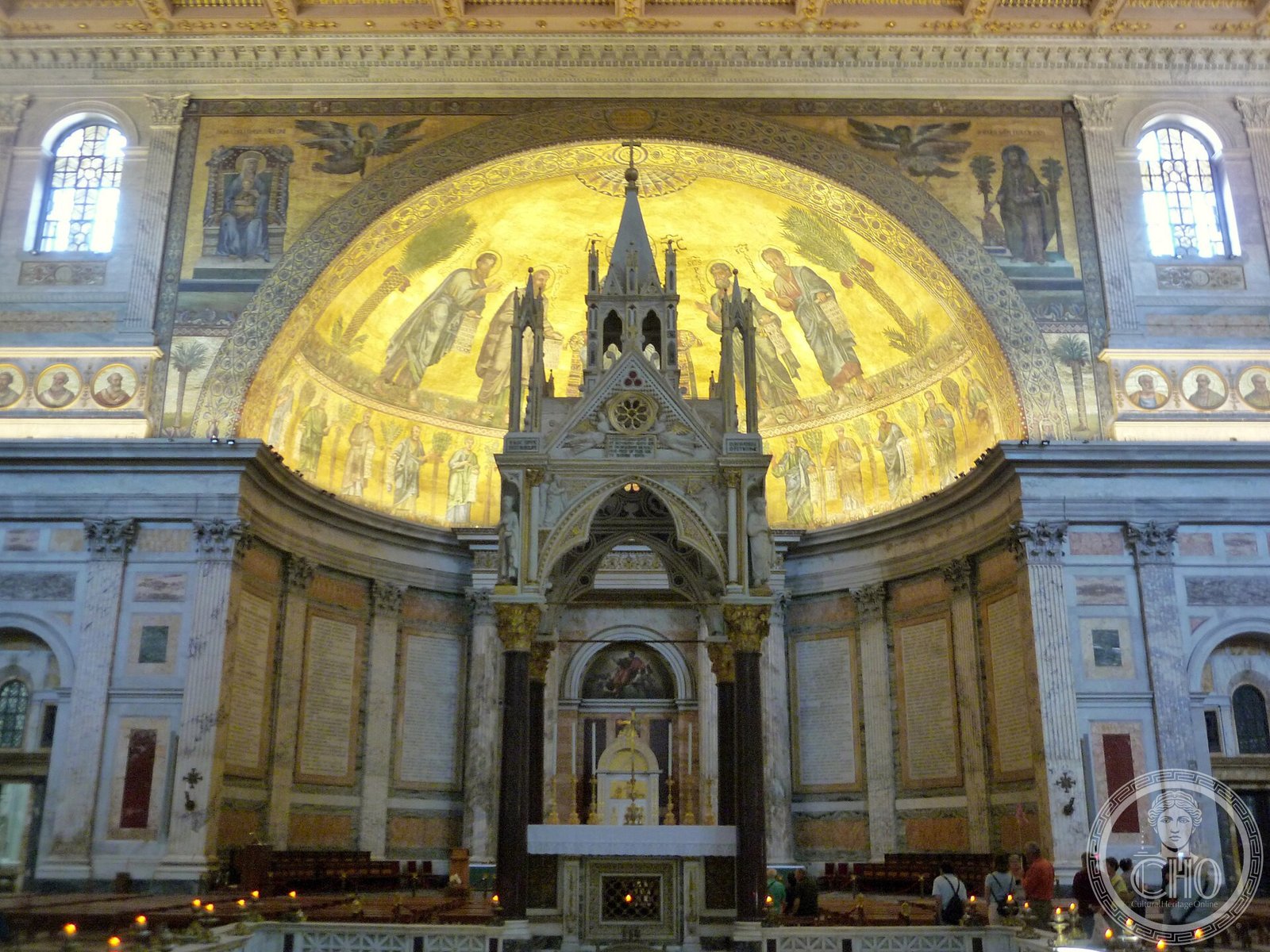
The second largest basilica in Rome burned down on a July night in 1823 and was rebuilt over thirty years with gifts from a tsar and an Egyptian king. Arnolfo di Cambio’s ciborium, the cloister and the marble candlestick came through the fire.
At a glance
- Type
- One of the four papal basilicas of Rome, second in size after Saint Peter’s
- Stands over
- The tomb of the apostle Paul, beneath the papal altar
- Destroyed
- Fire of the night of 15–16 July 1823
- Reconsecrated
- 10 December 1854, by Pius IX
- Status
- Extraterritorial property of the Holy See on Italian soil
- Location
- Piazzale San Paolo 1, via Ostiense, Rome
Overview
The basilica stands on the via Ostiense, outside the Aurelian Walls from which it takes its name, a little under two kilometres from the Porta San Paolo. Beneath the papal altar, at 1.37 metres, a marble slab of 2.12 by 1.27 metres bears the inscription PAULO APOSTOLO MART.
Paul was beheaded between the years 65 and 67 at Aquae Salviae, the place known today as Tre Fontane, and his body was laid two Roman miles away in the burial ground that the Christian Lucina owned on the via Ostiense. The church has been built and rebuilt over that spot ever since.
History
A monastic community has been here since the time of Gregory I, and Gregory II, who reigned from 715 to 731, established the Benedictines permanently at the tomb. They are still here after thirteen centuries; they did not abandon their charge even when the monastery was confiscated in 1870.
From the fourteenth century the practice of the Jubilees drew pilgrims to the apostle’s tomb, and each Holy Year left something behind: a balustrade under Gregory XIII for 1575, a raised high altar under Clement VIII for 1600, Carlo Maderno’s transformation of the chapel of San Lorenzo under Urban VIII for 1625, Antonio Canevari’s new portico for 1725.
On the night of 15 to 16 July 1823 the ancient basilica burned. Workmen repairing the leaking roof had left a brazier badly extinguished; a gust probably tipped it onto the beams. The monks were away at their summer house in Trastevere. A cowherd, Giuseppe Perna, saw the flames and two clerics rang the bell tower; the firemen took two hours to arrive and the fire burned for five. Pius VII lay dying and was deliberately not told. The roof was gone, Constantine’s bronze door had melted, columns had fallen, and the mosaics, the furnishings and the papal portraits were all damaged.
The transept did not collapse, and that is why the medieval church survives in fragments: Arnolfo di Cambio’s Gothic ciborium of 1285, the Vassalletto cloister, and the marble Easter candlestick made by Nicola d’Angelo and Pietro Vassalletto in 1170 came through, blackened but standing. The apse mosaic of Innocent III and Honorius III survived and was reworked afterwards reusing part of the old tesserae; fragments of the original apostles’ heads are shown in the permanent exhibition.
Leo XII appealed to the whole world with the letter Ad plurimas of 25 January 1825. Valadier began the works, Pasquale Belli drew the definitive plan, and Luigi Poletti carried them to 1869, giving the basilica its facade, bell tower and left flank. Tsar Nicholas I sent malachite and lapis lazuli for the two transept altars; King Fouad I of Egypt and the viceroy Mohamed Ali sent alabaster for the columns and windows. On 10 December 1854 Pius IX consecrated the new basilica before cardinals and bishops gathered in Rome from across the world for the proclamation of the dogma of the Immaculate Conception; their names are carved along the apse walls.
What you see
The approach is through Poletti’s quadriportico, seventy metres long with a hundred and fifty columns, finished by Calderini, with Giuseppe Obici’s colossal statue of Saint Paul at its centre and the facade mosaics executed between 1854 and 1874 from cartoons by Agricola and Consoni. Antonio Maraini’s green bronze central door was installed in 1931; the Holy Door in gilded bronze, by Enrico Manfrini, was placed for the Jubilee of 2000.
Inside, the celebrated band of papal medallions runs round the nave, a series begun under Leo the Great between 440 and 461 and continued to the present pope — a sequence that exists nowhere else. Those visible today are post-fire: the fire damaged the portraits. The ciborium over the papal altar is the original of 1285, and the cloister beside the church is among the finest of medieval Rome.
Cultural significance
The basilica belongs to the World Heritage property named “Historic Centre of Rome, the Properties of the Holy See in that City Enjoying Extraterritorial Rights and San Paolo Fuori le Mura”, held jointly by Italy and the Holy See. The property was inscribed in 1980 and the boundaries were significantly modified in 1990, and it was in that extension that the basilica was brought in.
Under the Lateran Treaty the Holy See holds full ownership of the basilica and the enjoyment of the immunities that international law grants to diplomatic missions. Article 16 exempts it from ordinary and extraordinary taxation and bars expropriation for public utility except by prior agreement with the Holy See.
Practical information
- Address: Piazzale San Paolo 1, 00146 Roma
- Basilica: open every day 07:00–18:30, entry free
- Cloister and archaeological area: every day 08:00–18:00, last entry 17:30; €4, or €3 for groups over ten
- The archaeological area covers about 1,000 square metres, with remains of a monastery of the fifth to seventh centuries and the colonnaded portico that once ran from the Aurelian Walls to the ancient basilica
- Official site: basilicasanpaolo.org
Getting there
Metro line B to Basilica San Paolo, which comes up beside the complex. The basilica is a little under two kilometres from the Porta San Paolo and the Piramide interchange, an easy walk down the via Ostiense.
Sources
- Santa Sede, official pages of the basilica on the tomb of the apostle, the Benedictine abbey, the Jubilees, the exterior and the fire of July 1823 — vatican.va
- Vatican News, account of the bicentenary of the 1823 fire, 15 July 2023
- Basilica Papale San Paolo fuori le Mura, opening hours and admission to the cloister — basilicasanpaolo.org
- Turismo Roma, Comune di Roma, entry on the basilica (surviving works: apse mosaic, Vassalletto cloister, Easter candlestick of 1170, ciborium of 1285)
- Lateran Treaty, articles 13, 15 and 16, text published by the Holy See
- UNESCO World Heritage Centre, property ref. 91, inscribed 1980, boundaries modified 1990 — whc.unesco.org
Find it on the map
See this place and what’s around it →Historical events at this place (2)
📷 Become a Cultural Heritage Online photographer
Share your photos of places: they stay published under your name as the author. The more they're seen, the more you get noticed — and soon a contest will reward the most appreciated photos.
Log in or sign up free to add a photoIs this page about you?
This page is read by travellers and heritage enthusiasts who find it on Google. Tell us how you are connected to this place and we will take it from there.