

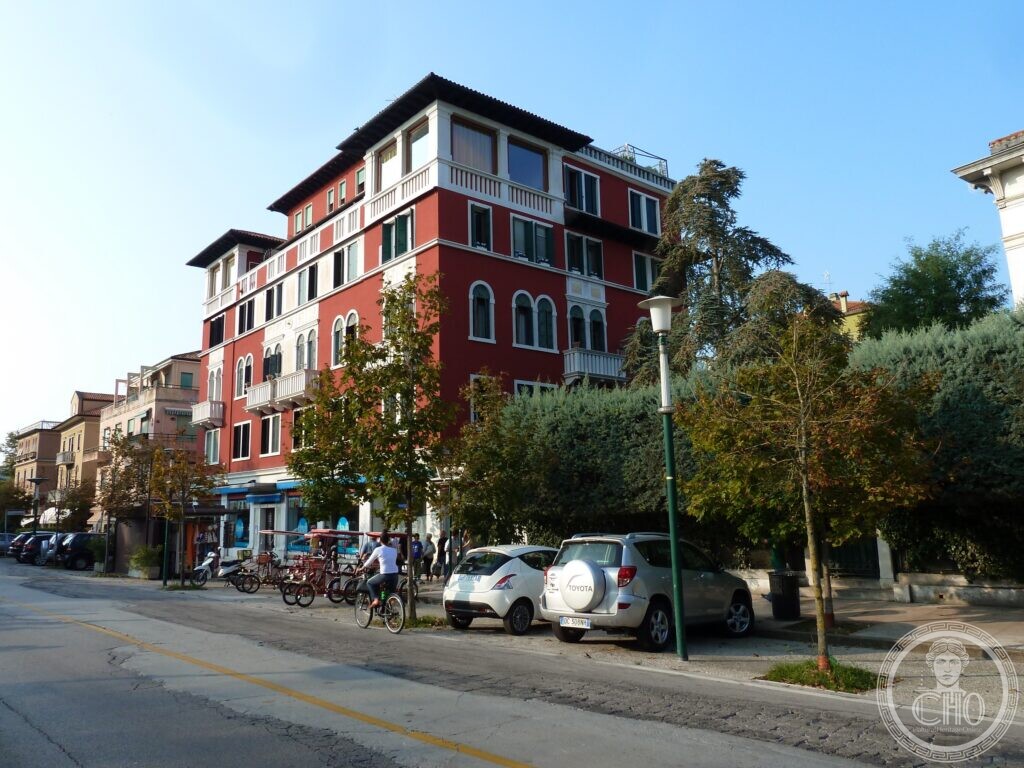
A five-storey block in Venetian red with white stone arches, balconies and an open loggia under the eaves, with shops at its foot, on the streets between the Gran Viale and the beach. It belongs to the Lido of the early twentieth century; its date and its architect are not documented.
At a glance
The building stands at the corner of a street near Via Dardanelli, a short walk from the Gran Viale towards the sea, in the grid of streets that the Lido’s developers laid out around the avenue in the first decades of the twentieth century. Stefano Vigolo photographed it in September 2014 from across the street, where bicycles and a cycle-rickshaw stand in front of its shops. It is a tall apartment house in the eclectic manner of the resort: red plaster with white stone frames, round-arched windows on the lower floors, small balconies with iron railings, and at the top, under the wide eaves of the roof, an open loggia with slender columns and a terrace.
What this page does not say. The Comune’s catalogue of the Lido’s architecture lists two villas on Via Dardanelli, at numbers 17 and 28–29, and a building at number 46, none of which is this one; we found no other source on it. Its date and its architect are not documented, and the position is that of the photographer’s map pin, which falls on the viewpoint from which he took the picture.
Key facts
- Where: near Via Dardanelli, Lido di Venezia, between the Gran Viale and the beach
- Type: apartment house of five storeys with a roof loggia and shops at street level (as seen in the photograph)
- Date and architect: not documented in any published source found so far
- GPS (photographer’s pin): 45.4141, 12.3740 · Open in Google Maps (OpenStreetMap)
What is known, and what is believed
The streets between the Gran Viale and the Lungomare were built up in the thirty years around the First World War, when the bathing resort became a residential quarter of Venice, and their apartment houses borrowed freely from the city across the lagoon: round arches, stone balconies, loggias under the roof. The Comune’s catalogue of that season documents the villas of Via Dardanelli but not this block, which stands at the edge of the street. It is believed, from its forms, to belong to the same decades; who built it, and when, remains to be found.
What you see
A five-storey corner block in deep red plaster with white stone trim. The ground floor holds shops with blue awnings; above, three floors of windows, round-arched on the lower ones with keystones and small iron balconies with flower boxes, rectangular above; and at the top, under the broad overhanging eaves of a tiled roof, an open loggia on slender white columns running the length of the front, with a roof terrace behind a railing. The side towards the street repeats the scheme. Trees line the pavement, and the lower houses of the street continue to the left.
Do you know more about this building?
If you know the address, the date or the architect of this red building, or its name, write to Sofia at sofia@culturalheritageonline.com or through the contact page. What arrives with a source goes into this page, with your name as the contributor.
Nearby
- Gran Viale Santa Maria Elisabetta 36 — the neo-Venetian apartment house on the avenue
- Ex sede della Cassa di Risparmio — Saccardo’s bank of 1926
Sources
- Comune di Venezia, Municipalità di Lido-Pellestrina, L’architettura del Lido — elenco edifici (via the Wayback Machine): the villas at Via Dardanelli 17 and 28–29 and the building at number 46, and the absence of this block from the catalogue
- Hoppa, Venice Lido, Santa Maria Elisabetta’s area: the Gran Viale and the resort quarter around it
- Stefano Vigolo, photograph of 28 September 2014 and map pin sent to the editorial staff on 28 September 2026: the identification of the building. Not a published source
- OpenStreetMap (Nominatim), Via Dardanelli, Lido: the position of the pin
Find it on the map
See this place and what’s around it →📷 Become a Cultural Heritage Online photographer
Share your photos of places: they stay published under your name as the author. The more they're seen, the more you get noticed — and soon a contest will reward the most appreciated photos.
Log in or sign up free to add a photoIs this page about you?
This page is read by travellers and heritage enthusiasts who find it on Google. Tell us how you are connected to this place and we will take it from there.