

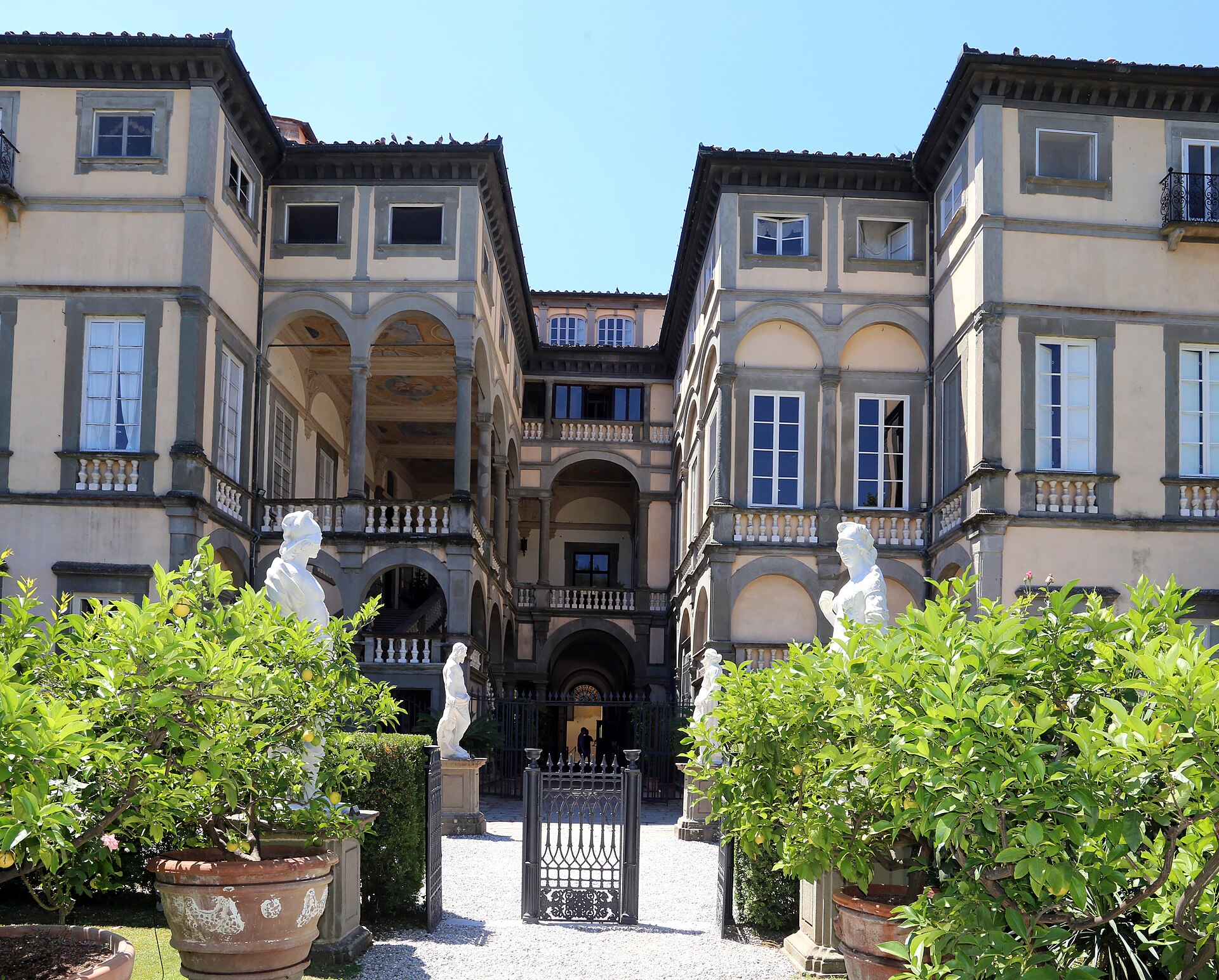
A Luccan palace built for merchant patrons and refined by celebrated architects, Palazzo Pfanner stands as a testament to the city’s economic prominence and cosmopolitan taste across three centuries.
At a glance
Palazzo Pfanner occupies a prominent position on the edge of Lucca’s historic walls. The structure began as a private residence for the city’s merchant elite and evolved through successive renovations by leading architects of the Baroque period. Today it remains in family ownership and welcomes visitors.
History
The Moriconi family, merchants of considerable standing, commissioned the palace in 1660. Economic pressures forced their sale of the building to the Controni in 1680, another silk-merchant dynasty recently elevated to nobility.
The Controni embarked on ambitious improvements. Around 1686 they oversaw construction of a monumental staircase, attributed to Domenico Martinelli, the Luccan architect celebrated for his work at the courts of Vienna and Prague. In the early eighteenth century they commissioned Filippo Juvarra, likely, to redesign the garden. Local fresco painters decorated the staircase vaults and principal rooms during this period of enhancement.
The palace achieved prominence as a venue for distinguished guests. In 1692 it hosted Prince Federico of Denmark during his Grand Tour—an occasion marked by his notable courtship of the local noblewoman Maria Maddalena Trenta.
Felix Pfanner, an Austrian-born entrepreneur of Bavarian descent, acquired the property incrementally from 1846 onward. He established the first brewery in the Duchy of Lucca and among Italy’s earliest industrial operations, utilizing the palace’s cellars and garden space. The Pfanner Brewery closed in 1929. The family has owned the palazzo since the mid-nineteenth century, undertaking systematic restoration from 1995 and opening it for exhibitions and concerts.
What you see
The palazzo displays refined Baroque sensibilities refined through successive campaigns. The monumental staircase by Martinelli represents a focal point of the interior, its vaults frescoed by accomplished local painters. The garden, remodeled in the early eighteenth century, retains spatial logic and proportions associated with Juvarra’s approach to landscape composition.
Cultural significance
Palazzo Pfanner documents the intersection of merchant capital, architectural innovation, and industrial enterprise in early modern Lucca. The involvement of Martinelli and Juvarra anchors it within broader European aesthetic currents. The brewery’s operations illustrate the transition from aristocratic villa to productive commercial space—a uniquely Tuscan phenomenon of entrepreneurial adaptation.
Key facts
- Address: Via degli Asili, 33, 55100 Lucca
- Coordinates: 43.8455816, 10.503
- Construction began: 1660
- Monumental staircase: circa 1686, attributed to Domenico Martinelli
- Garden redesign: early 18th century, attributed to Filippo Juvarra
- Pfanner Brewery: 1846–1929
- Phone: 0583 954029
- Website: http://www.palazzopfanner.it
Practical information
The palazzo is open to the public and hosts exhibitions and concerts. Consult the official website for current opening hours, admission fees, and event schedules.
Getting there
Palazzo Pfanner is located on via degli Asili, accessible from within Lucca’s historic center near the circuit of city walls. Parking is available in the surrounding zona storica.
See the place
Sources & resources
Find it on the map
See this place and what’s around it →📷 Become a Cultural Heritage Online photographer
Share your photos of places: they stay published under your name as the author. The more they're seen, the more you get noticed — and soon a contest will reward the most appreciated photos.
Log in or sign up free to add a photoIs this page about you?
This page is read by travellers and heritage enthusiasts who find it on Google. Tell us how you are connected to this place and we will take it from there.