

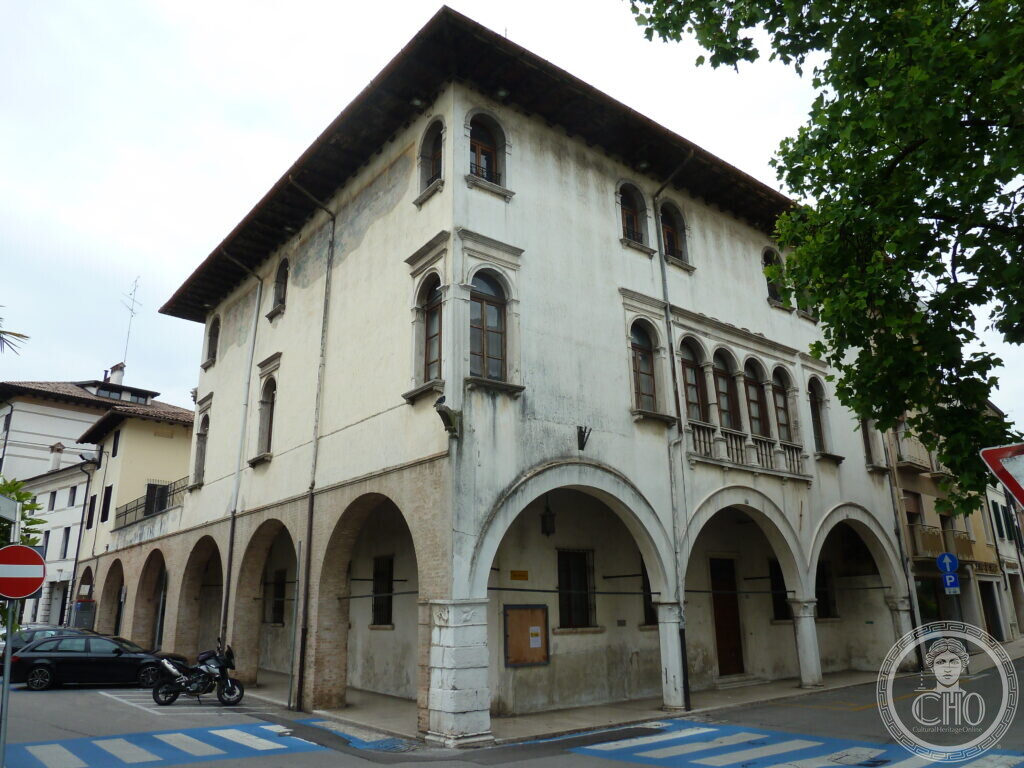
A sixteenth-century noble residence in central Sacile, built by the Ettoreo family and later owned by the Vando, known for its porticoes, Istrian stone windows and the night Silvio Pellico spent here as a prisoner in 1822.
At a glance
Palazzo Ettoreo sits at the meeting point of Via Pelizza and Campo Marzio in Sacile, with a corner window that looks towards the Livenza. The Ettoreo family built it in the first half of the sixteenth century over an earlier Gothic building, and it later passed to the Vando family. Now owned by the town, it was for over a century the “Leon d’oro” inn, where Silvio Pellico stayed on 25 March 1822.
Key facts
- Where: Via Pelizza 2, corner of Campo Marzio, Sacile
- What: Palace
- When: First half of the 16th century
- GPS: 45.9533, 12.5010 · Open in Google Maps
History
The Ettoreo family raised the palace in the first half of the sixteenth century on the site of a previous Gothic building, in the district then called Borgo Fratta. The residence later belonged to the Vando, whose family coat of arms appears in the old church of the Transfiguration at Vistorta. The building then served for more than a century as the “Leon d’oro” inn. Silvio Pellico slept here on 25 March 1822 while being moved from the Venetian prisons to the Spielberg fortress. The municipality now owns the building.
What you see
The palace has a trapezoidal plan and a sober Venetian Renaissance look. A portico runs along the two street fronts: three round arches on octagonal white stone columns face Via Pelizza, while six arches on rectangular brick pillars face Campo Marzio and carry a small sixteenth-century loggia. On the corner pillar are two reliefs of winged fantastic creatures, a griffin and a dragon; the central column carries the carved Ettoreo coat of arms. The façade includes a four-light window in Istrian stone and a corner window with an unusual view towards the Livenza. Under the Via Pelizza portico hangs a devotional fresco of the Madonna and Child from the early eighteenth century. Faint traces of other frescoes remain on the outer walls, including three winged putti.
Do you know more about this place?
If you know a date, a name, a document, a plaque or a photograph that tells its story, write to Sofia through the contact page. What arrives with a source goes into this page, with your name as the contributor.
Nearby
- No related place cards published yet.
Sources
- Visit Sacile, Palazzo Ettoreo | Visit Sacile: architectural description, history, the Ettoreo and Vando families, the “Leon d’oro” inn and Silvio Pellico’s stay
- Dolce Charm, Palazzo Ettoreo and Silvio Pellico, Sacile: location, construction date, Gothic predecessor, ownership, Pellico’s night, reliefs and window details
- Microturismo delle Venezie, Palazzo Ettoreo: Vando coat of arms, portico details, frescoes, Pellico’s transfer route
- Pordenone with Love, Palazzo Ettoreo: rebuilding around mid-sixteenth century, fresco remains, Madonna and Child lacerto
- Stefano Vigolo, photographs and notes to the editorial staff (2026): identification of the subject and GPS coordinates. Not a published source
Find it on the map
See this place and what’s around it →
Advertisement. Pictured, from the Cleveland Museum of Art (CC0) and not for sale: a parure of about 1850, a Lalique brooch, a Castellani bangle. How we handle this
📷 Become a Cultural Heritage Online photographer
Share your photos of places: they stay published under your name as the author. The more they're seen, the more you get noticed — and soon a contest will reward the most appreciated photos.
Log in or sign up free to add a photoIs this page about you?
This page is read by travellers and heritage enthusiasts who find it on Google. Tell us how you are connected to this place and we will take it from there.