

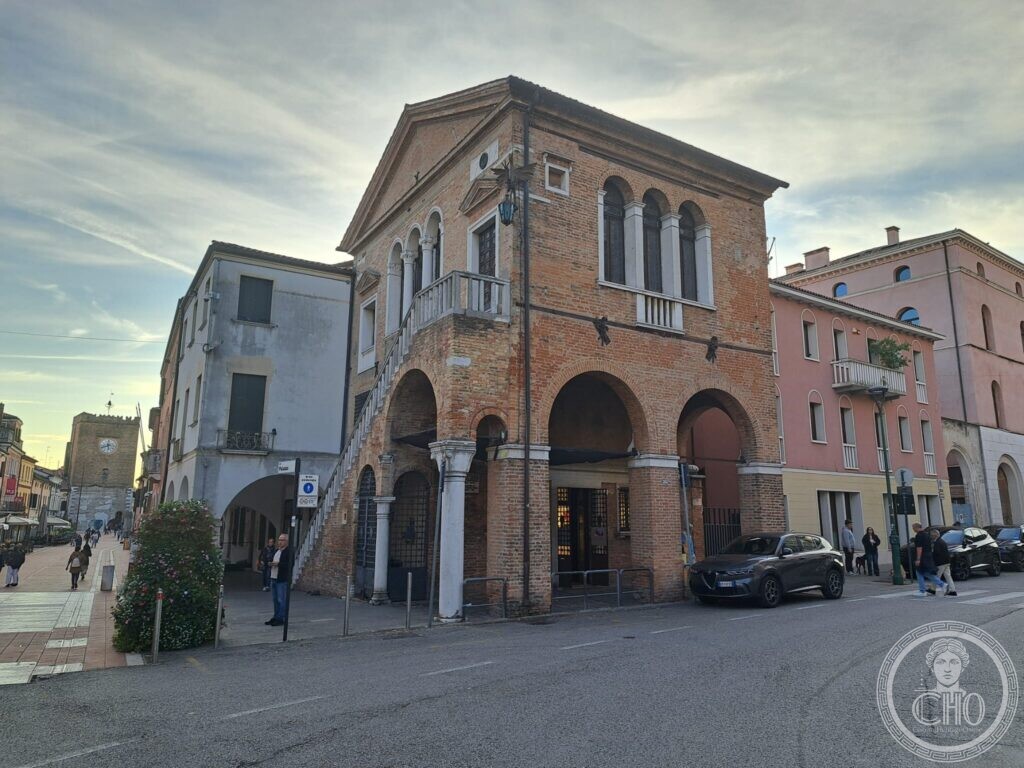
The brick palace that closes Via Palazzo was built in 1457 as the loggia where the civic council of Mestre met. With the Palazzo Podestarile across the street it was the seat of government of the Venetian podesteria, and today the Comune marries couples in its upstairs hall.
At a glance
The Provvederia stands at the end of Via Palazzo, the medieval street of Mestre’s walled town, at the corner with Via Torre Belfredo and facing the Palazzo Podestarile, today’s town hall. The Comune di Venezia dates it to 1457, when the Civic Council of Mestre, made up of representatives of the leading families, asked the Podestà for permission to build a new loggia for its regular meetings. Over the centuries the building housed one city institution after another; it is now the municipal hall for weddings and civil unions.
Key facts
- Built: 1457, as the loggia of the Civic Council of Mestre, with the permission of the Podestà
- Role under Venice: with the Palazzo Podestarile opposite, one of the two seats of government of the podesteria of Mestre
- Today: the wedding hall of the Comune di Venezia, on the second floor, entered from Via Palazzo
- In the hall: a ceiling canvas by Giuseppe Urbani de Gheltof depicting Mestre; a small balcony over the historic centre
- At the corner: a votive shrine of the Madonna and Child, which local tradition dates to the fifteenth century; restored with a private donation and blessed on 8 September 2023
- GPS: 45.4961, 12.2440 · Open in Google Maps (OpenStreetMap)
History
Mestre grew in the thirteenth and fourteenth centuries on three inhabited sites, one of them the villages of Santa Maria dei Battuti and Mestre along the line of today’s Via Torre Belfredo and Via Palazzo. Venice took the castle of Mestre on 29 September 1337 and made the town the stronghold of its mainland. The podesteria that followed had jurisdiction over some thirty villages across 230 square kilometres; it was administered by a Podestà e Capitano, assisted by two Castellani and flanked by a Civic Council of about thirty citizens, whose decisions were carried out by the Provveditori. The Palazzo Podestarile and the Provvederia facing it were the two seats of that government.
The council’s loggia of 1457 is the building that still stands. The Comune records that over the centuries it saw «the alternation of various city institutions»; it has kept its public role to this day, as the place where the Comune di Venezia celebrates civil weddings. The hall, decorated in shades of red, has large ornamented windows, a ceiling canvas of Mestre by Giuseppe Urbani de Gheltof and a small balcony looking over the old centre.
In recent years Via Palazzo has been returned to pedestrians. The redesign lowered the level of the street by about thirty centimetres starting from the town hall and created a small square between the Municipio and the Provvederia, keeping the trachyte paving; its brick patterns allude to the old Loggia gate at the foot of the clock tower, which the medieval street led to.
What you see
A compact two-storey front in exposed brick, closed by a triangular pediment with a small oculus. On the upper floor a three-light window with round arches on slender columns opens over the street; below, two round arches on columns form a short portico, and on the left an external staircase in Istrian stone, with a balustrade, climbs to a small loggia. The side towards Via Torre Belfredo is plainer, with a single arched window and a balcony. Beyond the palace, at the end of the view, rises the Torre dell’Orologio, the only survivor of the towers of Mestre’s castle: built between 1108 and 1245 according to the Comune’s historical notes, it received its clock in 1827 and a full restoration in 1878.
Nearby
- Ca’ Collalto, the Palazzo Podestarile — the town hall facing the Provvederia across Via Palazzo
- Civic Tower – Clock Tower — the last tower of the castle, at the end of the street
Sources
- Comune di Venezia, Palazzo della Provvederia Hall in Mestre: the date of 1457, the Civic Council’s request to the Podestà for a loggia, the succession of city institutions, the wedding hall on the second floor with access from Via Palazzo, the balcony and the ceiling canvas by Giuseppe Urbani de Gheltof
- Centro Studi Storici di Mestre, Le stagioni di Mestre, 2 (PDF): Venice’s conquest of 29 September 1337, the podesteria of thirty villages and 230 square kilometres, the Podestà e Capitano, the Castellani, the Civic Council of about thirty citizens, the Provveditori, and the Palazzo Podestarile and Provvederia as seats of government; and Le stagioni di Mestre, 1 (PDF): the villages along Via Torre Belfredo and Via Palazzo in the thirteenth and fourteenth centuries
- Magico Veneto, Mestre, storia: the Torre dell’Orologio (1108–1245, clock of 1827, restoration of 1878), the medieval street leading to the Loggia gate, the pedestrian redesign of Via Palazzo and the small square between the Municipio and the Provvederia
- Italpress, Benedetta la Cappella mariana al Palazzo della Provvederia dopo restauro (8 September 2023): the votive shrine at the corner of Via Palazzo and Via Torre Belfredo, its traditional fifteenth-century date, the private donation and the blessing
- Montagna di Viaggi, Mestre, cosa vedere: the Istrian stone staircase of the Provvederia at the end of Via Palazzo
- OpenStreetMap, Via Palazzo / Via Torre Belfredo, Mestre: the position
Find it on the map
See this place and what’s around it →📷 Become a Cultural Heritage Online photographer
Share your photos of places: they stay published under your name as the author. The more they're seen, the more you get noticed — and soon a contest will reward the most appreciated photos.
Log in or sign up free to add a photoIs this page about you?
This page is read by travellers and heritage enthusiasts who find it on Google. Tell us how you are connected to this place and we will take it from there.