

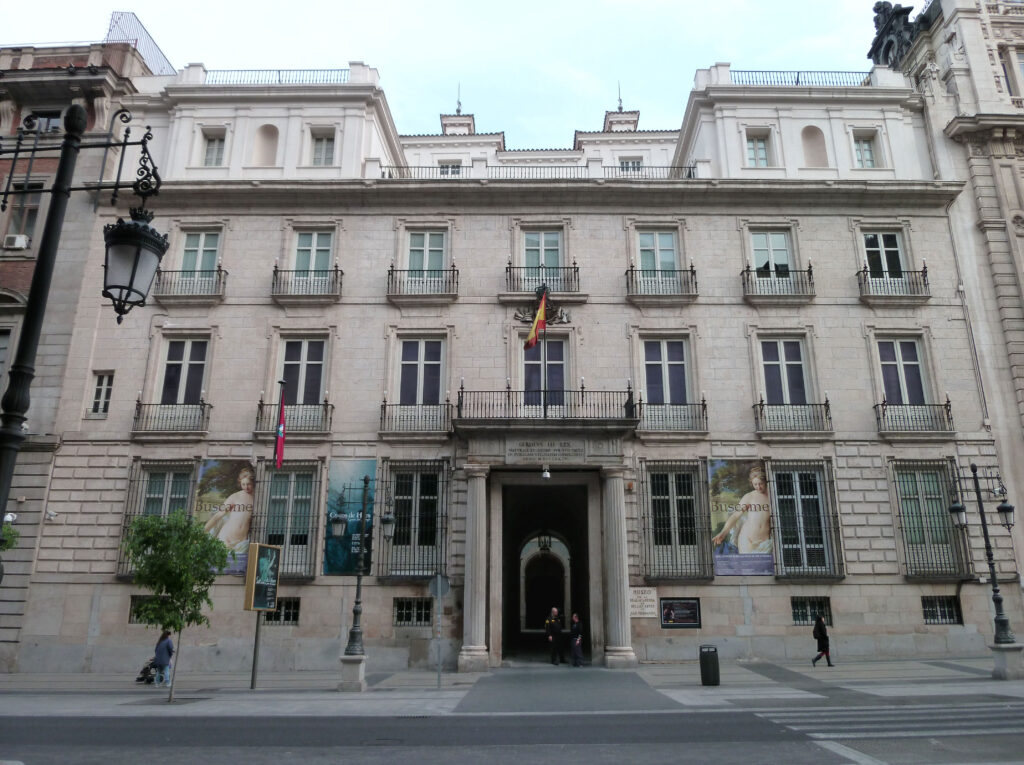
Juan de Goyeneche built himself a palace in the street of Madrid’s money and tobacco. Fifty years later the Academy of San Fernando bought it, shaved the Baroque off its front, and has taught and exhibited there ever since.
At a glance
The Palacio de Goyeneche stands at Calle de Alcalá 13, a few steps from the corner where the street meets the Gran Vía. José Benito de Churriguera built it in 1720 for Juan de Goyeneche, a minister and financier of Philip V’s reign, and it was known before that as the Mesón de la Miel. In 1773 the Royal Academy of Fine Arts of San Fernando bought the building and moved in. It is still there: the academy’s museum, its library and archive, and its workshop of casts all sit inside the same walls.
Key facts
- Architect: José Benito de Churriguera
- Built: 1720
- Client: Juan de Goyeneche, minister, financier and industrialist under Philip V
- Earlier name: the Mesón de la Miel
- Bought by the Academy: 1773, from the conde de Saceda
- New front: Diego de Villanueva, who gave the façade its neoclassical air and a Doric portal
- Protection: monumento histórico-artístico, Decreto 301/1971 of 4 February (BOE, 23 February 1971)
- Visiting: Tuesday to Sunday, 10:00–15:00, holidays included
- GPS: 40.4178, -3.7007 · Open in Google Maps
History
The house was built as a private palace, not as a school. Its first owner, Juan de Goyeneche, was one of the men who ran the finances of Philip V’s Spain, and Calle de Alcalá was where the court’s business was done. The building he commissioned from Churriguera in 1720 kept the name of what had stood there before, the Mesón de la Miel, and it carried the full ornamental repertoire of its architect’s name.
The Academy came to it by purchase. Having decided that it needed a building of its own, and after several offers, the academicians settled in 1773 on the palace in Calle de Alcalá, which belonged to the conde de Saceda and was then occupied by the offices of the Renta y Real Estanco de Tabaco. The tobacco monopoly moved out and the Academy moved in.
What the Academy did next is the reason the building looks as it does. Diego de Villanueva, architect and academician, was given the job of dressing the front, and the academy’s own account uses the word afeitar — to shave it — for what he did, drawing new plans for the floors and a façade with a Doric portal. In 1776 Charles III visited the new building and gave the Academy the casts of a large group of sculptures from Pompeii and Herculaneum. The palace was declared a monument in 1971.
What you see
Inside, the building works as a museum: fifty-nine rooms on three floors hold Spanish, Italian and Flemish painting and sculpture. The top floor joined the exhibition route in 2002, when the display space was extended and a hundred-seat auditorium and a visible store for works of art were added.
The workshop of casts is the part of the house that still works the way an academy works. Its history begins with the royal gift of 1776, when the sculptures of Pompeii and Herculaneum arrived as plaster copies rather than as marbles, so that students could draw from them.
Practical information
- Address: Calle de Alcalá 13, 28014 Madrid
- Opening: Tuesday to Sunday, 10:00–15:00, holidays included
- Library: the reading room opens to researchers Monday to Friday, 9:00–14:00
- Status: protected as a monument since 1971; the museum is open to the public
Getting there
Calle de Alcalá 13 is in the centre of Madrid, on the stretch of the street between the Puerta del Sol and the Banco de España. It is a short walk from Sol and from the Gran Vía, and the entrance is on the street itself.
Nearby
- La Unión y el Fénix Español building — on the same stretch of Alcalá
- Metropolis Building — where Alcalá meets the Gran Vía
- Gran Hotel Inglés — a few minutes away, off the Calle de las Huertas
Sources & resources
- Real Academia de Bellas Artes de San Fernando, El Edificio — Churriguera, 1720, Goyeneche, the Mesón de la Miel, the purchase of 1773 and the work of Diego de Villanueva
- Real Academia de Bellas Artes de San Fernando, Museo — Historia — the fifty-nine rooms on three floors and the extension of 2002
- Real Academia de Bellas Artes de San Fernando, Taller de Vaciados — Historia — the royal gift of casts of 1776
- Boletín Oficial del Estado, Decreto 301/1971, de 4 de febrero — the declaration as monumento histórico-artístico
- Real Academia de Bellas Artes de San Fernando, Visitas — Horario and Archivo-Biblioteca
Find it on the map
See this place and what’s around it →
Advertisement. Pictured, from the Cleveland Museum of Art (CC0) and not for sale: Latz commode, Meissen group, Paul Storr tureen. How we handle this
📷 Become a Cultural Heritage Online photographer
Share your photos of places: they stay published under your name as the author. The more they're seen, the more you get noticed — and soon a contest will reward the most appreciated photos.
Log in or sign up free to add a photoIs this page about you?
This page is read by travellers and heritage enthusiasts who find it on Google. Tell us how you are connected to this place and we will take it from there.
This entry stays online and free either way — and a free account lets you add to it yourself.