
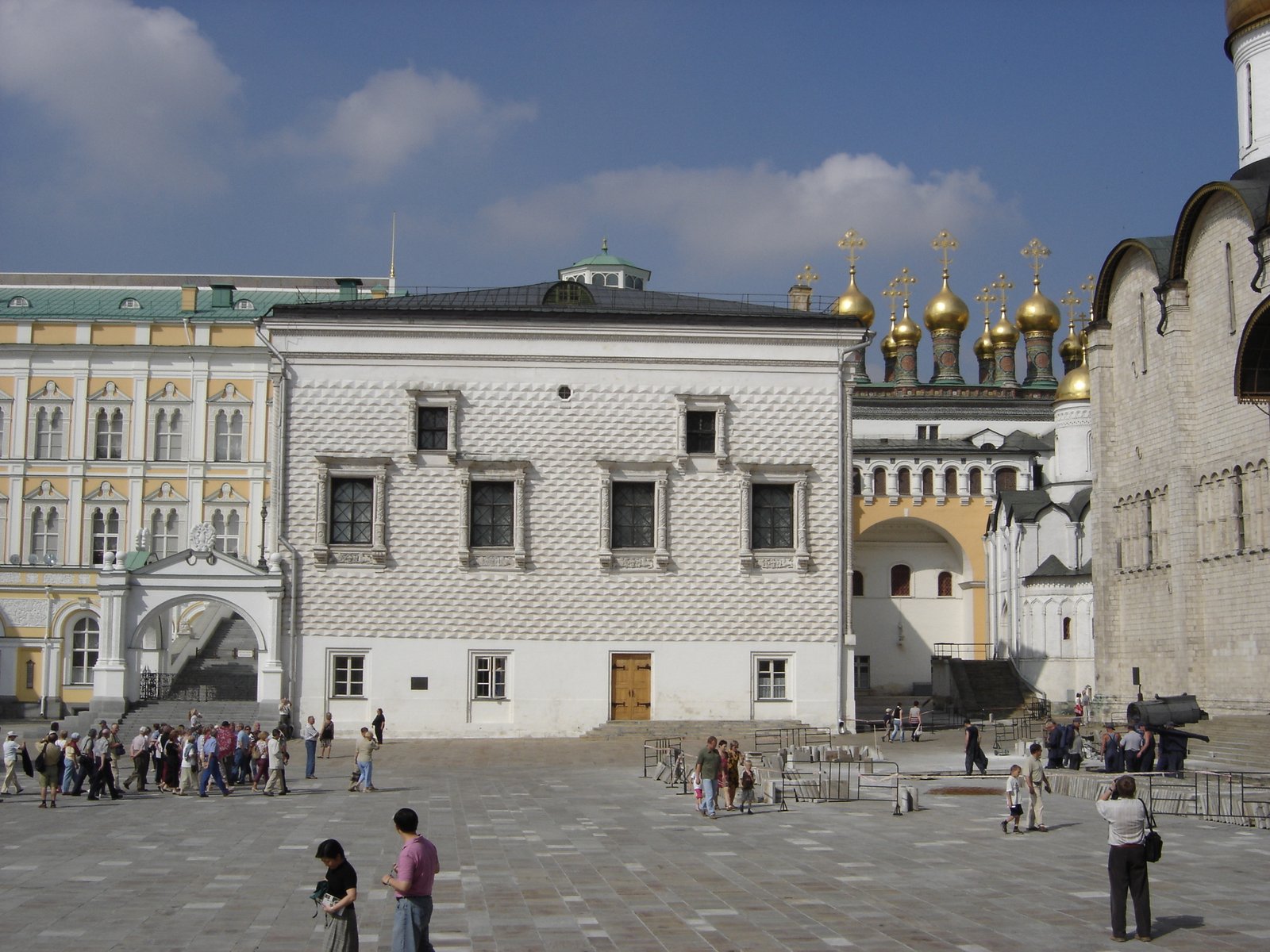
On Cathedral Square inside the Kremlin stands the oldest secular building in Moscow, a stone hall built for Ivan III where tsars once feasted, crowned, and were carried down a lion-flanked staircase to their coronations.
At a glance
The Palace of the Facets takes its name from the diamond-cut stonework on its east facade, a treatment borrowed from Italian Renaissance practice. Behind that faceted wall sits a single grand chamber, not the three storeys the exterior suggests. Built in 1487–1492 for Grand Duke Ivan III, it survives today as a ceremonial hall within the residence of the President of the Russian Federation.
History
Fire drove the decision to build it. After repeated blazes tore through the largely wooden Kremlin, Ivan III commissioned Italian architects Marco Ruffo and Pietro Antonio Solari to raise a stone palace in its place. Completed in 1492, it quickly became the setting for the empire’s most important rituals. Ivan the Terrible marked his conquest of Kazan here in 1552 with three days of feasting. Peter the Great celebrated victory over Sweden at Poltava within these walls. In 1654 the Zemsky Sobor met here, sealing the Treaty of Pereyaslav. Fires damaged the palace repeatedly over the centuries, forcing successive rebuildings, yet it never lost its ceremonial role. Queen Elizabeth II was received here during her 1994 state visit, and the building reopened to prearranged public tours in June 2012 after extensive restoration.
What you see
The main hall is vast: roughly 500 square metres beneath a single vault, without interior columns. Frescoes cover the ceiling and walls, laying out episodes from Russian state and church history in dense, gilded detail. Icon painters from Palekh restored these paintings in the 1880s on Tsar Alexander III’s order. A sacred vestibule adjoins the hall, decorated to match. Outside, on the south facade, the Red Porch descends in an open staircase edged with stylized stone lions. Tsars walked down these steps toward the Dormition Cathedral for their coronations, the last being Nicholas II in 1896. Stalin’s government demolished the staircase in the 1930s, replacing it with a workers’ canteen; it was rebuilt in 1994, the first Moscow monument restored after the Soviet collapse.
Cultural significance
Few buildings in Russia carry this density of state ritual. The Red Porch witnessed both coronation blessings and violent reprisal, including the 1682 Streltsy Uprising, when rebels threw members of the young Peter the Great’s family down its steps onto waiting pikes. Later emperors turned the same staircase into a gesture of reciprocity, bowing three times to crowds below. That mixture of splendor, brutality and symbolic exchange between ruler and subject makes the palace a physical record of how Russian sovereignty was performed for four centuries.
Key facts
- Location: Cathedral Square, Moscow Kremlin, Russia
- Architects: Marco Ruffo and Pietro Antonio Solari
- Built: 1487–1492
- Style: Italian Renaissance
- Main hall area: approximately 500 m²
- Heritage status: listed monument
- Current use: ceremonial hall, Presidential Residence
Practical information & getting there
The palace sits within the Moscow Kremlin complex, reached via the Kremlin’s designated visitor entrances near Alexander Garden. Access is restricted to prearranged organized tours rather than walk-in visits, so plan any visit well ahead through official Kremlin museum channels. Expect security checks typical of a working government residence.
Sources & resources
Find it on the map
See this place and what’s around it →📷 Become a Cultural Heritage Online photographer
Share your photos of places: they stay published under your name as the author. The more they're seen, the more you get noticed — and soon a contest will reward the most appreciated photos.
Log in or sign up free to add a photoIs this page about you?
This page is read by travellers and heritage enthusiasts who find it on Google. Tell us how you are connected to this place and we will take it from there.