
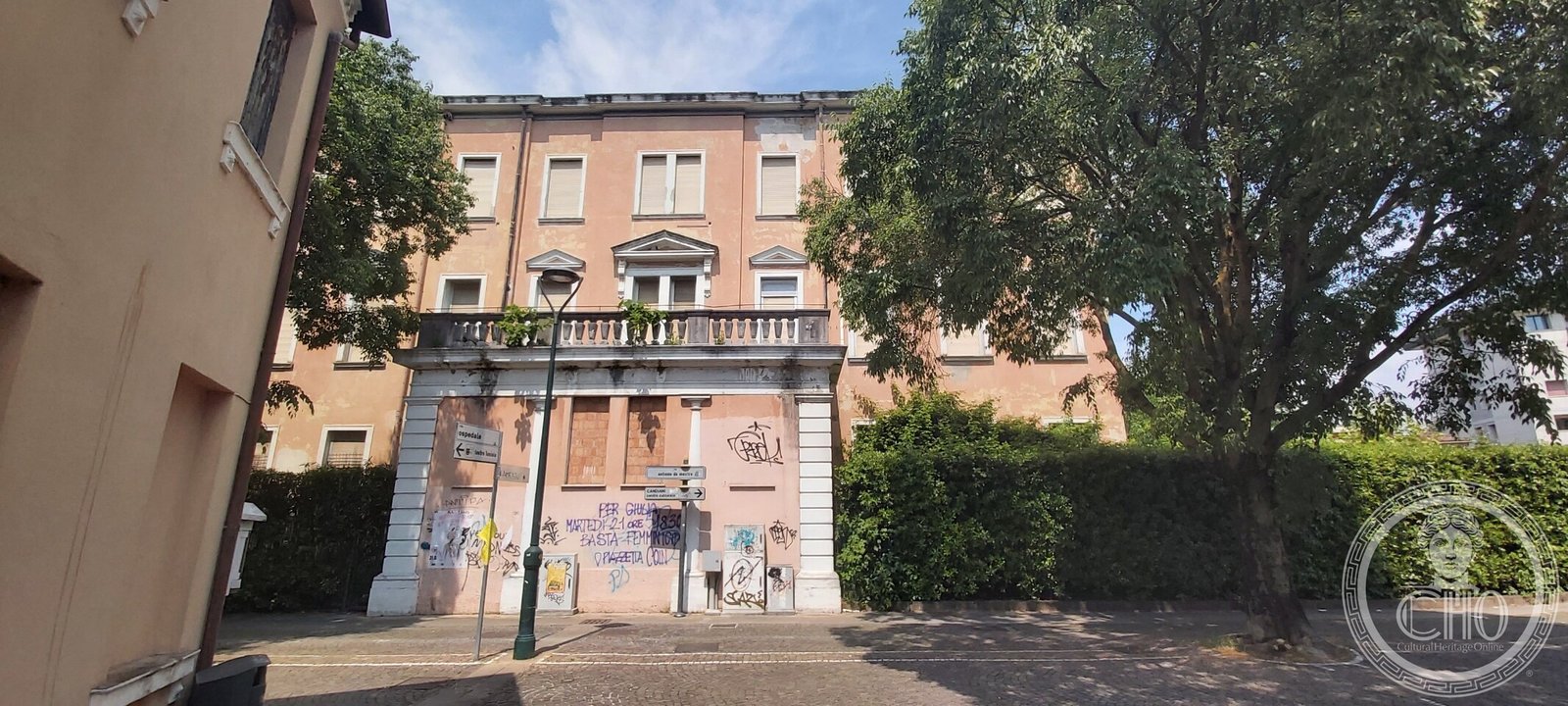
The second building of Mestre’s Umberto I hospital carries the name of a man who left the money for it. Its entrance was dressed up with a loggia in 1933 and served as the hospital’s main door until the 1960s. Today the render is falling off it, and the plans say it will be handed to the city.
At a glance
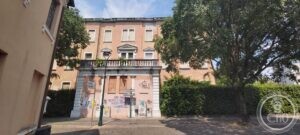
A three-storey block in pink render on the corner where via Castelvecchio meets via Antonio da Mestre, with a wide arched opening at ground level carrying a balustraded terrace, and pedimented windows above it. It was the second pavilion of the Ospedale Umberto I, built in 1915; the loggia across its entrance came eighteen years later. The hospital closed in 2008 and the site is waiting on a redevelopment scheme.
Key facts
- What it is: a pavilion of the former Ospedale Umberto I of Mestre, disused
- Where: via Castelvecchio, at the corner of via Antonio da Mestre, Mestre, Venice
- Pavilion built: 1915
- Loggia added: 1933
- Named after: Cesare Cecchini, former mayor of Chirignago and a councillor of the hospital administration, who left 100,000 lire towards its construction
- Enlarged: 1926, with a radiology department
- Served as: the hospital’s main entrance until the 1960s
History
The Ospedale Umberto I of Mestre opened in 1906 and grew pavilion by pavilion. The second of them went up in 1915 and was named for Cesare Cecchini — a former mayor of Chirignago and a member of the hospital board — in recognition of the hundred thousand lire he had left towards building it. In 1926 a radiology department was added.
Via Antonio da Mestre was opened in 1925, and the junction it created gave the pavilion a proper street corner. In 1933 the entrance there was dressed with the loggia that is still on it, and from then until the 1960s this was the main way into the hospital — the door that everyone in Mestre used.
The hospital worked until 2008. Since then the complex has been empty and the subject of successive redevelopment schemes; under the current plan the Cecchini pavilion and the old administration building are to be restored and transferred to the municipality for public use.
What you see
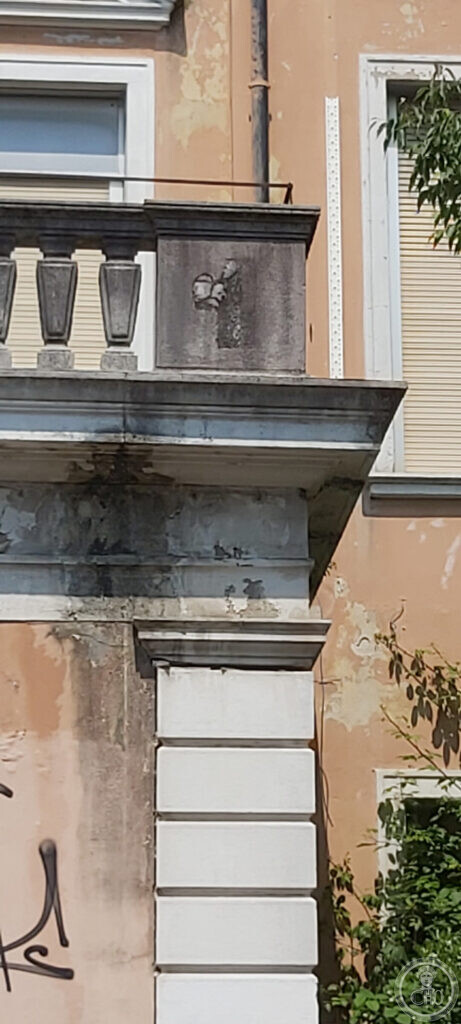
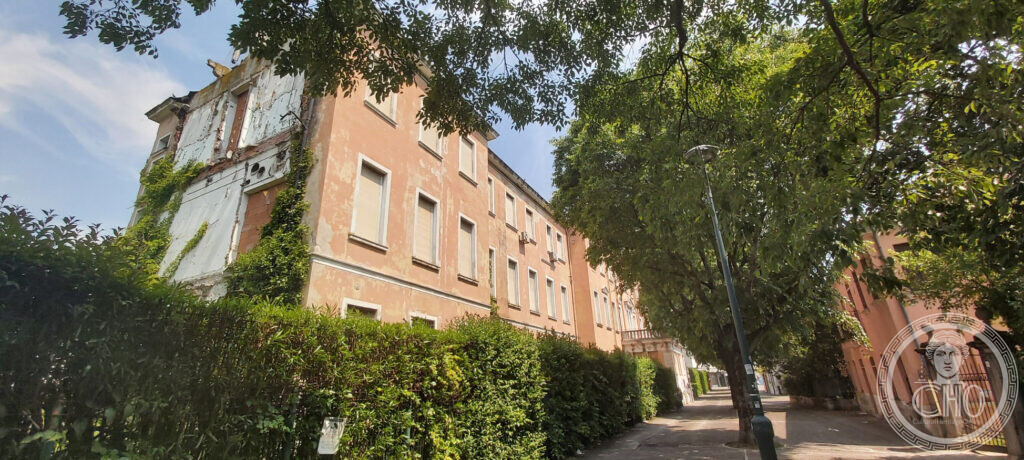
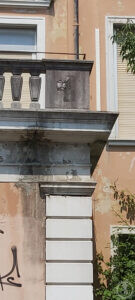
Very little of a hospital and quite a lot of a townhouse. The corner is treated as an entrance front: a single wide arched opening between rusticated piers, a heavy moulded cornice above it, and on top a stone balustrade forming a terrace, with a small pedimented window behind. The upper floors have plain rectangular windows with white surrounds, three of them given little triangular pediments at the centre. All of it is rendered in a faded pink that is now flaking away in sheets, with damp stains down the piers, boarded openings, graffiti at street level and a hedge grown up against the flank.
The building is worth looking at precisely because it is in this state. A loggia added in 1933 to give a public hospital a dignified door is the kind of thing that vanishes in a redevelopment without anyone photographing it first.
Practical information
- Disused and closed. The exterior is on public streets and can be seen at any hour.
- There is no access to the interior and no visitor route.
- Our map point marks the corner of via Castelvecchio and via Antonio da Mestre.
Getting there
A few minutes on foot from Mestre town centre and about fifteen from Venezia Mestre railway station.
Nearby
- Piazza Ferretto and the old centre of Mestre.
- The Torre dell’Orologio and the surviving fragment of the Castelvecchio.
- Forte Marghera, 2 km south.
Look around it
Google Street View opens on the nearest panorama to this point: Via Castelvecchio in Street View.
More photographs
Sources
- History of the Ospedale Umberto I of Mestre, 1906–2008: the Cecchini pavilion as the second building of the hospital, built in 1915 and named after Cesare Cecchini, former mayor of Chirignago and councillor of the hospital administration, for his bequest of 100,000 lire; the radiology department added in 1926; the opening of via Antonio da Mestre in 1925; the entrance embellished with a loggia in 1933 and used as the main hospital entrance until the 1960s.
- Comune di Venezia, documents on the recovery plan for the former Umberto I, under which the Cecchini pavilion and the former administration building are to be restored and transferred to the municipality.
- Photograph taken on site by Stefano Vigolo; the present condition is described from it.
Find it on the map
See this place and what’s around it →Record researched and written by Stefano Vigolo for Cultural Heritage Online, 2026.
📷 Become a Cultural Heritage Online photographer
Share your photos of places: they stay published under your name as the author. The more they're seen, the more you get noticed — and soon a contest will reward the most appreciated photos.
Log in or sign up free to add a photoRequest to use these images
Each photograph is by the person named on it. Cultural Heritage Online is the seller: it runs the payment, handles tax and delivers the file, and the photographer receives 70% of the price net of tax. Buying gives you the right to use the image in your own project — a website, an article, a presentation — with the file and a written licence. Read the Terms of Sale.
What you receive. The file as it is held in our archive: the photographer's own original, without the Cultural Heritage Online watermark, unretouched and not enlarged. This is a working archive built over many years by many people, so the files differ — some were taken recently, others years ago with the equipment of their time. Older pictures are usually smaller: a camera from fifteen or twenty years ago simply recorded fewer pixels than a phone does today, so the resolution is lower and the print comes out smaller. We say so rather than hide it. The size, weight, format and year of each one are printed below it, and the print size is given at 300 dpi. Nothing is upscaled to make a number look better. Where the picture on this page has been cropped for the layout, the file you receive is the full frame, which may be wider or taller than what you see here.
Padiglione Cecchini, former Ospedale Umberto I
Photo: Stefano Vigolo
€3.00
1948 × 876 px · JPG · 1,000.2 KB
prints 16 × 7 cm at 300 dpi
Padiglione Cecchini, former Ospedale Umberto I
Photo: Stefano Vigolo
€3.00
2976 × 1341 px · JPG · 910.0 KB
prints 25 × 11 cm at 300 dpi · taken 2025
Padiglione Cecchini, former Ospedale Umberto I
Photo: Stefano Vigolo
€3.00
2132 × 959 px · JPG · 1.0 MB
prints 18 × 8 cm at 300 dpi · taken 2025
Is this page about you?
This page is read by travellers and heritage enthusiasts who find it on Google. Tell us how you are connected to this place and we will take it from there.